Published on: 2026-04-20
Updated on: 2026-04-20
Financial markets do not move in one direction forever. While many investors focus on buying assets and waiting for prices to rise, traders can also use strategies that aim to profit when prices fall. One of the most important of these strategies is taking a short position.
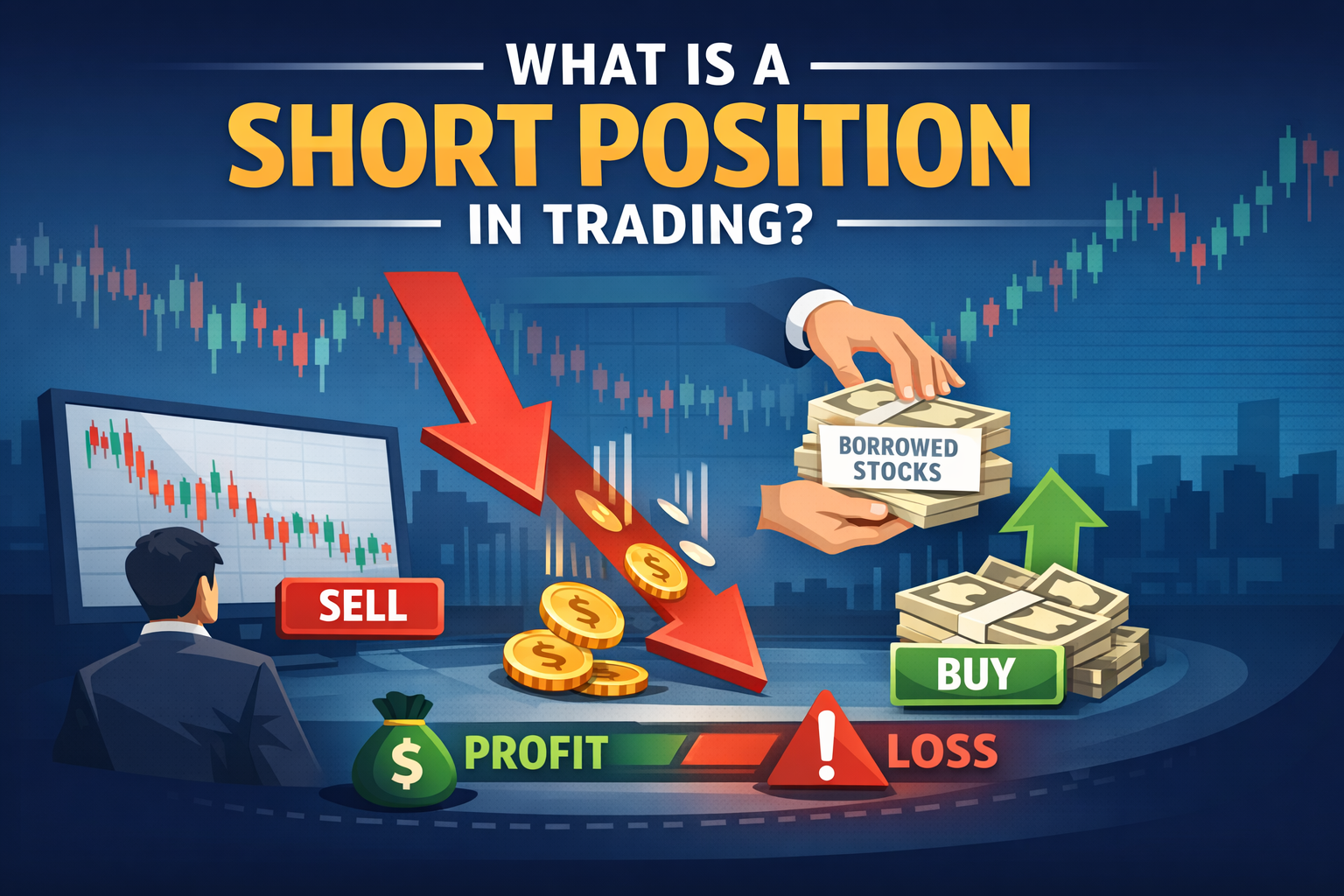
A short position aims to profit from a decline in an asset’s price.
In stocks, a short position usually involves borrowing shares, selling them, and buying them back later.
More broadly, short exposure can also be created through derivatives such as futures, put options, and, where available, Contracts for Difference (CFDs).
Traditional short selling carries a higher risk than a long-only trade because losses can keep growing if the price rises.
Borrowing costs, margin requirements, and short squeezes are key risks to understand before trading short.
A short position is a bearish trade that aims to profit from a fall in price. In stocks, that often means a traditional short sale: selling borrowed shares and later buying them back. More broadly, traders can also create short exposure through derivatives such as futures, put options, and, where available, Contracts for Difference (CFDs). That is why a short position is a broader idea than a stock short sale.
A short position is the opposite of a long position, where the trader expects the asset’s price to rise instead of fall.
These terms are related but not identical.
A short position describes the market view and exposure: you benefit if the price moves lower. A short sale is one specific way to create that exposure in the stock market by borrowing shares, selling them, and later buying them back. In other words, every traditional short sale creates a short position, but not every short position comes from a short sale.
In the stock market, a traditional short position usually follows a clear sequence:
Borrow shares through a broker.
Sell the borrowed shares at the current market price.
Wait to see whether the price falls.
Buy back the same number of shares later.
Return the shares to the lender.
If the repurchase price is lower than the sale price, the trader keeps the difference, minus fees and other costs. If the price rises, the trade loses money. Traditional stock short selling is typically done through a margin account, and the trader may also face borrowing fees, dividend obligations, and margin pressure while the position is open.
Assume a trader believes a stock is overvalued at $100 per share.
The trader borrows and sells 100 shares at $100, receiving $10,000.
The price falls to $70.
The trader buys back 100 shares at $70, paying $7,000.
Gross profit = $3,000, before commissions, borrowing fees, and any dividend-related costs
If the trade moves the other way:
The price rises to $130.
The trader buys back 100 shares at $130, paying $13,000.
Gross loss = $3,000, before additional costs
This simple example shows the core idea: a short seller sells first and buys later.
Traders and investors use short positions for several reasons:
A short position gives traders a way to look for opportunities during declining markets, not only during rallies.
Investors also use short positions for hedging, especially when they want to offset downside risk in a long portfolio or related asset.
Some traders use short positions when they believe the market price is too high relative to fundamentals, sentiment, or recent price action.
Many traders combine fundamentals with technical analysis before opening a bearish trade, especially when momentum weakens or support levels break.
Short selling can be useful, but it carries important risks and operating costs.
In a traditional stock short sale, the maximum gain is limited because a stock can only fall to zero. The loss side is very different: if the price rises sharply, losses can keep growing.
Traditional short sales usually involve margin. If the position moves against you, the broker can require more capital or reduce the position. Firms can also change margin policies, especially in volatile markets.
Some short positions are expensive to maintain. Borrow fees can rise when shares are hard to borrow, and if the borrowed stock pays a dividend, the short seller generally has to cover that payment.
A short squeeze occurs when rising prices force short sellers to cover their positions quickly, creating additional buying pressure and pushing the price even higher.
Even if the bearish idea is correct in the long run, the market can move against the position first. Good analysis does not guarantee good timing.
A short squeeze occurs when a heavily shorted asset rises quickly, prompting short sellers to rush to cover their positions by buying it back. That buying can add further upward pressure, worsening losses for traders who are already short. Short squeezes are one reason why short positions require strict risk control.
Short exposure can appear in several markets, but the mechanics are not the same in each one:
Stocks: traditional short selling through borrowed shares.
Forex: selling one currency against another.
Futures: taking the sell side of a futures contract.
Options: buying put options can provide bearish exposure with risk limited to the premium paid, while more advanced options strategies behave differently.
Contracts for Difference (CFDs): Through a Contract for Difference (CFD), traders can take short exposure without owning the underlying asset, where local rules allow it.
Because products, rules, and costs vary, traders should always check how a specific market and broker handle short exposure before opening a trade.
A trader may consider a short position when several signals point in the same direction, such as:
weak fundamentals
stretched valuation
deteriorating sentiment
a break below key support
a clear event risk that could hurt earnings or demand
The key is not just having a bearish opinion. The trade also needs a defined entry, exit, position size, and risk limit.
Short selling is generally better suited to experienced traders than complete beginners. For anyone learning the strategy, discipline matters more than prediction.
Practical risk controls include:
Use stop-loss orders or buy-stop orders to define risk before the trade is live.
Keep position sizes small.
Understand margin requirements before entering the trade.
Avoid crowded or highly volatile names unless you fully understand the squeeze risk.
Review borrowing costs and trade mechanics in advance.
A stop order can help manage risk, but it does not guarantee execution at the exact stop price in fast-moving markets.
Usually not. Short selling is generally considered an advanced strategy because it involves margin, trade mechanics that are less intuitive than buying long, and a more difficult risk profile.
Yes. In a traditional stock short sale, losses can exceed your initial capital because the asset price can continue rising.
Covering means buying back the asset that was sold short in order to close the position. In the case of stocks, the bought-back shares are returned to the lender.
No. Direct stock short selling usually requires a margin account, and the broker must also be able to borrow shares. Rules can also differ by market, broker, and product.
No. Buying a put option is one way to gain bearish exposure, but it is not the same as a traditional short sale. A put option gives the buyer the right to sell at a specified strike price for a limited time, while a short sale involves selling borrowed shares and later repurchasing them.
A short position allows traders to benefit from falling prices, but the mechanics depend on the instrument being used. In stocks, short selling usually means borrowing shares, selling them, and buying them back later.
In other markets, bearish exposure can come through futures, options, forex, or CFDs. The opportunity is real, but so are the risks. Anyone considering short positions should understand margin, costs, short squeeze risk, and trade management before entering the market.