Published on: 2026-04-27
Updated on: 2026-04-27
SoFi stock price prediction in 2026 is no longer a simple growth story. It is a credibility test. SoFi Technologies has already proven it can scale revenue, members, products and profitability. The harder question is whether investors trust the quality of that growth enough to value SoFi as a fintech platform rather than discount it as a credit-sensitive lender.
That debate sharpened on March 17, when Muddy Waters published a short report on SoFi, and CEO Anthony Noto bought 28,900 shares that same day at an average price near $17.32. The purchase did not settle the controversy. It framed the central question. Management appears to see a mispriced stock. The market still wants more transparency before rewarding SoFi with a higher multiple.
SOFI recently traded near $18.44, below the average analyst target in the mid-$20s. But the gap is not simply about earnings growth. It is about whether SoFi’s earnings should be capitalised as a durable financial platform or discounted as a lender exposed to consumer-credit risk.
The base case is not a blind reliance on analyst consensus. It reaches a similar range through a different logic. SoFi guided for roughly $0.60 in 2026 adjusted EPS. A stock price in the low-to-mid $20s implies that investors accept the growth profile but still apply a discount for accounting, credit and disclosure risks.
The probability column below reflects a judgment-based scenario framework, not an actuarial estimate. It weighs the severity of Muddy Waters’ allegations against SoFi’s regulatory structure, public disclosures, insider buying, current business momentum and the evidence available before Q1 earnings.
| Scenario | Price Zone | Key Condition | Probability |
|---|---|---|---|
| Bull | $28-$32 | LPB is confirmed as capital-light, charge-offs remain stable and management provides specific numerical answers to Muddy Waters’ allegations. Credibility discount narrows. | 25% |
| Base | $22-$25 | Muddy Waters’ claims remain contested but unproven. SoFi executes near guidance. Growth is rewarded, but a risk discount persists. | 55% |
| Bear | $13-$16 | LPB accounting or credit-quality concerns prove directionally correct. Restatement or regulatory-review risk emerges. Multiple compresses toward lender levels. | 15% |
These probabilities are editorial risk weights, not statistical forecasts. Their purpose is to show how sensitive SOFI’s valuation is to disclosure quality, not to imply false precision.
The bull case requires more than a revenue beat. The discount shrinks when management answers questions with numbers, specifically around LPB mechanics, delinquent-loan sale accounting, charge-off presentation and fair-value marks. A revenue beat alone will not re-rate SOFI.
The bear floor at $13 to $16, rather than the $15 to $17 most forecasts suggest, reflects what could happen if the LPB accounting allegation proves directionally correct. That would not be a normal price-target adjustment. It would raise restatement or regulatory-review risk, and accounting shocks rarely respect pre-set valuation floors.
Most SOFI coverage treats the March 17 report as background noise. That is too casual. Carson Block made four specific, numerical allegations, not vague accusations:
SoFi’s 2025 adjusted EBITDA is inflated by approximately 90%, with the true figure near $103 million rather than the reported $1.05 billion.
A material misstatement of at least $312 million in unrecorded debt from off-balance-sheet structures that Muddy Waters argues disguise borrowings as revenue.
The personal loan charge-off rate is approximately 6.1%, versus SoFi’s reported 2.89%.
The Loan Platform Business is not a capital-light toll road but a wet-funded forward-flow transaction, a disguised form of borrowing whose proceeds SoFi books as fee income.
Not all four allegations carry equal plausibility, and that asymmetry matters for how investors weight the risk.
The 90% EBITDA inflation claim is the most dramatic allegation. It also carries the highest burden of proof. SoFi is a public company, a regulated bank holding company and the operator of a nationally chartered bank. A claim of that scale would have to survive public-company reporting controls, banking regulatory scrutiny, and external audit review. That does not make it impossible, but it does make the bar meaningfully higher than in a lightly regulated fintech.
The charge-off allegation is different. It turns less on broad institutional failure and more on how delinquent-loan sales affect reported credit metrics. That makes it more important to track in quarterly filings. Investors should separate the two issues because they carry different probabilities, evidentiary burdens, and valuation consequences.
Muddy Waters later argued that SoFi’s response did not address its specific factual claims. SoFi rejected the report and said it may explore legal action. Noto bought shares. None of those events is a numerical rebuttal, and the market knows the difference.
The most important credit disclosure is not Muddy Waters’ 6.1% estimate. It is SoFi’s own. The personal loan annualised charge-off rate increased to 2.80% from 2.60% in the prior quarter. Had SoFi not sold late-stage delinquent loans, the all-in annualised net charge-off rate for personal loans would have been approximately 4.4%, versus 4.2% in the prior quarter.
That 4.4% figure, SoFi’s own conservative estimate disclosed beneath the headline, sits 157 basis points above the 2.80% number that leads most earnings summaries. It does not prove Muddy Waters’ allegation. It explains, on its own, why investors apply a credibility discount. The gap between headline credit metrics and all-in credit optics is precisely where the valuation debate lives, independent of whether Carson Block is right about anything else.
Personal loan annualised net charge-offs decreased 57 basis points year over year. The directional trend is genuinely positive, and SoFi’s borrower quality, anchored by median FICO scores in the high 740s and a 90%+ direct deposit rate among SoFi Money customers, is meaningfully stronger than broad consumer-credit cohorts. The direction is right. The presentation gap is self-inflicted, and self-inflicted problems are the ones management holds the power to fix.
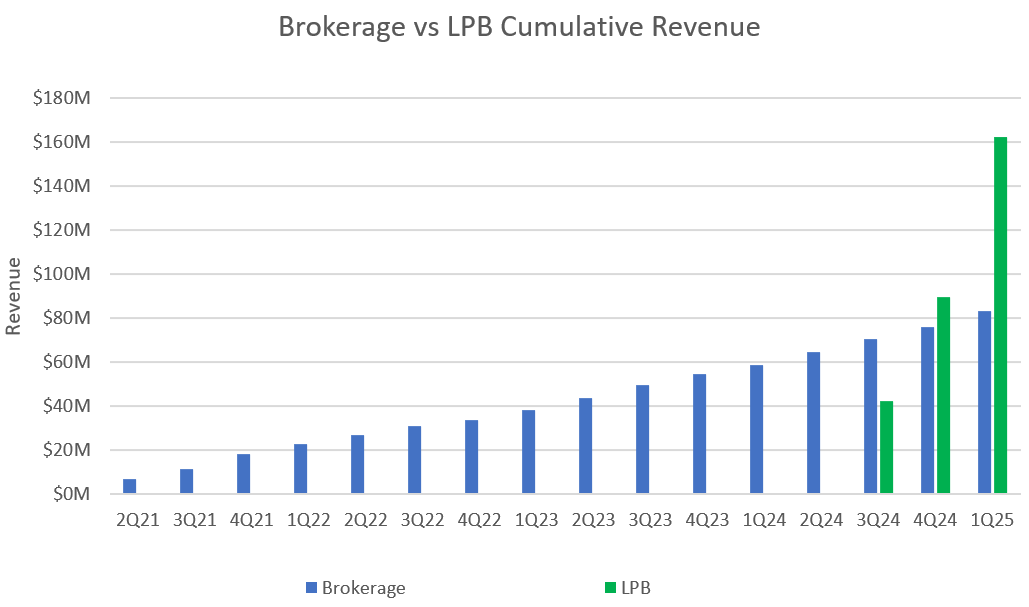
In Q4 2025, LPB originations nearly tripled to $3.7 billion, driving $194 million in revenue, also up nearly threefold. If management’s description is accurate, the model is materially less balance-sheet intensive than traditional lending and should carry lower retained credit risk. That would make LPB one of SoFi’s most important capital-efficiency levers.
Muddy Waters’ version is structurally different: loans are briefly funded on SoFi’s own balance sheet during the transfer period, and the funding proceeds are recognised as fee income rather than as borrowings. If true, LPB is a disguised balance-sheet business reporting fee-level margins, and the fintech premium it currently supports is unjustified.
The weight of available evidence leans against that interpretation, though not conclusively. With more than $10 billion in LPB commitments in 2025 and new agreements with a leading global bank, a top-five global private asset manager and a financial services and insurance group, the runway appears substantial. Large institutional counterparties normally conduct their own credit and legal diligence, which weighs against the disguised-borrowing interpretation but does not remove the need for clearer disclosure.
The presence of a leading global bank among the disclosed partner categories makes the strongest version of the Muddy Waters claim harder to sustain, but it does not exonerate the LPB model entirely. It shifts part of the burden back toward the short-seller while leaving management responsible for explaining the mechanics more clearly.
What remains opaque is the precise mechanics of the funding gap period, and opacity is always Muddy Waters’ foothold, regardless of underlying reality. The clearest path to removing the LPB discount is voluntary disclosure from management, not quarterly data that is consistent with multiple interpretations.
| Q1 Signal | Bullish Reading | Bearish Reading |
|---|---|---|
| EPS | Holds near $0.12 or better | Profitability disappoints despite scale |
| Revenue | Tracks near $1.0 billion guidance | Q4 momentum fades |
| Charge-offs | Stable trend eases credit concerns | Bear case gains traction |
| LPB | More disclosure supports fee-quality thesis | Structure remains contested |
| Deposits | Funding advantage holds | Deposit growth slows or costs rise |
| Galileo | Platform narrative stabilises | Tech-platform multiple remains pressured |
A clean Q1 report does not need to be spectacular. It needs to be transparent. The strongest signals would be stable credit, clear LPB language, continued deposit strength, and fee revenue, which shows that SoFi’s earnings base is becoming less balance-sheet intensive.
SoFi’s business is fundamentally strong. Record adjusted net revenue of $1.0 billion grew 37% year over year, adjusted EBITDA rose 60% to $318 million, and fee-based revenue hit a record $443 million, up 53%. None of that is the weak point in the investment case. The weakness is the credibility gap between strong operating growth and unresolved questions around credit presentation, LPB mechanics and earnings quality.
What has held the stock back is a forensic short-seller publishing specific numerical allegations, a CEO buying shares, a company threatening legal action and a market left to decide which evidence deserves more weight. The insider purchase is a confidence signal. The legal threat earns no valuation credit unless it is followed by clearer disclosure.
The base case points toward $22 to $25 if SoFi executes near guidance while the credibility discount persists. The bull case toward $28 to $32 requires clearer disclosure and proof that LPB is genuinely capital-light.
The bear case toward $13 to $16 remains a low-probability but material risk, not because SoFi is a weak business, but because accounting or disclosure shocks can override fundamental quality.