Published on: 2026-06-30
Updated on: 2026-06-30
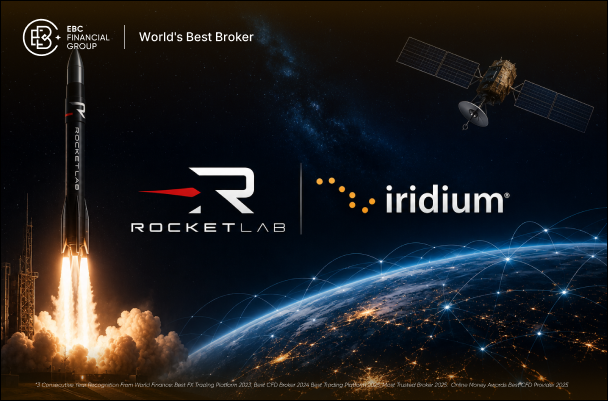
Rocket Lab agreed to acquire Iridium for $54 a share, made up of $27 in cash plus Rocket Lab stock, in a transaction worth roughly $8.0 billion [1][2].
Iridium brings a 66-satellite low-Earth-orbit network, globally licensed L-band spectrum, more than 2.5 million subscribers and recurring communications revenue [1][4].
Rocket Lab enters the deal with first-quarter 2026 revenue above $200 million and backlog over $2.2 billion [3].
Iridium is a mature, cash-generating business, with $871.7 million of 2025 revenue and $495.3 million of OEBITDA [4].
The prize is a broader space-infrastructure platform; the pressure points are financing, dilution, integration, leverage, Neutron execution and a valuation that has already re-rated.
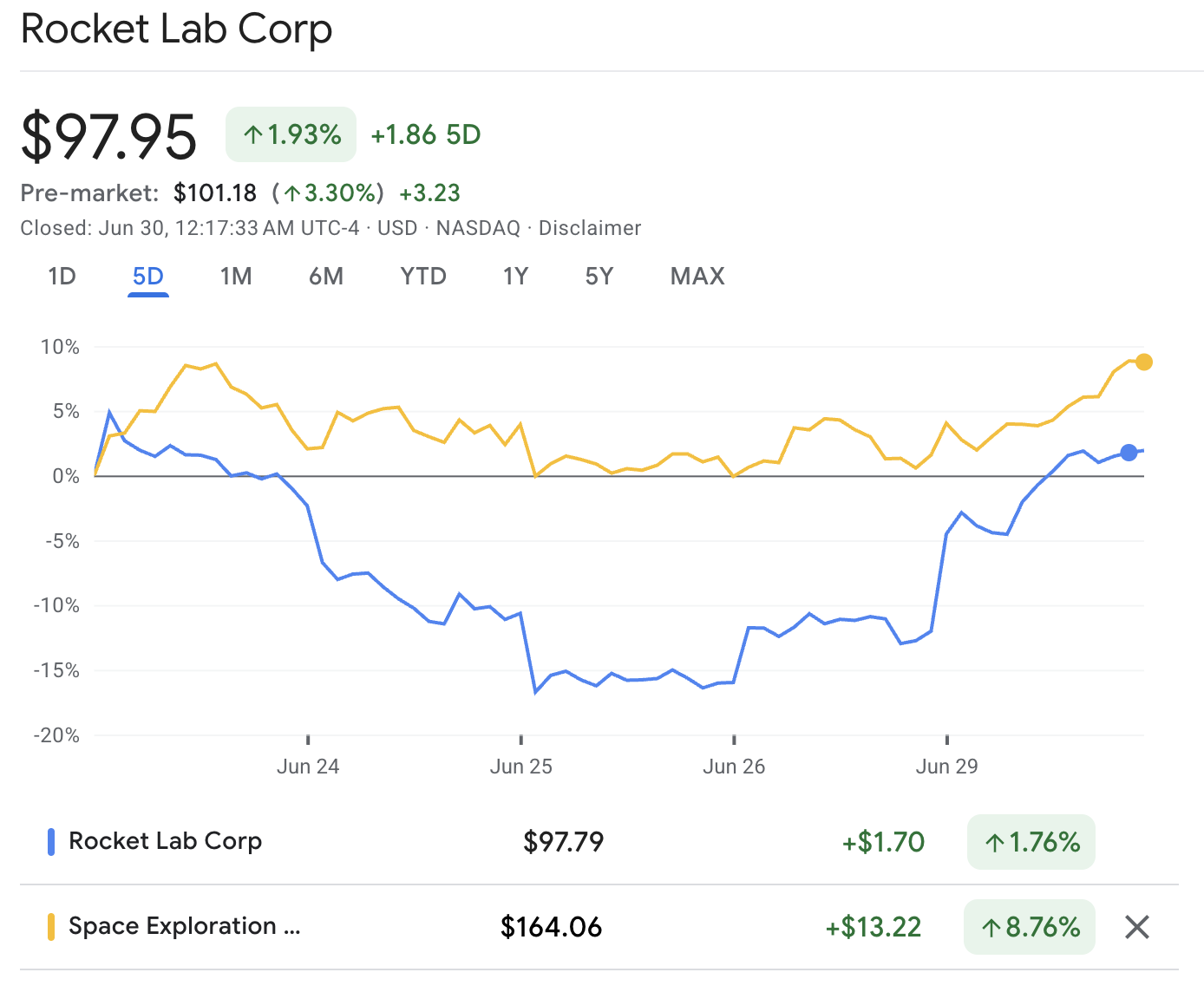
Rocket Lab stock surged after the company agreed to acquire Iridium Communications, and the move was about identity as much as price. RKLB rose roughly 15.9% on the 29 June announcement and Iridium jumped more than 25%, as investors weighed a bigger question than the next launch: can a launch-and-space-systems company become a communications platform?
The SpaceX comparison is unavoidable but easily overstated. Rocket Lab is not buying its way to SpaceX’s scale, and Iridium is not Starlink. With this deal, RKLB becomes a listed, smaller-scale version of the integrated launch-and-network model SpaceX built, more leveraged and with more to prove.
| Factor | Rocket Lab After Iridium Deal | SpaceX |
|---|---|---|
| Public access | Listed as RKLB | Listed as SPCX after June 2026 Nasdaq IPO |
| Core identity | Launch, spacecraft systems, satellite communications | Launch, Starlink, spacecraft, defense, AI infrastructure |
| Network asset | Iridium’s LEO network and L-band spectrum | Starlink broadband constellation |
| Revenue profile | More recurring communications revenue | Launch plus recurring Starlink revenue |
| Launch scale | Electron now, Neutron key to future scale | Falcon 9, Falcon Heavy, Starship |
| Strategic model | Acquired network plus launch, manufacturing | Built network plus internal launch demand |
| Financial profile | Smaller firm absorbing an $8.0bn acquisition | Larger platform, established scale |
| Main upside | Vertical integration, scarcity of listed space plays | Scale, cost advantage, platform dominance |
| Main risk | Integration, debt, dilution, Neutron | Valuation, regulation, execution risk |
SpaceX’s June 2026 Nasdaq debut, under the ticker SPCX, gave the market its first listed benchmark for integrated space infrastructure [5]. Rocket Lab’s Iridium deal is a smaller, more execution-sensitive take on the same idea: launch, satellite manufacturing and communications revenue under one roof.
The market read the deal as a change in identity, not a bolt-on. Rocket Lab had traded on Electron cadence, Space Systems growth, defense contracts and the wait for Neutron. Iridium adds what none of those did: an operating communications layer, with spectrum, subscribers and revenue already in place.
The terms are explicit. Iridium holders receive $54 a share, half in cash and half in Rocket Lab stock, valuing Iridium at about $8.0 billion, with closing expected in mid-2027 once shareholders and regulators sign off [1][2]. To fund the cash half, Rocket Lab has lined up a $3.6 billion bridge loan from Deutsche Bank and Wells Fargo [1][2].
The price is not modest. At about $8.0 billion of enterprise value, the deal values Iridium at roughly 9.2 times its 2025 revenue and 16.2 times its 2025 OEBITDA, a multiple that works only if Rocket Lab can turn a stable operator into a faster-growing platform. Iridium has traded close to the $54 consideration since the announcement, signalling a credible deal with little merger-arbitrage spread.
The scale is easy to underestimate. Rocket Lab’s first-quarter revenue of $200.3 million annualises near $801 million [3], and Iridium’s 2025 revenue was slightly larger, so this is not an add-on but a business that could roughly double the combined base.
At about $98 a share, Rocket Lab is worth in the region of $55 billion even after a steep run, which raises the bar to prove Iridium is more than a defensive asset and pushes capital structure to the front of the story.
Iridium gives Rocket Lab something launch companies almost never own outright: a working satellite communications network with customers already attached. It runs a 66-satellite low-Earth-orbit constellation over globally licensed L-band spectrum, carrying voice, data and positioning, navigation and timing services to 2.537 million billable subscribers [1][4].

The financials reframe the story. Iridium produced $871.7 million of revenue in 2025 and $495.3 million of OEBITDA, a margin near 57% [4]. A combined Rocket Lab would own a recurring connectivity business across government, defense, aviation, maritime and remote-industrial markets, with growth options in satellite IoT, direct-to-device, aviation tracking, defense communications and PNT rather than consumer broadband.
The deeper value is owning the full stack: Rocket Lab builds spacecraft, launches them, and after closing would operate the network they serve, internal demand that could improve its own launch economics once Neutron is flying.
The “anti-SpaceX trade” works only as relative exposure, not rivalry. It does not mean Rocket Lab can match SpaceX on launch cadence, Starlink’s scale or cost; SpaceX stays the benchmark by a wide margin, with a larger network and deeper launch economics.
The two reach similar ground by opposite means. SpaceX built Starlink in-house, using Falcon launches to deploy its own constellation. Rocket Lab is buying an operating network and bolting it onto its launch and manufacturing base, trading years of build-out for immediate revenue and a larger bill.
Iridium is also not a broadband clone of Starlink. Its L-band network is built for resilient global coverage: narrowband data, safety-of-life services, aviation and maritime tracking, defense communications and positioning. Starlink is a high-throughput broadband platform. Iridium is more specialised, lower-bandwidth and harder to replicate in mission-critical coverage, a spectrum and reliability asset, not a second Starlink.
For investors, the difference is the shape of the exposure: Rocket Lab is the smaller, more leveraged and more execution-sensitive way to own the same theme.
The upside is a larger, more recurring share of the space value chain. Iridium’s contracted revenue loosens Rocket Lab’s dependence on launch timing and gives Neutron an internal customer once it is flying. As one of the few listed integrated space plays, Rocket Lab can command a scarcity premium, though that rests on execution, not the concept.
The risk is the execution bar an $8.0 billion deal sets for a company still scaling. The stock half passes part of the cost to existing holders, while the bridge loan turns the cash half into refinancing risk, so final dilution, interest and leverage stay unknown until permanent financing is set.
Iridium is mature rather than fast-growing, and Neutron remains the key variable, with any slip weighing more now. After a steep re-rating, the evidence still has to catch up to the multiple.
What matters first is the deal itself: the Iridium shareholder vote, regulatory review and the mid-2027 close. After that, capital structure matters most: the final debt terms, share issuance and leverage that decide how much cost current holders absorb, alongside Iridium’s revenue, margins and subscribers.
Rocket Lab’s own scoreboard still counts: Electron cadence, Space Systems backlog, government awards, Neutron milestones and the path to positive free cash flow.
Rocket Lab’s Iridium deal does not make RKLB another SpaceX. It makes it a more serious public expression of the vertically integrated space trade, spanning launch, spacecraft systems and an operating network.
The upside is a wider platform with recurring revenue and valuable spectrum; the cost is a heavier balance sheet, a harder integration and continued reliance on Neutron. The anti-SpaceX label fits only in the relative sense: smaller, more leveraged, more execution-sensitive, no longer just a launch stock.
Ready to take flight with the space trade? Rocket Lab and SpaceX are both public now, so the launch-plus-network theme is no longer one you can only watch from the ground. Track the instruments that move with it, sharpen your strategy and trade global markets with EBC Financial Group, a regulated broker built for traders who act on their own conviction. Your setup, your call.