Published on: 2026-09-08
Updated on: 2026-09-08
India’s $136.4 billion foreign currency mobilisation has left the Reserve Bank of India managing a record banking system liquidity surplus of ₹11.16 trillion as of 6 September. The central bank has scheduled a fresh ₹5 trillion overnight variable rate reverse repo for 8 September, a day after absorbing more than ₹6.12 trillion across two auctions.
A ₹1.1432 trillion seven-day operation from 1 September also reverses today, handing that cash back to banks.
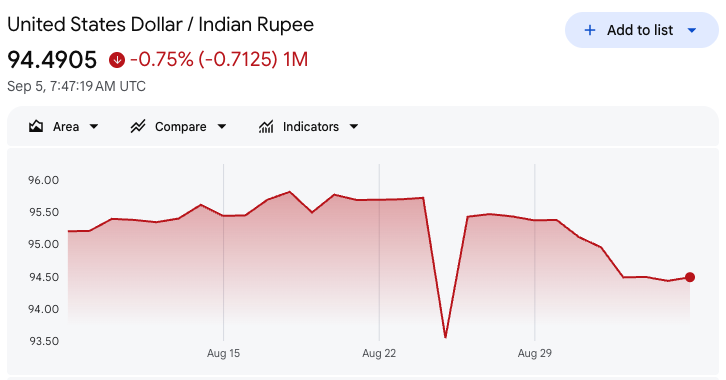
 The programme has helped hold USD/INR near 94.48 even with Brent close to $97. The open question is how the RBI drains the rupees without surrendering the currency support those dollars were raised to provide.
Net banking system liquidity stood at a surplus of ₹11.16 trillion on 6 September, after ₹10.73 trillion on Friday, according to RBI data. Absorption is now close to continuous, with 32 VRRR auctions between August and early September at tenors from overnight to 14 days.
The consequence is visible in money market rates. The weighted average call rate, the operating target of monetary policy, has been running near 4.93%, roughly 32 basis points below the 5.25% repo rate, which weakens monetary transmission.
The ₹5 trillion overnight window scheduled for 09:30 to 10:00 IST therefore does less work than its size implies. Much of it re-absorbs the ₹1.1432 trillion returned to banks this morning rather than draining anything new.
| Indicator | Latest figure | Market relevance |
|---|---|---|
| Special FX inflows | $136.38B | Added FX and rupee liquidity |
| Banking liquidity surplus | ₹11.16T | Forces daily RBI absorption |
| Forex reserves | $740.80B | Record external buffer |
| RBI net short forwards | $136.77B | Future dollar deliveries |
| USD/INR, 7 Sep close | 94.4850 | Rupee support holding |
The mobilisation reached $136.377 billion by 31 August: $127.23 billion through FCNR(B) deposits, $5.26 billion through overseas foreign currency borrowings and $3.89 billion through external commercial borrowings. The FCNR(B) window closed a month early after demand overran expectations, while the OFCB and ECB routes stay open until 31 December.
Banks raised foreign currency abroad, sold those dollars to the RBI under the special swap window, and took rupees in return. Those rupees landed in the domestic banking system.
A programme designed to strengthen the external position therefore created a domestic money market problem as a by-product. EBC examined the early stage of that mobilisation when it stood at $40.8 billion. The final total is more than three times larger.
On 7 September the RBI notified ₹7 trillion at a 30-day VRRR and received ₹2.59276 trillion, accepted in full at a cut-off and weighted average rate of 5.24%. Dealers had expected up to ₹5 trillion.
Two explanations are circulating and neither is settled. Market participants said a technical fault on the RBI’s e-Kuber platform pushed bidding onto another system, leaving some banks unable to take part. One person familiar with the operation has disputed that, saying the platform worked normally. Dealers separately cited goods and services tax and advance tax outflows due shortly, which makes a 30-day commitment unattractive.
The auction carried a premature reversal option, a first for a VRRR, meant to soften that objection. The follow-up ₹5 trillion overnight auction drew ₹3.53 trillion, more than 70% of the notified amount, at the same rate. Short-tenor absorption is clearly still effective, and the 30-day shortfall cannot be read as a clean verdict on what banks want.
Six bankers put the RBI’s dollar sales at a minimum of $8 billion in the week to 4 September, with individual estimates running as high as $15 billion. That selling lifted the rupee to 94.2850 on 3 September, its strongest in over two months, before a 94.4850 close on 7 September.
The two arms of policy work against each other on rupee liquidity. A dollar-rupee swap that delivers dollars to the RBI injects rupees. A spot dollar sale reverses that flow, supplying dollars and withdrawing rupees. At around 94.5, $10 billion of spot sales removes roughly ₹945 billion, close to a fifth of today’s notified auction.
Currency intervention is therefore serving two purposes at once. It defends the rupee, and it sterilises part of the liquidity the swap facility created.
Foreign exchange reserves reached a record $740.803 billion in the week to 28 August, a rise of $11.475 billion.
The forward book provides the counterweight. The RBI’s net short dollar position in forwards reached a record $136.77 billion at the end of July, from $103.33 billion a month earlier. Of that, $47.66 billion matures within a year and $91.54 billion beyond it.
The figure is not money India owes. It is the net position of future contractual dollar deliveries arising from the central bank’s own operations, and most of the July increase came from long-dated swaps attached to the deposit facility. July data also predate the final week of August, so the programme’s full effect is not yet visible.
That obligation influences how the central bank intervenes. Because much of the inflow is borrowed and repayable over three to five years, economists have argued that the RBI would prefer to work through forwards rather than spend spot reserves. Last week’s selling suggests that preference has limits once crude prices move against the import bill.
VRRR stays the first line against the RBI liquidity surplus because it is reversible and leaves reserve requirements untouched. Beyond it, every option carries a price.
Longer-tenor VRRRs absorb for longer but depend on bank willingness, which Monday tested. A cash reserve ratio increase is durable but reduces bank earnings. Open market bond sales drain rupees permanently while lifting yields during a heavy government borrowing programme. Sell-buy swaps withdraw rupees and rebuild the forward book. Market Stabilisation Scheme bills were designed for this situation but require government coordination.
Nothing has been announced, and the sequencing will depend on how much the coming tax outflows remove without intervention.
Four markers over the next ten days.
Today’s overnight VRRR result will show whether short-tenor demand held after Monday’s disruption. Friday’s weekly reserves release, covering the week to 4 September, is the first to capture both the final FCNR(B) sprint and last week’s dollar sales. The August forward book, due later this month, will reveal what the programme did to the RBI’s obligations.
The fourth is external. US August CPI lands on 11 September ahead of the Federal Reserve’s 15 to 16 September meeting, where a 25 basis point hike is close to a coin flip. A hawkish outcome would firm the dollar into a market where Brent already trades near $97 and India’s import bill is rising with it.
India’s programme did what it set out to do. Reserves are at a record, the rupee has recovered to a two-month high, and the FCNR(B) window closed early on demand rather than fatigue.
The bill arrived as ₹11.16 trillion of surplus rupees that must now be managed without unwinding that support. August’s forward book data will show how much of the cost was moved out in time rather than removed.