Published on: 2026-03-04
As Okta prepares to report fourth-quarter and full-year fiscal 2026 results after the market close on March 4, 2026, the focus extends beyond a single-quarter performance.
The central question is whether identity security will serve as a sustainable growth driver as 'agents' are recognized alongside humans and machines as primary users.
That macro backdrop is supportive. Worldwide end-user spending on information security is projected to rise to $240 billion in 2026, up 12.5%, even as CIOs remain selective on incremental projects.
Okta (OKTA) is scheduled to report its fiscal 2026 fourth-quarter results on March 4, 2026.
A clear framework for evaluating the upcoming results involves comparing revenue growth to backlog trends and assessing Okta’s capacity to self-fund product expansion.
Throughout fiscal 2026, Okta has consistently emphasized steady revenue growth, backlog expansion, and enhanced operating leverage.
| Metric | Q1 FY2026 (Reported) | Q2 FY2026 (Reported) | Q3 FY2026 (Reported) | Q4 FY2026 (Guided) |
|---|---|---|---|---|
| Total Revenue | $688M | $728M | $742M | $748M to $750M |
| Subscription Revenue | $673M | $711M | $724M | Included In Total |
| RPO | $4.084B | $4.152B | $4.292B | Not Guided |
| cRPO | $2.227B | $2.265B | $2.328B | $2.445B to $2.450B |
| Non-GAAP Operating Margin | 27% | 28% | 24% | 25% (Guided) |
| Non-GAAP EPS | $0.86 | $0.91 | $0.82 | $0.84 to $0.85 |
| Free Cash Flow Margin | 35% | 22% | 28% | ~31% (Guided) |
Analyst expectations are closely aligned with company guidance. Consensus estimates project fourth-quarter earnings per share (EPS) of approximately $0.85 and revenue of approximately $750 million.
That matters because, when estimates sit near the top end of management’s range, the stock reaction tends to hinge on the forward curve: cRPO, next-year growth cadence, and whether operating margin gains look repeatable.
Okta’s primary strategic shift is conceptual: identity management now encompasses not only employees and customers, but also software entities capable of initiating actions, requesting permissions, and accessing sensitive data.
Management has directly adopted this perspective, positioning Okta’s 'neutral identity platform' as essential for managing and governing all identities, including agents. The introduction of Auth0 for AI Agents serves as an initial product manifestation of this strategy.

This development is relevant for earnings, as AI-related demand typically emerges in phases. Initial expenditures focus on infrastructure and model access, followed by increased investment in governance and security as enterprises expand deployments and identify new control gaps.
Okta has the opportunity to become the default identity layer for these deployments, which may be reflected initially in the bookings mix and subsequently in the backlog.
For SaaS businesses, reported revenue is backwards-looking. RPO is forward-looking, capturing the contracted backlog that has not yet been recognized. cRPO narrows that view to the next 12 months, making it one of the cleanest reads on near-term demand and renewal health.
Okta’s fiscal 2026 performance has demonstrated positive momentum, though growth has not been linear:
Q1 RPO grew 21% year over year; cRPO grew 14%.
Q2 RPO grew 18%; cRPO grew 13%.
Q3 RPO grew 17%; cRPO grew 13%.
In summary, backlog growth remains robust, although the pace of improvement has slowed. Management’s fourth-quarter guidance suggests cRPO growth of approximately 9%, representing a central point of uncertainty in this earnings preview.
Deal Duration Mix: Longer contracts can lift total RPO while muting cRPO growth if revenue is spread beyond 12 months.
Renewal Timing and Expansion: If expansions are delayed or renewals are compressed, cRPO can soften quickly.
Discounting and Packaging: Competitive pressure can push more aggressive multi-year pricing, lifting bookings but lowering near-term revenue recognition.
A cRPO print above guidance would likely be interpreted as a demand resilience signal. A miss would intensify concerns that Okta’s growth is converging toward a mature SaaS profile faster than bulls expect.
Okta has leaned hard into operating discipline, and fiscal 2026 results support that emphasis.
In Q3, the company generated $211 million in free cash flow and a 28% free cash flow margin, alongside a 24%non-GAAP operating margin.
Earlier in the year, Q1 free cash flow margin reached 35%, demonstrating how working capital timing and disciplined spend can generate outsized cash conversion.
The board’s $1 billion share repurchase authorization, effective January 5, 2026, formalizes this transition and indicates that management considers the stock undervalued relative to its long-term cash-generating capacity.
It remains important to distinguish between the quality of earnings and their presentation. While Okta’s GAAP profitability is improving, non-GAAP metrics remain the company’s primary benchmarks, and stock-based compensation remains a significant expense.
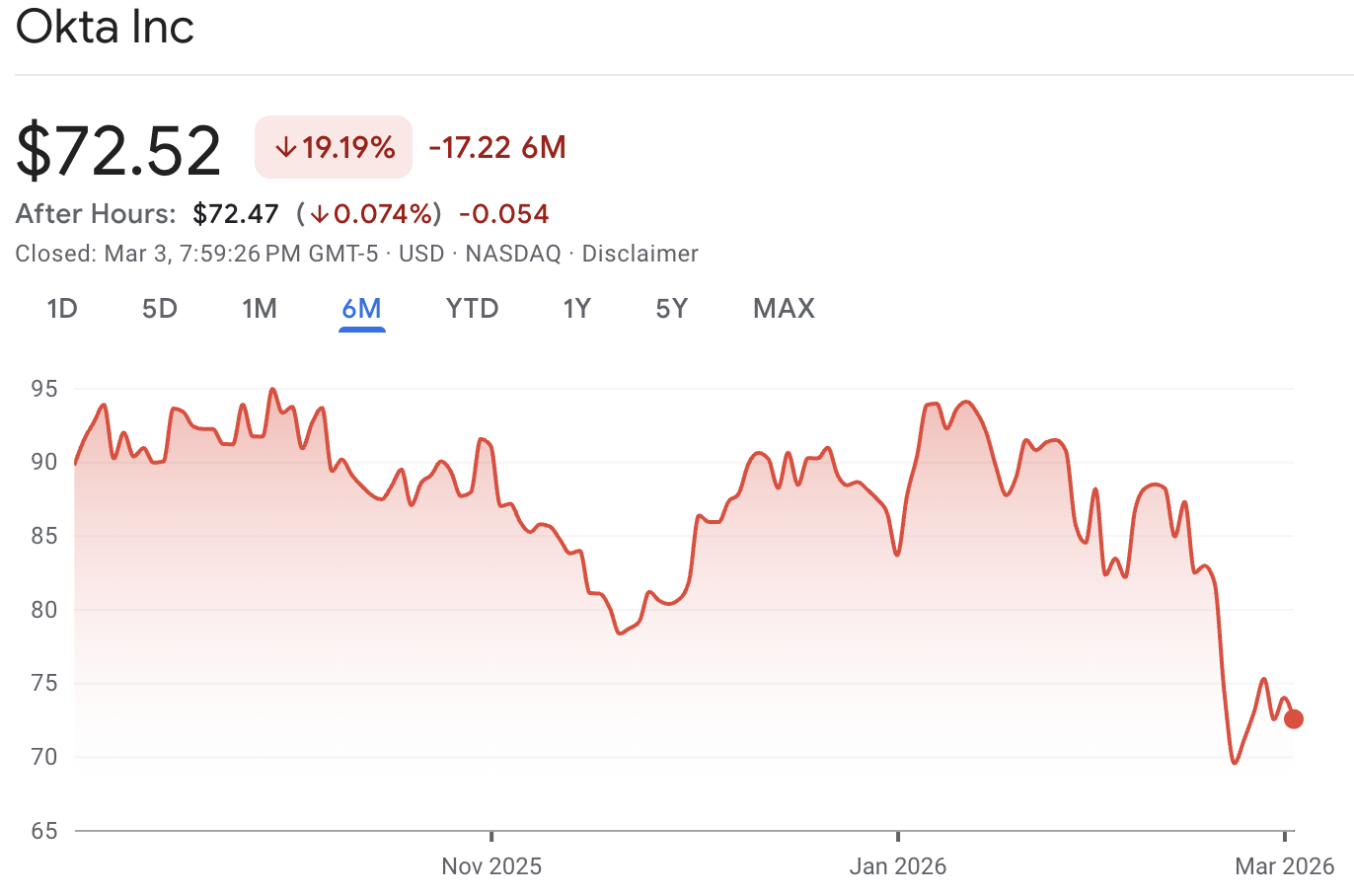
| Timeframe | Return | Start Close | End Close | End Date (Close) |
|---|---|---|---|---|
| 1D | -1.96% | $73.97 | $72.52 | Mar 3, 2026 |
| 1W | +1.94% | $71.14 | $72.52 | Mar 3, 2026 |
| 6M | -19.26% | — | $72.52 | Mar 3, 2026 |
At roughly $16.1 billion in market cap, OKTA is no longer priced like a high-growth software company, but it is also not priced like a slow-growth utility.
Using the latest reported cash balance of $2.463 billion (as of October 31, 2025) and the FY2026 revenue midpoint of about $2.907 billion, the stock trades around 4.7 times enterprise value to forward revenue on a simple cash-adjusted basis.
This valuation multiple aligns with expectations for a business growing at a low-teens rate while delivering expanding margins.
Okta (OKTA) last traded near $72.52, with an intraday range of $70.23 to $73.73. The near-term chart remains heavy: daily signals skew bearish, with RSI (14) near 46 and MACD below zero, suggesting rallies are still more likely to meet supply than trigger sustained breakouts.
| Zone | Level | Why It Matters |
|---|---|---|
| Resistance | $73.73 | Session high; first level bulls need to reclaim convincingly. |
| Resistance | $74.67 to $75.15 | 50-day SMA and 50-day EMA area, often a key sell zone in downtrends. |
| Pivot | $71.85 | Classic daily pivot; price acceptance above or below can set the day’s bias. |
| Support | $71.57 to $71.31 | Classic S1/S2 band, a common first defense on pullbacks. |
| Support | $70.23 | Session low; a breakdown raises odds of a momentum flush. |
| Major Resistance | $84.06 | 200-day SMA, the longer-term “regime” line that defines trend recovery. |
Three post-earnings scenarios are plausible:
1) Bull Case: Q4 revenue lands at the high end, cRPO beats the guided range, and management frames AI agent security as an attach-driven growth vector that can stabilize or improve demand into FY2027. In that setup, multiple expansions become possible because visibility improves alongside margin confidence.
2) Base Case: Results meet guidance, cRPO lands near the midpoint, and FY2027 commentary stays conservative. The stock reaction then depends on positioning: a “fine” print can still sell off if investors were leaning bullish into the event.
3) Bear Case: cRPO disappoints versus the guide, or FY2027 growth signals slip below 10% without a compensating margin upside. That would likely reinforce the market’s concern that the backlog deceleration is demand-driven rather than mix-driven.
Additional catalysts beyond earnings should be considered. The upcoming Okta Showcase 2026 on March 16, 2026, may be a key opportunity to announce AI-focused products and update go-to-market strategies.
Okta is scheduled to release fourth-quarter and full-year fiscal 2026 results after the U.S. market close on March 4, 2026, with a webcast at 5:00 p.m. Eastern.
cRPO focuses on backlog expected to be recognized within 12 months, making it a sharper indicator of near-term demand and renewal strength than total RPO. Okta’s Q4 cRPO guidance is a central swing factor for the stock.
Okta is positioning identity as critical for AI agents, not only human users, and has launched Auth0 for AI Agents. Investors will look for evidence that AI-driven use cases are increasing attach rates and influencing bookings mix.
Beyond Q4 revenue and EPS, investors will prioritize cRPO performance relative to guidance, any initial framing of fiscal 2027 revenue growth, and confidence in sustaining mid-20% non-GAAP operating margins alongside continued product investment.
Okta Earnings Preview: AI Demand, RPO, and Guidance ultimately comes down to whether Okta can keep backlog growth strong enough to defend low-teens revenue expansion while maintaining the margin and cash flow profile it has worked to establish across fiscal 2026.
The company’s positioning around AI agents is strategically sound, but the market will demand evidence in forward indicators, especially cRPO and FY2027 commentary.
Given that expectations are closely aligned with guidance and the stock is trading at cautious levels, the forthcoming report is likely to favor clear evidence of demand momentum over optimistic projections.
Disclaimer: This material is for general information purposes only and is not intended as (and should not be considered to be) financial, investment or other advice on which reliance should be placed. No opinion given in the material constitutes a recommendation by EBC or the author that any particular investment, security, transaction or investment strategy is suitable for any specific person.