Published on: 2026-02-20
Updated on: 2026-02-20
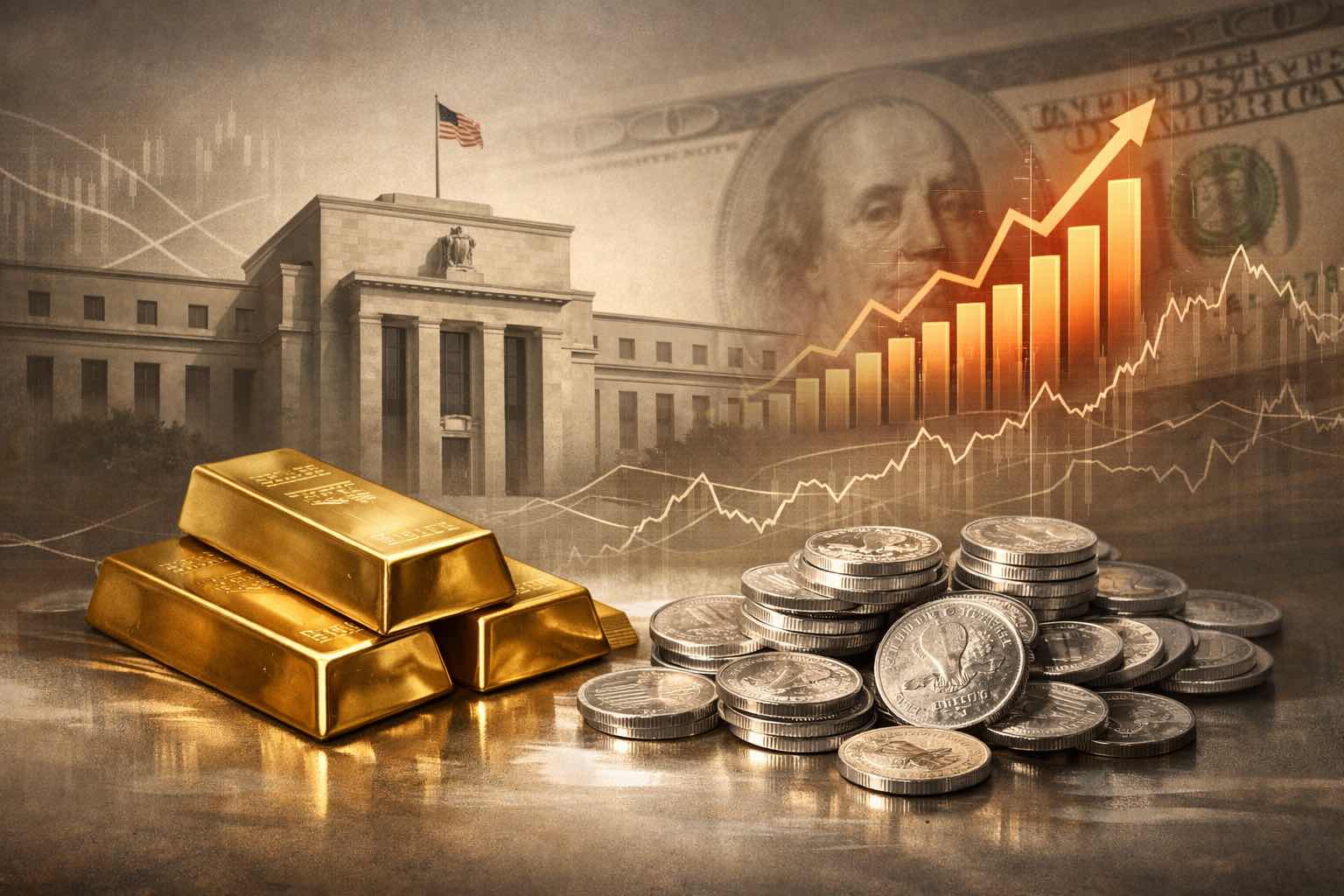
On Friday, February 20, 2026, gold and silver face persistent inflation concerns alongside an unprecedented price scale. Despite incomplete resolution of the inflation narrative, precious metals remain valued in a context where policy credibility, geopolitical risks, and real-rate uncertainty continue to command a premium.
The primary catalyst is the Bureau of Economic Analysis Personal Income and Outlays report, released at 8:30 a.m. Eastern, which includes the PCE Price Index and Core PCE. These inflation measures most directly influence the Federal Reserve’s policy decisions. Even minor deviations from expectations can significantly impact real yields and the dollar, potentially triggering liquidations in leveraged metals positions and causing pronounced repricing in mining equities.
| Data Point | Latest / Reference Level | Why It Matters For Gold And Silver |
| Today’s PCE Release Time | 8:30 a.m. ET (Feb 20, 2026) | The market reprices real yields before equities open, which can exaggerate metals moves. |
| Headline PCE Inflation (Latest Official) | 2.8% YoY (Nov 2025) | Sets the starting line for “re-acceleration” vs “continued glide path.” |
| Core PCE Inflation (Latest Official) | 2.8% YoY (Nov 2025) | Core drives Fed confidence; gold trades the real-rate implication. |
| Market Focus For Today | Dec 2025 PCE and Core PCE | Dec is a hinge month for whether inflation momentum is re-emerging. |
| Street Expectation Band (Dec 2025) | ~2.8%–2.9% YoY headline; ~3.0% YoY core | A narrow consensus can amplify volatility on a small surprise. |
| Street Expectation (Dec 2025 MoM) | ~0.4% headline and ~0.4% core | A high monthly print immediately lifts the “sticky inflation” narrative. |
| Fed Inflation Target | 2% (PCE) | Any persistence above target keeps real yields elevated and caps upside. |
| 10-Year Treasury Yield | 4.09% (Feb 18) | Nominal yields anchor discount rates, the dollar, and opportunity cost. |
| 10-Year Real Yield (TIPS) | ~1.83% (Feb 18 close) | Real yields are the most direct macro headwind or tailwind for gold. |
| Dollar Index (DXY) | ~98 area | Dollar strength is a mechanical drag on dollar-priced metals. |
| Gold (Proxy) | GLD $459.56 | A liquid expression of gold that trades with tight spreads into data. |
| Silver (Proxy) | SLV $71.01 | Silver’s higher beta means larger percentage swings around macro shocks. |
| Gold Miners (ETF) | GDX $104.24 | Operational leverage can magnify gold moves, but equity risk can interfere. |
| Silver Miners (ETF) | SIL $103.22 | Combines silver beta with equity volatility; often moves more than spot. |
| Implied Gold Volatility | GVZ ~33–34 | Elevated implied vol means options are pricing large post-data ranges. |
| Equity Volatility | VIX ~20 | If risk-off hits, silver can trade like a cyclical asset rather than a haven. |
| Next FOMC Policy Decision Window | March 17–18 (statement March 18) | Today’s PCE can shift the odds of the next policy pivot. |
Data sources for the table include BEA PCE pages and release timing, the Fed’s calendar and projections, and market pricing for yields, volatility, and ETFs as of February 20, 2026. (Bureau of Economic Analysis)
PCE matters because it is both the Fed’s preferred inflation framework and a cleaner signal for policy than CPI. The Fed targets 2% inflation, and its communication has consistently treated core inflation's persistence as the main reason policy cannot be relaxed quickly.
The current environment is particularly sensitive due to recent disruptions in data reporting, which have distorted the information pipeline. When market participants perceive trends as unreliable, they place greater emphasis on the first clear data confirmation. This often results in an initial sharp movement in interest rates and foreign exchange markets, followed by subsequent adjustments in precious metals as market positioning adapts.
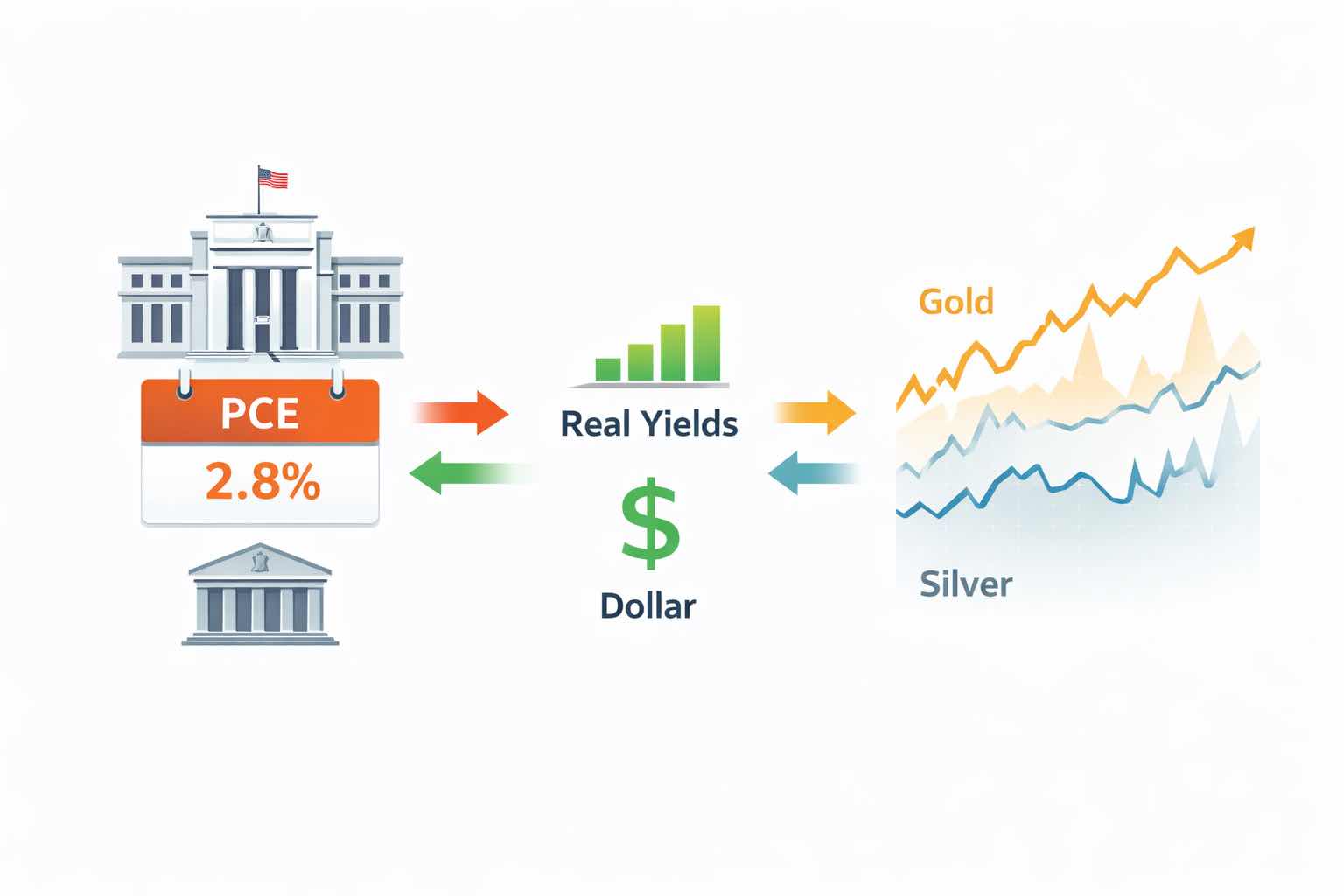
The fundamental drivers of gold remain consistent, despite changes in price levels. Real yields continue to exert significant influence. When the 10-year real yield approaches the upper end of the 1% range, gold must justify its role as a hedge or risk being viewed as a non-yielding asset competing with instruments offering positive real returns.
Simultaneously, safe-haven demand has become more fragmented. Currently, the US dollar absorbs a significant share of the risk premium, even as market uncertainty increases, occasionally appreciating. This dynamic can diminish gold’s traditional defensive appeal, particularly if the PCE report exceeds expectations and reinforces the dollar's interest rate differential.
Recent swings have made the market more “stop-driven” than “valuation-driven.” Gold futures have recently printed in a band that places psychological importance around the $5,000 area, with nearby support zones in the high $4,800s. In a hot PCE scenario, those supports become the first test of whether the market is simply repricing yields or actively de-risking leveraged length.
Silver is never just a monetary metal. It is also an industrial input, and that dual identity makes it a more unstable instrument in macro data. When inflation surprises higher, the first reaction is typically “rates up, dollar up, metals down.” But the second-order reaction can diverge: if the market interprets the same data as growth-resilient, silver can stabilize faster than gold because cyclicality re-enters the narrative.
Current pricing dynamics support this observation. Silver futures have recently traded in the upper $70s, with daily ranges that are wide even by historical standards. This indicates heightened market nervousness and limited liquidity near recent highs.
Using current futures levels, the gold-silver ratio sits in the low-to-mid 60s. That is a “silver-strong” configuration. If today’s PCE is soft and real yields slip, silver often outperforms in percentage terms. If PCE is hot and risk assets wobble, silver can underperform because it inherits equity-style drawdowns.
Spot metals react first to rates and FX. Mining equities react to spot, but also to equity liquidity, credit conditions, and operating-cost narratives. That is why miners can lag on a gold up-move when the broader tape is risk-off, and why they can drop harder than spot when volatility spikes.
If core PCE prints above the market’s comfort zone, the cleanest path is for real yields to rise and the dollar to firm. Gold typically tests support first. Silver often falls faster on a percentage basis. Miners tend to underperform spot in the first hour because equity risk premia widen alongside rates.
If the PCE result aligns with consensus expectations, attention should shift to secondary factors such as data revisions, the tone of services inflation, and consumer spending strength. In-line inflation, accompanied by robust spending, may still elevate yields, while softer spending can support gold prices. In this scenario, options pricing becomes particularly relevant, as implied volatility may decrease even if spot prices remain stable.
A lower-than-expected core PCE reading is the most direct bullish catalyst for precious metals, as it alleviates real-rate pressures. Gold typically shows a more immediate upside response, though silver may quickly follow if equity markets interpret the data as signalling policy flexibility without recession risk. Mining equities can rally significantly in this scenario, as margin expectations improve amid higher prices and reduced interest rate pressures.
Gold Beta Instruments: GLD offers close tracking of gold prices, while GDX provides amplified price movements but with greater exposure to equity market dynamics.
Silver Beta Instruments: SLV provides direct exposure to silver prices, whereas SIL offers higher beta performance with additional equity market risk.
Large-Cap Gold Miners And Streamers: Newmont (NEM), Agnico Eagle (AEM), Franco-Nevada (FNV), Wheaton Precious Metals (WPM) tend to trade as “quality duration” within the complex. They can hold up better when volatility rises, but they still gap on spot shocks.
Silver-Leaning Equities: Pan American Silver (PAAS) and Hecla (HL) often exhibit larger percentage swings than the metals themselves around macro events.
The key release is the Personal Income and Outlays report, which includes the PCE Price Index and Core PCE. Core PCE is closely watched because it filters out food and energy volatility and is central to Fed policy decisions.
PCE is more directly tied to the Fed’s target framework, and it tends to shape expectations for the path of real yields. Metals react to real yields and the dollar first, then to broader risk sentiment after the initial rate move.
Core PCE month-over-month is usually the fastest market mover because it signals near-term momentum. Year-over-year matters for narrative, but the monthly print drives immediate repricing in rates, especially when consensus is tight.
Hot inflation can lift real yields and the dollar, which is negative for metals. Silver also trades with industrial and equity beta, so if the market interprets hot inflation as “policy tighter for longer,” growth-sensitive positioning can unwind.
Miners can outperform on a favorable surprise because earnings leverage expands when gold rises, and financing pressure eases. But they also inherit equity drawdowns. On risk-off days, miners can lag even if gold is stable.
The Fed’s December 2025 projections embedded a disinflation path into 2026, with median PCE inflation moving closer to target and a policy rate path that remains restrictive. Today’s PCE is a key test of whether that trajectory still holds.
Gold and silver prices respond not to inflation in isolation, but to the effects of inflation on real yields, the subsequent impact on the US dollar, and the speed at which market positioning must adjust when the Federal Reserve’s credibility is at stake. As core PCE remains above the level required for a clear return to target, the market is positioned to react to unexpected outcomes rather than headline figures.
The practical approach to today’s print is disciplined: map your scenarios, respect the rate-and-dollar impulse, and treat miners as leveraged instruments that can either reward precision or punish impatience. The PCE release does not just set the day’s direction. It sets the market’s confidence in policy pricing over the next two months.
Disclaimer: This material is for general information purposes only and is not intended as (and should not be considered to be) financial, investment or other advice on which reliance should be placed. No opinion given in the material constitutes a recommendation by EBC or the author that any particular investment, security, transaction or investment strategy is suitable for any specific person.