Published on: 2026-03-05
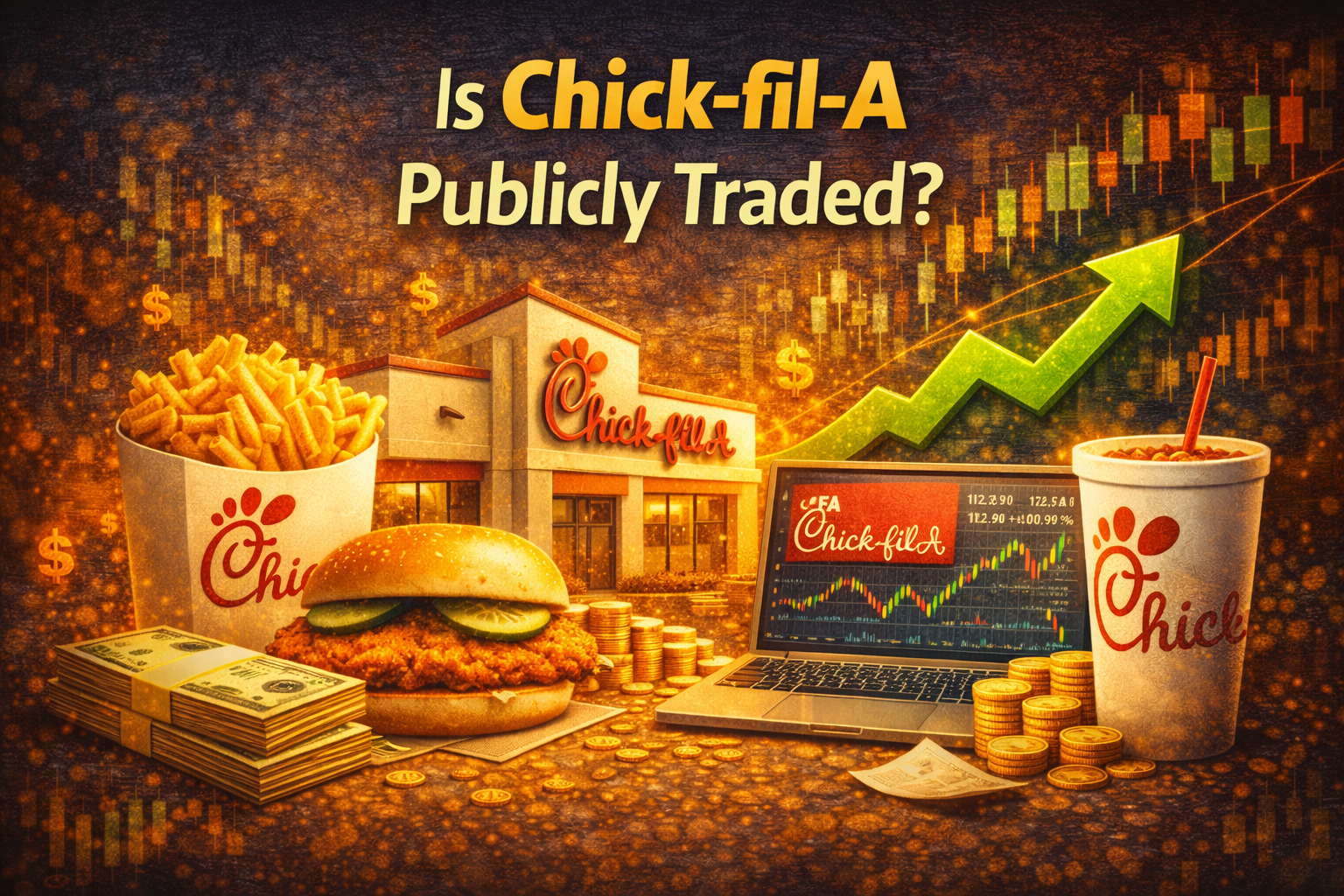
Chick-fil-A is not publicly traded, which means its shares are not listed on any stock exchange and cannot be purchased by retail or institutional investors through a brokerage account.
The company remains privately owned by the Cathy family and has consistently chosen to maintain that structure.
No, Chick-fil-A is a privately held company. It does not have a ticker symbol, it does not publish quarterly earnings reports for public investors, and it does not trade on the New York Stock Exchange or Nasdaq.
Ownership remains concentrated within the Cathy family, who have maintained control since the company’s founding in 1946. Because it is private, financial disclosures are limited compared with publicly listed restaurant chains.
Investors, therefore, cannot directly buy shares of Chick-fil-A stock.
Chick-fil-A’s decision to remain private is deliberate and strategic. Several core factors explain why the company has not pursued an IPO.
The company has always been owned and controlled by the Cathy family. Remaining private allows the family to maintain full decision-making authority without outside shareholder influence.
Public listing would require equity dilution and shared governance with institutional and retail investors.
Public companies are often evaluated based on quarterly earnings performance. Private ownership allows Chick-fil-A to prioritise long-term growth, operational consistency, and brand identity without short-term market pressure.
Chick-fil-A has built a strong brand identity around its operating model, including its Sunday closures. Remaining private provides flexibility to preserve this structure without shareholder pressure to maximise revenue opportunities every day of the week.
The company generates substantial revenue through its franchise model. Because expansion is funded internally and through franchise partnerships, there is no urgent need to raise capital through public markets.
While it is impossible to rule out any future corporate restructuring, there are no credible indications that Chick-fil-A plans to go public.
An IPO would require:
A significant governance restructuring.
A decision by the controlling family to dilute ownership.
A willingness to comply with extensive regulatory reporting obligations.
Given the company’s sustained growth and strong private ownership structure, an IPO appears unlikely in the foreseeable future.
If Chick-fil-A chose to pursue an IPO, it would gain access to public capital markets, but it would also face measurable costs and trade-offs.
For a company that values long-term cultural consistency and operational discipline, these trade-offs are significant.
Although investors cannot buy Chick-fil-A shares directly, they can gain exposure to related consumer brands available on the EBC platform.
Investors may consider large, publicly traded companies in similar consumer and food categories, such as:
The Coca-Cola Company (KO.N)
McDonald’s Corporation (MCD.N)
PepsiCo, Inc. (PEP.OQ)
These companies operate within the global consumer food and beverage ecosystem and provide exposure to the broader quick-service restaurant and consumer staples industry.
Investors may also consider broader exposure to consumer discretionary or consumer staples to reduce single-stock risk while maintaining sector participation.
Chick-fil-A currently fits entirely within the private company model.
No, Chick-fil-A is privately owned by the Cathy family and does not have publicly listed shares. Investors cannot purchase Chick-fil-A stock through any stock exchange or brokerage account because the company has chosen to remain outside the public capital markets.
Chick-fil-A has chosen to remain private to preserve family control, protect its long-term strategic direction, and avoid short-term earnings pressure from shareholders. Private ownership allows management to focus on operational consistency and brand values without quarterly performance scrutiny.
There is currently no indication that Chick-fil-A plans to launch an initial public offering. Given its strong financial position, stable ownership structure, and historical commitment to private control, an IPO appears unlikely unless there is a major shift in corporate leadership strategy.
If Chick-fil-A went public, it would gain access to substantial capital but would also face regulatory reporting requirements, shareholder oversight, and earnings pressure. Strategic decisions could become influenced by investor expectations, potentially altering governance, expansion priorities, or operational policies.
Although Chick-fil-A shares are unavailable, investors can gain exposure to comparable consumer brands such as The Coca-Cola Company, McDonald’s Corporation, and PepsiCo, Inc., which are publicly traded and accessible through the EBC platform under their respective ticker symbols.
Chick-fil-A remains one of the most prominent privately held restaurant chains in the United States. Its decision to remain private reflects a clear preference for control over ownership, cultural preservation, and long-term strategic flexibility.
For investors, understanding why a successful company chooses not to go public offers insight into how ownership structure influences corporate governance, growth strategy, and financial decision-making.
While direct investment in Chick-fil-A is not possible, exposure to the broader food and beverage sector remains accessible through publicly listed alternatives.
Disclaimer: This material is for general information purposes only and is not intended as (and should not be considered to be) financial, investment or other advice on which reliance should be placed. No opinion given in the material constitutes a recommendation by EBC or the author that any particular investment, security, transaction or investment strategy is suitable for any specific person.