Published on: 2025-12-09
Updated on: 2025-12-09
A dividend is one of the most important income concepts in equity markets, and beginner traders often underestimate how much dividends shape price behavior, volatility, and total returns.
Understanding how dividends work helps traders recognise opportunities, avoid common timing mistakes, and better interpret market signals that appear around payout dates.

A dividend is a payment a company makes to its shareholders, usually drawn from profits. It can be paid in cash, more shares, or occasionally other forms.
For traders and investors, dividends matter because they affect total returns, share price behavior, and market expectations.
Stable or rising dividends often signal financial strength, while cuts or cancellations can trigger sharp price reactions.
In trading terms, a dividend is part of the total return that a shareholder earns, along with price appreciation. Shares with regular dividends often attract long-term investors looking for stability.
When a dividend is announced, adjusted, or cancelled, it can influence the stock price immediately. On the ex-dividend date, most markets automatically reduce the share price by roughly the dividend amount because new buyers will not receive the upcoming payout.
Traders see dividend information on broker platforms, earnings announcements, economic calendars, and corporate filings. Dividend yield, dividend as a percentage of share price, is a key metric that income investors and equity analysts watch closely.
Dividends influence a stock in several practical ways that traders must understand:
A trade or investment does not earn only from price appreciation. Dividends add direct cash income. A stock that moves sideways in price may still deliver attractive total returns if its payout is high and consistent.
When a stock reaches the ex-dividend date, the market typically reduces the share price by about the dividend amount because new buyers will not receive the upcoming payment. This price adjustment can create gap openings, change intraday volatility, and affect stop placements.
A dividend increase often signals confidence from management.
A cut or cancellation can cause sharp sell-offs because it may reflect underlying weakness.
A stable dividend supports predictability, something many long-term investors value.
Traders encounter dividend information on broker platforms, earnings announcements, trading calendars, and corporate releases.
Dividend yield, the payout relative to share price, is one of the most watched metrics for income-focused investors.
| Dividend Type | Paid In | Why Companies Use It | Impact on Shareholders | Common Notes |
|---|---|---|---|---|
| Cash Dividend | Cash | Share profits directly and signal financial stability | Investors receive immediate income | Most common dividend type |
| Stock Dividend | Additional shares | Conserve cash while rewarding investors | More shares owned; proportional price adjustment | Dilutes share price but not total value |
| Special / Extraordinary Dividend | Usually cash | Distribute excess profits or proceeds from asset sales | One-off payout; may cause temporary price spike | Not expected to recur |
| Interim Dividend | Cash | Share profits before full-year results | Paid mid-year; may be followed by final dividend | Declared only by board approval |
| Final Dividend | Cash | Share confirmed annual profits | Paid after annual report; usually larger | Requires shareholder approval |
| Property / Asset Dividend | Physical assets or shares of another company | Distribute non-cash value | Shareholders receive non-cash assets | Rare in public markets |
| Scrip Dividend | Optional: cash or shares | Preserve cash reserves | Investors choose cash or additional shares | Common in UK and parts of Europe |
| Liquidating Dividend | Cash or assets | Return capital during company wind-down | Returns part of original investment | Reduces cost basis; not paid from earnings |
| Preferred Dividend | Cash (fixed rate) | Contractual payment to preferred shareholders | Fixed, periodic income | Paid before any dividend to common shareholders |
Several forces influence dividend decisions:
Profitability. When earnings rise, companies are more likely to raise dividends.
Cash flow health. Even if profits look strong, weak cash flow can force a company to pause increases or cut dividends.
Economic conditions. During recessions, firms often reduce payouts to preserve capital.
Debt levels. Highly leveraged companies may prioritize repayment over dividends.
Management policy. Some firms commit to stable dividends, others to flexible or cyclical payouts.
When dividends rise, traders often see it as a positive signal.
When dividends fall, it can trigger sell-offs because it hints at internal weakness.
When dividends stay stable, it reinforces predictability and reduces uncertainty.
Dividends influence entry decisions because part of the expected return comes from dividend payments, not just price movement. Some traders enter positions before the ex-dividend date to collect the payout, but this must be weighed against the expected automatic price drop.
Exits can also be timed around dividends. Short sellers, for example, must pay the dividend to the share lender, making shorting expensive around dividend dates.
Dividend announcements can increase volatility, widen spreads, and cause price gaps, key considerations when managing risk.
The company has stable earnings and a long history of predictable dividends.
Dividend announcement aligns with strong fundamentals.
Market conditions support income-focused strategies.
Dividend cuts or suspensions in a weak economic environment.
High dividend yield caused by collapsing share price rather than strong payouts.
Trading short without accounting for dividend liabilities.
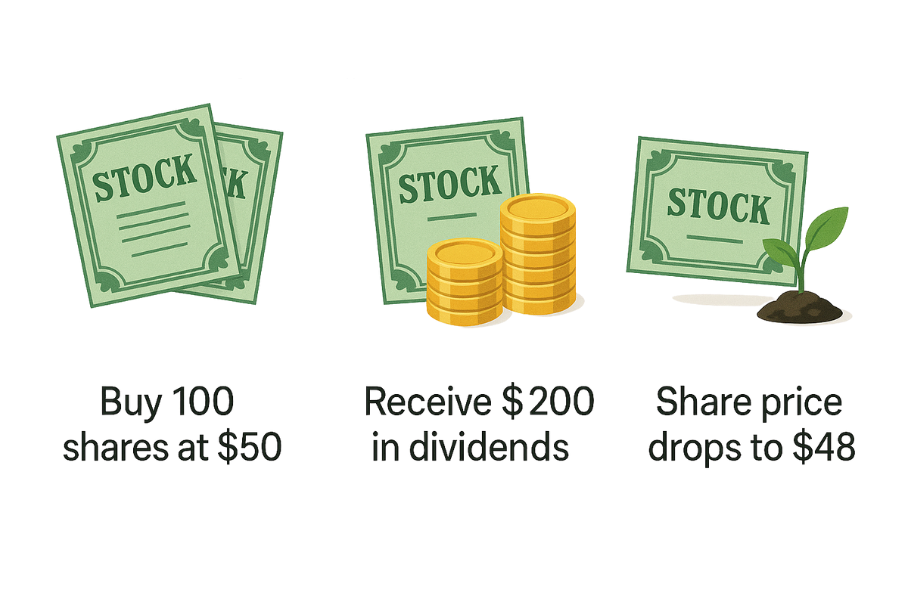
Imagine you buy 100 shares at 50 each. The company pays a yearly dividend of 2 per share. You receive 200 in dividends. If the share price rises to 53 by year-end, your price gain is 300 plus the 200 dividend, giving you a total return of 500.
But on the ex-dividend date, the share price may drop from 50 to about 48 because new buyers no longer receive the dividend. The key idea: dividends add to returns but also influence short-term price dynamics.
Look at dividend history: rising, stable, or inconsistent.
Check payout ratio: how much of earnings are distributed.
Review upcoming dividend dates: declaration, ex-dividend, record, payment.
Check cash flow strength to assess sustainability.
Compare dividend yield to industry averages.
Consider tax rules in your region on dividend income.
A good habit is to check dividend schedules at the start of each month to avoid unexpected price adjustments.
Chasing high yields. Very high yields often signal financial trouble.
Ignoring ex-dividend price drops. Traders may misunderstand why price falls.
Shorting near dividends. Shorts may face large unexpected dividend payments.
Overestimating dividend safety. Payouts can be cut quickly in downturns.
Focusing only on dividends. A strong dividend does not guarantee a strong business.
Dividend Yield: Measures payout relative to share price.
Payout Ratio: Shows sustainability of dividends.
Ex-Dividend Date: Key date determining who receives the payout.
A dividend is a company’s way of sharing profits with its shareholders. For traders, it influences returns, price behavior, and risk around key dates.
When used correctly, dividend information helps plan entries, exits, and overall strategy. But, when misunderstood, it can lead to mistimed trades or misreading a company’s true health.
Disclaimer: This material is for general information purposes only and is not intended as (and should not be considered to be) financial, investment or other advice on which reliance should be placed. No opinion given in the material constitutes a recommendation by EBC or the author that any particular investment, security, transaction or investment strategy is suitable for any specific person.



World's Best Broker