Published on: 2025-12-17
Updated on: 2025-12-17
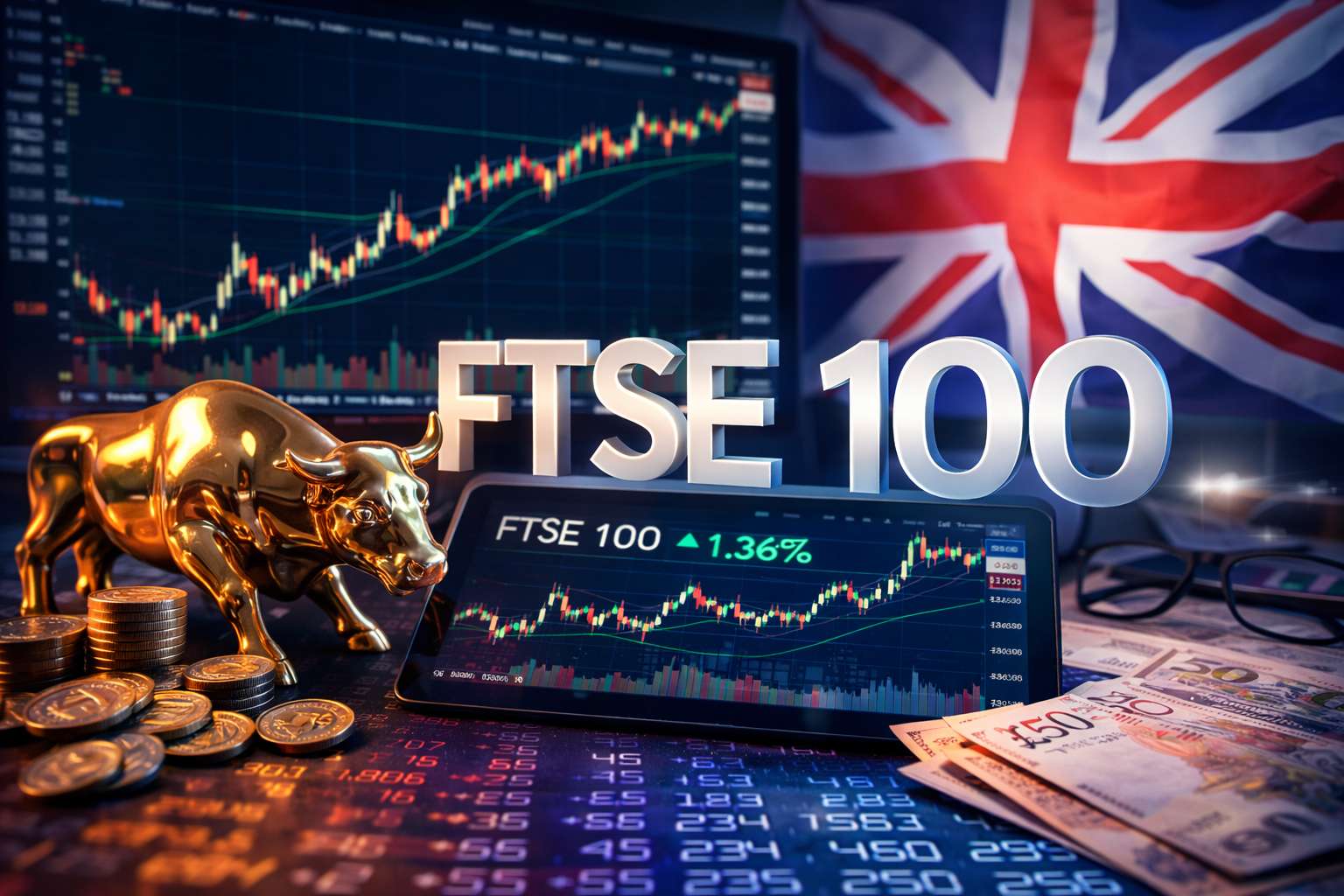
The FTSE 100 is the main stock market index of the United Kingdom and tracks the share prices of the 100 largest companies listed on the London Stock Exchange. It brings together major banks, energy firms, miners, and global consumer companies into one benchmark that reflects overall market conditions.
Traders follow the FTSE 100 because its movements offer insight into investor confidence, global risk sentiment, and how international economic forces are affecting UK-listed companies.
The FTSE 100 is the main stock market index of the United Kingdom. Every trading day, the FTSE 100 reflects how the largest companies in the UK are coping with global growth, currency moves, and investor confidence, all in one number.
It tracks the share prices of the 100 largest companies listed on the London Stock Exchange by market value. These companies include banks, energy firms, miners, consumer brands, and global exporters. Together, they represent a large part of the UK stock market and a significant share of international business activity.
For traders, the FTSE 100 matters because it offers a quick snapshot of market mood, risk appetite, and economic expectations, both in the UK and globally.
In trading terms, the FTSE 100 is a market-capitalisation-weighted equity index. This means companies with larger total market value have a bigger impact on index movements than smaller ones. A large energy or banking stock can move the index more than a small retailer.
Traders see the FTSE 100 quoted as a single price that rises and falls during market hours. It is traded through index CFDs, futures, options, and ETFs.
The index is closely watched by equity traders, macro traders, and portfolio managers because it reflects broad market trends rather than company-specific stories.
Several key forces move the FTSE 100 on a daily basis:
Global equity markets: When US or European stock markets rise, the FTSE 100 often follows. When global markets sell off, it usually comes under pressure.
The British pound (GBP): Many FTSE 100 companies earn revenue overseas. When the pound weakens, their foreign earnings look larger in GBP terms, which can lift the index.
Commodity prices: The index includes large oil, gas, and mining companies. Rising oil or metal prices often support the FTSE 100.
Economic data and interest rates: Inflation figures, growth data, and central bank decisions influence expectations for profits and borrowing costs.
When these factors shift, the FTSE 100 adjusts quickly to reflect the new balance of risk and opportunity.
The FTSE 100 influences trading decisions in several practical ways. First, it affects entry timing. Traders may wait for the index to confirm a broader market direction before entering individual UK stocks or index trades.
Second, it shapes exit decisions. If the index shows weakness while a trade is open, traders may reduce exposure or tighten stops. Strong index momentum can support holding positions longer.
Third, it affects costs and risk. During volatile periods, spreads can widen and price moves can become sharper.
Typical conditions traders look for include:
Good situation: steady index trend, moderate volatility, stable spreads
Bad situation: sharp swings, heavy news flow, fast reversals, wider spreads
Imagine the FTSE 100 is trading at 7,500 points. A trader believes improving global sentiment will lift European markets. They buy a FTSE 100 CFD expecting a 1 percent rise.
If the index rises from 7,500 to 7,575, that 75-point move reflects gains across many large companies, not just one stock. Now imagine instead that commodity prices fall sharply and global stocks weaken. The FTSE 100 drops to 7,425. The same trade now shows a loss, even though no single company collapsed.
This example shows how the index reflects broad forces rather than isolated events.
Before trading the FTSE 100, traders usually check several things:
Index chart: Look at daily and intraday charts to see trend direction and recent volatility.
Global market direction: Check how US and European futures are trading, as they often lead sentiment.
GBP movement: A falling or rising pound can strongly influence the index.
Economic calendar: Watch for UK inflation data, employment reports, or central bank announcements.
A simple rule is to check the index context at least once before each trading session and again when major news hits.
Treating it as a pure UK economy play, even though many companies earn most revenue abroad.
Ignoring the currency effect, which can move the index independently of UK news.
Overtrading during major news, when spreads and volatility increase.
Assuming all FTSE stocks move equally, despite large weighting differences.
Trading without global context, even though the index is highly international.
Each of these mistakes can distort risk and timing decisions.
Volatility: The speed and size of price changes in the index.
European Central Bank (ECB): The European Central Bank is the central bank for the euro area and is responsible for setting monetary policy and maintaining price stability for countries that use the euro.
GBP Exchange Rate: Currency movements that influence FTSE earnings value.
Central Bank Policy: Central bank policy, including decisions by the Bank of England and the European Central Bank (ECB), shapes interest rates, currency moves, and investor confidence that affect the FTSE 100.
The FTSE 100 measures the share price performance of the 100 largest companies listed on the London Stock Exchange by market value. It is used as a benchmark for the overall UK equity market.
It gives only a partial picture. Many FTSE 100 companies earn a large share of their revenue overseas, so global conditions often matter more than domestic UK data.
A weaker pound can increase the value of foreign earnings for large exporters in the index. This can push the FTSE 100 higher even when UK economic news is negative.
Trading activity is usually highest shortly after the London market opens and again near the close. Activity can also increase sharply around major economic releases.
The FTSE 100 tracks the share prices of the 100 largest companies listed in the UK and provides a broad view of market direction and investor risk appetite. Its movements are driven less by domestic news alone and more by global markets, currency shifts, commodity prices, and economic expectations.
When used properly, it helps traders judge market context and timing. When used without considering these wider forces, it can give a misleading signal.
Disclaimer: This material is for general information purposes only and is not intended as (and should not be considered to be) financial, investment or other advice on which reliance should be placed. No opinion given in the material constitutes a recommendation by EBC or the author that any particular investment, security, transaction or investment strategy is suitable for any specific person.



World's Best Broker