Published on: 2026-03-04
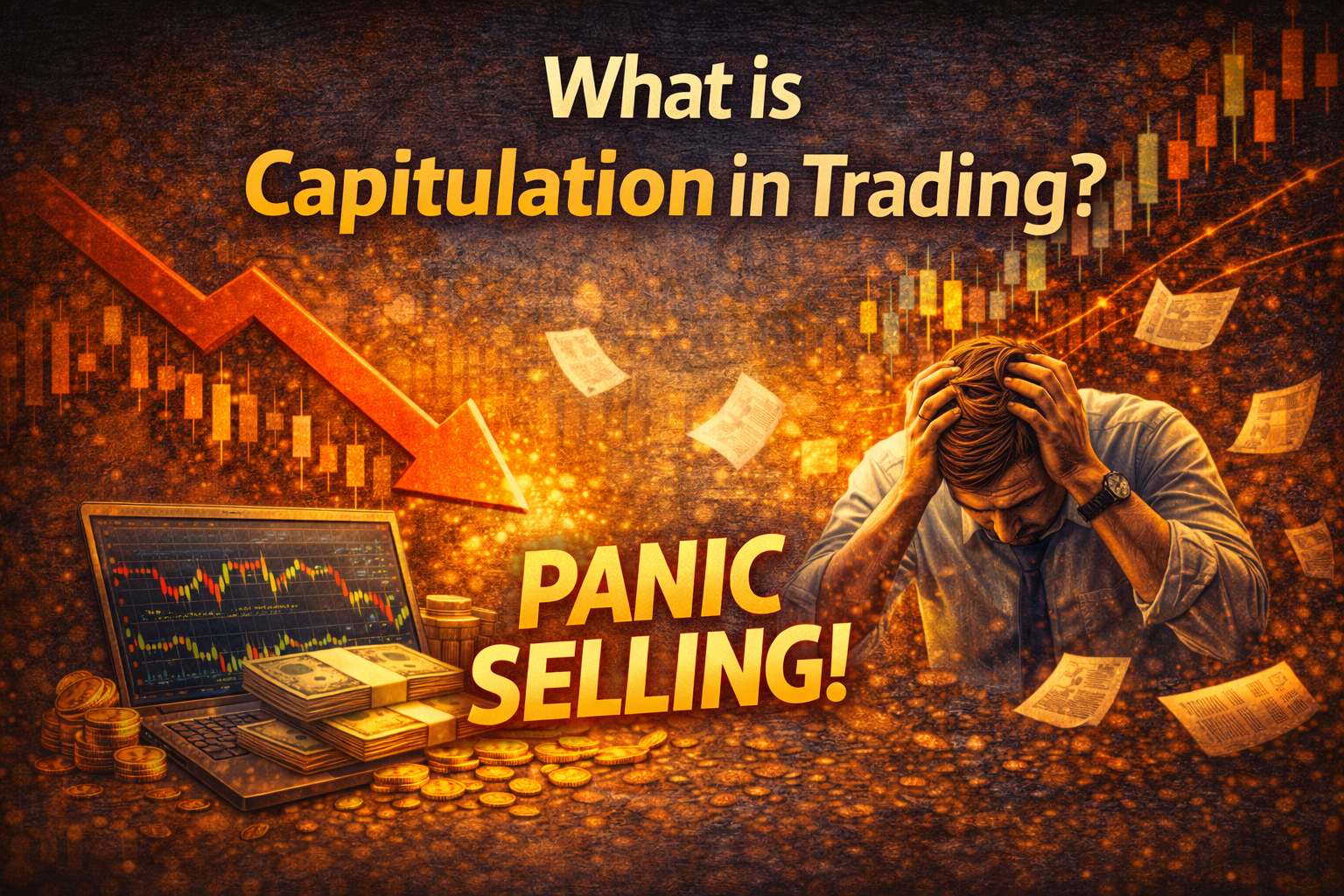
Capitulation in trading refers to a sudden and intense wave of panic selling in which investors abandon their positions after prolonged losses. At this stage, fear overwhelms rational analysis, and market participants rush to exit at almost any available price.
Capitulation is often associated with the final phase of a major market decline. While it does not guarantee an immediate reversal, it can signal that selling pressure is reaching exhaustion. Understanding capitulation helps traders interpret extreme volatility, assess sentiment shifts, and better navigate periods of market stress.
Capitulation marks the emotional climax of a downtrend, where fear-driven selling accelerates price declines and pushes trading volume sharply higher.
It often occurs near the later stages of a prolonged decline, when investors lose confidence in recovery prospects.
Capitulation reflects both psychology and market structure, combining panic sentiment with measurable technical signals such as volume spikes and volatility surges.
It may precede stabilisation or a market bottom, although confirmation typically comes only after the fact.
In financial markets, capitulation describes a widespread surrender of positions during a significant downturn. Investors who once believed in a recovery decide that preserving capital is more important than waiting for a rebound.
This behaviour is commonly described as panic selling. Rather than evaluating fundamentals, investors react emotionally to continued losses. The result is a surge in sell orders, sharp price declines, and heightened volatility.
Capitulation can occur in:
Individual stocks
Specific sectors
The entire market indices
Commodities or cryptocurrencies
When it affects broad segments of the market simultaneously, it is often called market-wide capitulation.
Capitulation rarely happens without warning. It usually develops through a sequence of psychological and technical stages.
Prices begin declining due to negative news, economic weakness, tightening liquidity, or deteriorating fundamentals. Early sellers may include short-term traders and risk-conscious investors.
As the downturn continues, more investors experience portfolio drawdowns. Some remain hopeful for a rebound, while others reduce exposure. Confidence begins to weaken.
When losses deepen and uncertainty grows, fear replaces optimism. Investors begin to believe that further declines are inevitable. Media narratives may become overwhelmingly negative, reinforcing pessimism.
This is the capitulation phase. Selling becomes indiscriminate. Investors liquidate positions at almost any price to avoid additional losses. Trading volume surges as participation intensifies. Price declines accelerate sharply, and volatility expands.
Eventually, most willing sellers have exited. With fewer sellers remaining, downward pressure weakens.
At this stage, prices may stabilise, consolidate, or begin a gradual recovery. However, confirmation of a bottom usually becomes clear only in hindsight.
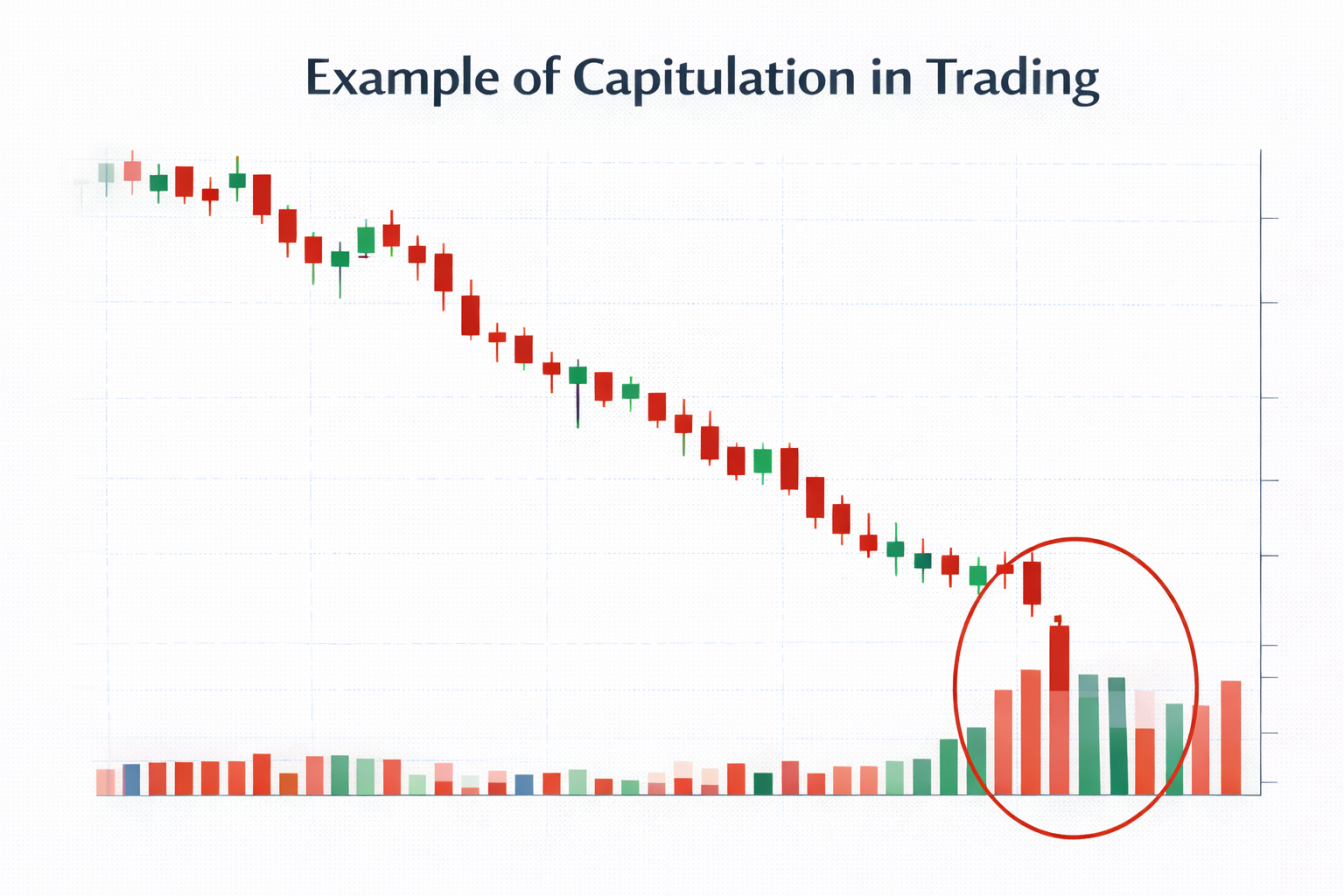
These signals, taken together, often indicate that a market is experiencing emotional exhaustion rather than a normal pullback.
These cases show that capitulation can precede a market bottom, but it is usually identifiable only in hindsight, after volume spikes and price stabilisation.
It marks the point where fear overwhelms rational positioning. Recognising sentiment extremes can help traders avoid emotional decisions.
While not guaranteed, capitulation can signal that the majority of selling pressure has already occurred.
Understanding capitulation dynamics helps traders assess whether a decline is accelerating or stabilising.
Long-term investors sometimes view capitulation-driven price levels as potential value opportunities, provided fundamentals remain intact.
Volume Analysis: A dramatic surge in trading volume during a steep decline suggests widespread liquidation.
Oversold Momentum Readings: Indicators such as the Relative Strength Index (RSI) or the Moving Average Convergence Divergence (MACD) may show deeply oversold conditions, reflecting intense downward momentum.
Volatility Measures: Volatility indexes or expanding price ranges often accompany panic-driven environments.
Price Structure: Large bearish candles, gap-down openings, and failed rebounds may indicate disorderly market behaviour consistent with capitulation.
Even if selling pressure exhausts itself, markets can remain unstable. A stabilisation phase often precedes sustainable recovery.
Normal corrections and pullbacks occur regularly. Capitulation specifically involves emotional exhaustion and unusually high participation.
Capitulation can occur in bonds, commodities, currencies, and cryptocurrencies. The driving force is investor psychology, not asset type.
Avoid Emotional Decision-Making: Reacting impulsively during panic phases can lock in losses unnecessarily.
Use Risk Management Tools: Predefined stop-loss levels and appropriate position sizing help control downside exposure during volatile conditions.
Wait for Confirmation: Many traders look for stabilisation signals such as reduced volatility or volume contraction before increasing exposure.
Maintain a Long-Term Perspective: For long-term investors, periods of extreme pessimism may present opportunities, provided overall financial objectives and risk tolerance remain aligned.
Capitulation is difficult to confirm in real time because it is defined by emotional exhaustion and selling climaxes. Traders usually recognise it only after observing stabilisation, reduced volatility, or a sustained rebound following extreme volume and sharp declines.
Capitulation is bearish in the short term because it involves accelerated selling and falling prices. However, it can sometimes signal a late-stage downtrend. If selling pressure exhausts itself, markets may stabilise or recover afterwards.
It can present opportunities, but it also carries significant risk. Buying during capitulation requires strong risk management and patience, as prices may remain volatile or continue declining before a clear bottom forms.
After capitulation, markets often enter a stabilisation phase. Volatility may decline, volume can normalise, and prices may consolidate before either recovering or resuming the broader trend.
Professional traders typically focus on risk control. Some reduce exposure to preserve capital, while others gradually scale into positions once evidence of stabilisation appears. Most avoid aggressive predictions and instead wait for confirmation signals.
Capitulation represents one of the most emotionally intense phases in financial markets. It occurs when fear overwhelms hope, prompting widespread liquidation and sharp price declines.
Although painful for investors, capitulation can mark the exhaustion of selling pressure and the beginning of stabilisation. Recognising its characteristics, volume spikes, volatility surges, and extreme sentiment helps traders respond with discipline rather than emotion.
Disclaimer: This material is for general information purposes only and is not intended as (and should not be considered to be) financial, investment or other advice on which reliance should be placed. No opinion given in the material constitutes a recommendation by EBC or the author that any particular investment, security, transaction or investment strategy is suitable for any specific person.