Published on: 2026-09-02
Updated on: 2026-09-02
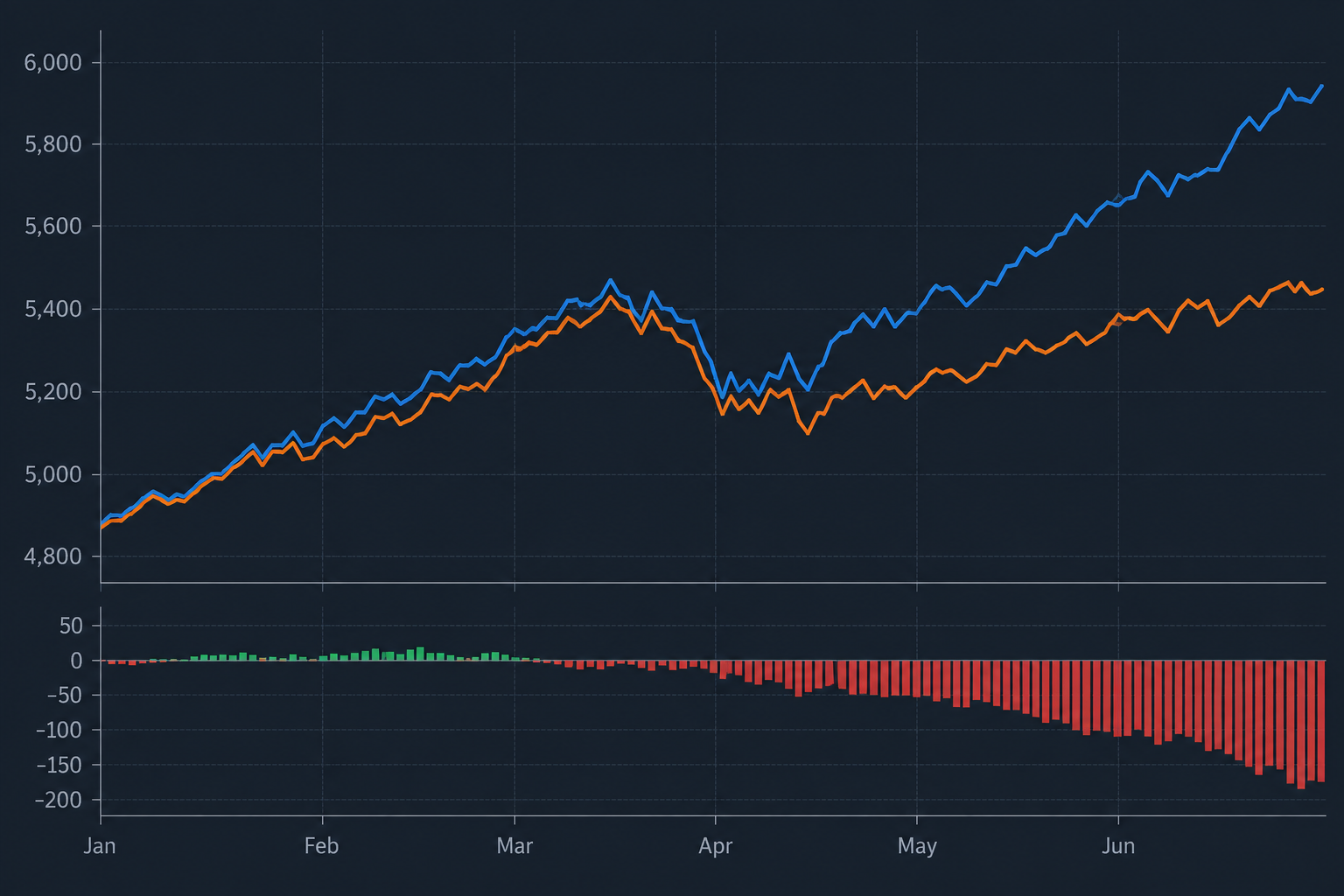
Hedging is designed to reduce uncertainty, but few hedges remove it completely. A futures contract, swap or related instrument may move broadly in line with the exposure being protected while still producing a different financial outcome. The risk created by that mismatch is known as basis risk, and it can affect commodities, currencies, interest rates and financial futures alike.
Basis risk is the risk that the price of an asset and the instrument used to hedge it do not move together as expected.
In futures markets, the basis is commonly expressed as:
Basis = Spot Price − Futures Price
For example, if wheat trades for $5.80 per bushel in the cash market while the relevant futures contract trades at $6.00, the basis is −$0.20 per bushel.
The convention is not universal. Some financial markets define basis as futures minus spot instead. CME Group, for example, uses futures minus cash when discussing the basis embedded in its Spot-Quoted futures. The direction of the calculation changes the sign, but not the underlying principle: basis measures the gap between two related prices.
The existence of a basis is not itself the risk. Basis risk arises when that gap changes unexpectedly while the hedge is open.
This is also different from a basis trade. A basis trade deliberately takes offsetting positions in related cash and futures markets to capture changes or convergence in their price difference. Basis risk refers to the uncertainty surrounding that relationship.
A hedge can work correctly in one market and still fail to deliver the expected overall result.
Suppose a producer expects a futures position to offset a fall in the price of a commodity. If the local cash price falls faster than the futures price, the gain on the futures hedge may cover only part of the cash-market loss. Directional price risk has been reduced, but some of it has effectively been replaced by basis risk.
In that sense, hedging does not necessarily eliminate risk; it can convert a larger exposure to the outright price into a smaller exposure to changes in the basis.
Recent research shows that this is more than a theoretical concern. A 2025 Journal of Futures Markets study by researchers from the Commodity Futures Trading Commission and USDA examined historical basis risk among U.S. corn and soybean producers. Farms in counties that had experienced large negative corn-basis shocks were found to be 6–12 percentage points less likely to use futures and 3–18 percentage points less likely to use options, indicating that past basis outcomes can materially influence real hedging decisions.
Basis risk therefore matters because a hedge’s success depends not only on predicting or protecting against the direction of prices, but also on the relationship between the two prices involved.
Consider a farmer preparing to sell wheat.
The local cash price is $5.80 per bushel and wheat futures trade at $6.00. The starting basis is therefore:
$5.80 − $6.00 = −$0.20
To hedge against falling prices, the farmer sells futures at $6.00.
By the time the wheat is sold, futures have fallen to $5.50. The short futures position therefore earns $0.50 per bushel. However, suppose the local cash price has fallen further, to $5.15.
The new basis is:
$5.15 − $5.50 = −$0.35
The change in basis is therefore:
−$0.35 − (−$0.20) = −$0.15
The basis has weakened by $0.15 per bushel.
For a simplified one-for-one short futures hedge:
Effective selling price = Final cash price + Futures gain
So:
$5.15 + $0.50 = $5.65
The same result can be expressed directly through the basis:
Effective price = Initial futures price + Final basis
Therefore:
$6.00 + (−$0.35) = $5.65
Had the basis remained at its original −$0.20 level, the effective selling price would instead have been:
$6.00 + (−$0.20) = $5.80
That means the 15-cent weakening in the basis produced a 15-cent worse hedged outcome in this simplified example.
This also illustrates two common terms used when discussing basis movements. Under the spot minus futures convention used here, a basis that becomes more positive or less negative has strengthened, while a basis that becomes more negative or less positive has weakened.
| Basis movement | Short hedger / seller | Long hedger / buyer |
|---|---|---|
| Strengthens | Generally favorable | Generally unfavorable |
| Weakens | Generally unfavorable | Generally favorable |
For example, a move from −$0.20 to −$0.35 represents a weakening basis and is generally unfavorable for a producer using a short futures hedge. A move from −$0.20 to −$0.05 represents a strengthening basis and would generally improve the short hedger’s effective outcome.
For contracts tied to exactly the same underlying asset and settlement benchmark, spot and futures prices generally move toward one another as expiration approaches. However, a real-world exposure may differ by location, quality, timing or benchmark, so the relevant basis does not necessarily disappear.
Basis risk usually appears because the hedge and the exposure are similar rather than identical.
Several factors can create that mismatch.
Location differences are especially important in commodities. Grain in one region or natural gas delivered at one hub can trade at a substantially different price from the benchmark underlying a futures contract.
Timing differences arise when the hedge expires before or after the actual transaction. Closing one contract and moving into another can introduce additional uncertainty.
Quality or grade differences also matter. A futures contract may reference a standardised commodity specification while the physical product has a different grade, composition or delivery cost.
Basis can also change because of transportation, storage, financing, liquidity and regional supply-demand conditions.
A 2026 CME Group example illustrates the scale these differences can reach. The spread between its South Asia crude palm oil benchmark and Malaysian crude palm oil futures ranged from $33.80 to $137.50 per metric ton within three months, a $103.70 range. CME attributed movements in the spread to factors including freight, regional supply and demand, and import economics.
A farmer may hedge local corn prices with CBOT corn futures. A strong local harvest, transportation bottleneck or weak nearby demand could depress the local cash price without producing an equivalent decline in futures.
The futures hedge would still respond to the broader corn market, but the local exposure could behave differently.
Natural gas provides a particularly clear example because prices vary significantly between regional delivery hubs.
A producer might hedge using NYMEX Henry Hub contracts while actually selling gas at another location. Range Resources explained in its second-quarter 2026 filing that regional natural gas prices may differ from Henry Hub and that this divergence can reduce the effectiveness of commodity derivatives. The company uses basis swaps to manage that exposure, with its disclosed basis swaps extending through December 2030.
Basis risk can also exist without a physical commodity.
A borrower might pay a floating rate linked to one benchmark while receiving floating payments from a swap linked to another. If those rates diverge, the swap does not perfectly offset the debt.
A 2026 New York State housing-agency disclosure provides a real example. At October 31, 2025, the weighted-average rate on certain hedged variable-rate debt was 3.9394%, while its derivative references included 100% compounded SOFR at 4.3043%, 75% of SOFR at 3.2333% and 73% of SOFR at 3.1471%. The agency explicitly identified the resulting mismatch between the rate on its debt and the rates referenced by its derivatives as basis risk.
Importantly, the difference between the 3.9394% hedged debt rate and the 4.3043% full compounded SOFR rate should not be interpreted automatically as a 0.3649-percentage-point hedging loss. Those figures demonstrate the benchmark mismatch. The actual financial effect depends on the terms and notionals of the swaps and the other rates referenced by the derivatives.
The same principle applies to financial markets. A company unable to hedge a currency exposure directly may use a highly correlated currency as a proxy. Likewise, a portfolio manager may hedge a group of shares with index futures.
If the proxy currency or index begins moving differently from the actual exposure, the hedge develops basis risk.
A perfect hedge would generate gains on the hedging position that exactly offset losses on the underlying exposure.
Real markets rarely provide that degree of precision. A futures hedge often replaces a large exposure to the outright price with a smaller exposure to the basis.
One important source is cross-hedging, where the available futures or derivative contract is based on a related but different asset. The effectiveness of the hedge then depends heavily on the stability of the historical relationship between the two instruments.
Basis movements can work either for or against the hedger. A change that improves the final effective price produces a better outcome than expected, while movement in the opposite direction leaves more residual exposure.
This means hedge performance should be evaluated at the combined-position level, rather than by asking whether the futures or derivative position itself made money. A profitable hedge leg can still accompany an unsatisfactory total result.
Basis risk generally cannot be eliminated completely, but it can often be reduced.
The first step is to choose a hedging instrument that matches the exposure as closely as possible. The underlying asset, benchmark, geographic location, quality and settlement terms should all be considered.
Timing also matters. Matching the hedge maturity with the expected transaction date reduces the need to close or roll contracts at an unfavourable basis.
Historical data can help determine how stable the relationship has been. However, historical correlation should not be treated as permanent. Transportation disruptions, liquidity shocks, weather, policy changes or shifts in regional supply can alter relationships that previously appeared reliable.
Other approaches include using basis swaps, locational contracts or adjusted hedge ratios when a standard futures contract alone does not adequately cover the exposure. The development of specialised spread contracts, such as CME’s 2026 South Asia–Malaysia palm-oil product, reflects the market’s attempt to isolate and hedge basis exposure separately from outright price risk.
The objective is therefore not simply to hedge more. It is to make the hedge more closely resemble the risk that actually needs to be managed.
Basis risk highlights an important limitation of hedging: reducing exposure to an outright price move does not automatically produce a predictable final price.
Differences in location, benchmark, maturity, quality, financing or market conditions can cause the asset and its hedge to move apart. Recent examples across agriculture, natural gas, palm oil and SOFR-linked debt show that those differences can have measurable financial consequences.
Understanding basis therefore means looking beyond whether two markets usually move in the same direction. The effectiveness of a hedge ultimately depends on whether the relationship between them remains stable when the protection is actually needed.