Published on: 2026-08-26
Updated on: 2026-08-26
A stock reaching a 52-week high can feel like the worst possible time to buy. Yet for momentum traders, a new yearly high can signal strength rather than an imminent reversal, especially when the move occurs within an established uptrend and is supported by stronger volume, relative outperformance and improving fundamentals.
So, should you buy a stock at a 52-week high? It can be rational when the breakout is supported by evidence that momentum is continuing, but the high itself is not enough. The stronger question is whether the move is being confirmed by the trend, trading activity, relative strength, market conditions and the underlying business.
A 52-week high is also different from an all-time high. A stock can reach its highest price in the past year while still trading well below a historical peak reached several years earlier.
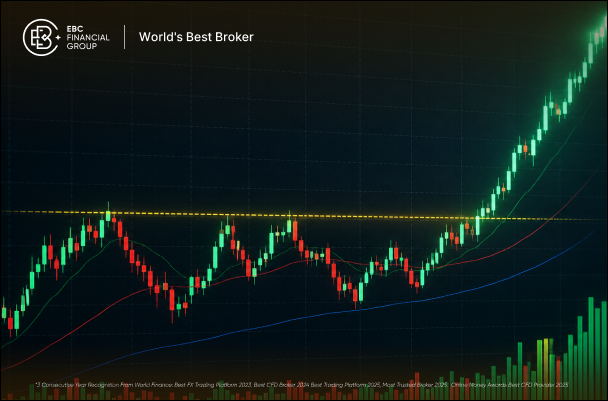
A 52-week high breakout occurs when a stock moves above its highest price from the previous 12 months.
Buying at a yearly high can be rational because momentum can persist, but price alone does not confirm that the breakout will continue.
Stronger breakouts usually combine an established uptrend, higher participation, relative strength, sufficient liquidity and supportive market conditions.
Traders can enter before the breakout, as it occurs or after a pullback, with each approach balancing earlier entry against greater confirmation.
A breakout begins to weaken when price falls back below the breakout level, momentum fades or the wider market turns against the move.
A 52-week high is the highest price at which a stock has traded during the previous 12 months. A 52-week high breakout occurs when the stock moves beyond that level.
Some strategies require only an intraday move above the previous high, while others require a daily close above it to reduce the risk of reacting to a temporary spike.
For momentum traders, the breakout can be significant because the stock is demonstrating enough demand to trade above every price reached during the previous year.
There is a difference between a stock trading near its 52-week high and one that has actually broken above it. Buying before the breakout means anticipating that resistance will be cleared. Waiting until price moves through or closes above the level provides more confirmation, but potentially at a higher entry price.
Neither approach guarantees continuation. A stock can briefly move above its yearly high and then fall back into its previous trading range, creating a false breakout.
Buying near a yearly high can appear counterintuitive because a stock that has already risen sharply may look expensive or overdue for a decline.
Momentum strategies instead ask whether the forces behind the move are still strengthening.
Research by Thomas George and Chuan-Yang Hwang found that a stock’s proximity to its 52-week high contained information about subsequent returns, helping establish the yearly high as more than simply a quote-screen statistic.
One explanation is behavioural anchoring. Market participants can adjust gradually when earnings, guidance or business conditions improve, allowing prices to continue rising even after reaching levels that previously appeared expensive.
Stocks showing persistent relative strength can also attract greater attention from momentum-based strategies.
None of this means a new high must keep rising. It simply explains why reaching a high is not, by itself, evidence that a reversal is imminent.
No. A 52-week high measures where a stock trades relative to its own recent price history. Valuation examines what shareholders are paying relative to earnings, cash flow, revenue or expected future growth.
A stock can therefore reach a new yearly high while its earnings outlook is improving fast enough to support the higher price. Conversely, a stock trading far below its 52-week high can still appear expensive if its fundamentals have deteriorated even faster.
For long-term investors, a new high may therefore be a reason to investigate the business more closely rather than an automatic reason to buy or sell.
There is no single way to enter a 52-week high breakout. The main choice is how much confirmation a trader wants before accepting the risk.
A trader can enter while the stock remains slightly below its 52-week high, anticipating that the level will be cleared.
The advantage is an earlier entry price. The disadvantage is that the breakout has not yet been confirmed, so resistance may hold and the stock may reverse.
Another approach is to enter when price moves through or closes above the previous high.
This provides evidence that buyers have pushed beyond the old resistance level. It also exposes the trader more directly to false breakouts if price quickly falls back into its earlier range.
Some traders wait for price to retreat toward the former breakout level.
If previous resistance begins acting as support and the stock resumes its advance, the pullback can provide additional confirmation that the breakout is holding.
The trade-off is that the stock may never return to the breakout level, causing the trader to miss the move altogether.
In simple terms:
| Entry Approach | Main Advantage | Main Trade-Off |
|---|---|---|
| Pre-breakout | Earlier entry | Least confirmation |
| Breakout | Confirms resistance has been crossed | Greater false-breakout exposure |
| Pullback | More evidence the level is holding | Risk of missing continued upside |
The better entry depends on how much uncertainty a trader is willing to accept. A valid breakout can also become a poor trade if price has already moved so far above the breakout level that the potential reward no longer compensates for the downside risk.
The 52-week high identifies the event. The evidence surrounding the move helps determine whether the breakout deserves further attention.
A breakout is generally more convincing when it develops from an established period of rising prices rather than from a sudden rebound after a prolonged decline.
Moving averages can help show that structure. A stock trading above its 50-day and 200-day moving averages, for example, is displaying a stronger existing trend than one still below those measures.
Higher volume suggests broader participation as the stock moves through its previous high, although it does not identify who is buying.
Thin volume deserves greater caution, particularly in smaller stocks where relatively few orders can move the price sharply.
Relative strength compares the stock’s performance with a benchmark, sector or peer group.
A stock already outperforming its sector and the broader market generally shows stronger momentum than one reaching a 52-week high while still lagging its peers.
Relative strength here should not be confused with the Relative Strength Index, or RSI, which is a separate technical oscillator.
A stock breaking out within a strong sector and an advancing market may have more supportive conditions than one moving higher while its industry or major indices are weakening.
Range-bound markets can also produce more whipsaws and false signals.
Fundamentals and liquidity can provide additional context without serving the same purpose. Improving earnings, revenue growth or guidance can help explain why demand may persist, while sufficient liquidity makes the price signal and trade execution more reliable.
A useful framework is therefore:
| Factor | What to Look For |
|---|---|
| Trend | Existing upward price structure |
| Participation | Stronger trading activity around the breakout |
| Relative strength | Outperformance versus market or sector |
| Market context | Supportive sector and broader trend |
| Fundamentals | Improving earnings, revenue or business expectations |
| Liquidity | Sufficient trading activity and manageable spreads |
| Risk | A clear level where the breakout thesis would be considered invalid |
A stock does not need every signal to be perfect. The objective is to determine whether several independent pieces of evidence are pointing in the same direction.
The clearest sign of failure is when price cannot hold above the former 52-week high and falls back into its previous trading range. Fading relative strength, weaker participation or a reversal in the stock’s sector or broader market can reinforce that warning.
A breakout can also become vulnerable when the stock is excessively extended or when thin liquidity exaggerates the initial move.
Risk management begins by deciding what would invalidate the original breakout thesis. Some traders use a close back below the breakout level, nearby support or a volatility-adjusted measure such as Average True Range. The appropriate level depends on the strategy and the stock’s volatility.
Position sizing should reflect that risk as well. A more volatile stock may require a smaller position than a stable large-cap company because the same percentage move can create a different portfolio-level impact.
Buying at a new high is also not automatically the same as chasing. Chasing means buying mainly because the price has already risen, often because of fear of missing out. A systematic breakout strategy instead uses predefined conditions for entry, confirmation and risk.
For long-term investors, the 52-week high usually serves a different purpose. It can highlight a company worth researching, but the longer-term decision still depends on fundamentals, valuation and expected growth.
Buying a stock at a 52-week high can be rational when the move is supported by an established trend, stronger market participation, relative outperformance and supportive market conditions. The yearly high itself is only the starting point.
The more useful question is not simply whether the stock has reached a new high, but whether the evidence behind that move remains strong, whether the entry still offers acceptable risk, and where the breakout thesis would be considered invalid if momentum fades.