Published on: 2026-06-25
Updated on: 2026-06-25
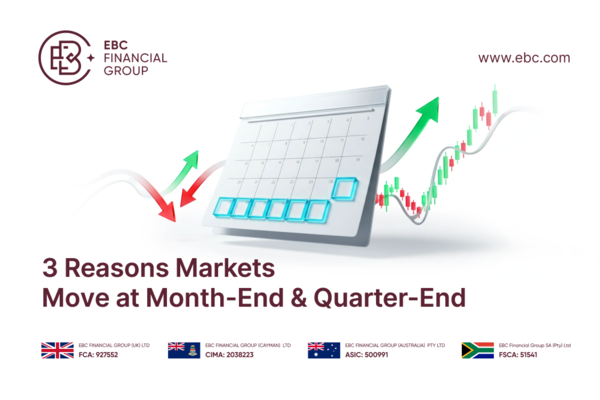
Investors may rebalance portfolios, review risk and even adjust currency hedges in the final days of the month or quarter before the reporting period ends. These flows can create short-term buying or selling even when the broader market outlook has not changed. Economic data, central banks, earnings, geopolitics, and risk sentiment are still major market drivers. Period-end flows simply help explain why prices sometimes move in ways that do not match the news.
Month-end and quarter-end flows are buying and selling linked to the close of a reporting period.
Large investors like pension funds, multi-asset managers, model portfolios, and some passive funds usually have a planned mix of investments or rules on how much risk they can take. A target allocation is the planned mix of assets in a portfolio. A risk limit sets how much risk the portfolio can take.
A portfolio might be built to hold a certain mix of stocks, bonds, cash, commodities, or investments from different regions.
For example, in a 60/40 portfolio, the fund aims to hold 60% in stocks and 40% in bonds. If stocks go up a lot, the stock portion can rise above the target, making the portfolio too focused on equities.
To fix this, the manager might sell some stocks and buy bonds or other assets. This doesn’t mean the manager is bearish on stocks or bullish on bonds. It’s just a routine step to get back to the target mix.
When many large portfolios make these changes around the same time, it can move market prices.
Market changes can shift portfolios away from their planned mix. If stocks have done well, some funds might cut back on stocks. If bonds have underperformed, some may add more bonds. If gold, oil, or other assets have moved a lot, funds with those holdings may also need to be adjusted.
After a strong month for global stocks, some balanced funds might sell stocks near the month-end. This selling doesn’t always mean they’re negative about the economy. It often just means stocks have become too large for a part of the portfolio.
The same idea works the other way. If stocks have dropped and bonds have done better, rebalancing might mean buying stocks and selling some bonds.
This isn’t a reliable sign that markets will reverse. Not all funds rebalance at the same time, and the size of these moves depends on how much markets have changed, who is investing, and the overall market situation.
A move at the end of a period doesn’t always mean there’s new economic news. Sometimes, it just shows that large portfolios are being adjusted back to their targets.
These reviews can lead managers to change their positions even when their view on the economy has not changed. A manager may reduce a position if it has grown too large after a strong run. If markets become more volatile, or if the portfolio is getting close to its risk limits, the risk team may ask them to cut exposure. Some funds may also avoid making big new trades right before the reporting period ends.
A strong performer might be sold for profit if it has become too big in a portfolio. A weaker holding might keep falling if managers don’t want to carry it into the next period. In both cases, the moves can look bigger than the news of the day would suggest.
This is sometimes called “window dressing” in market commentary. It means making changes before portfolio reports are prepared, often to make holdings look better to clients or stakeholders. Traders should be careful with this term, since price moves alone rarely prove that window dressing is happening.
Quarter-end doesn’t always follow a set pattern. Reporting dates and risk reviews can add short-term pressure, especially if markets have already moved a lot during the quarter.
Many large investors own assets in foreign currencies. For example, a UK fund might own US stocks, a European investor might hold Japanese stocks, and an Asian institution might have US bonds. Each investor is exposed to both the asset and the currency it’s priced in.
If the foreign currency changes a lot, it can affect how much the investment is worth in the investor’s home currency. Some funds use currency hedges to limit this impact.
A currency hedge helps reduce the effect of exchange-rate changes on overseas investment. As the value of the investment changes, the hedge might need to be updated.
If US stocks go up a lot, a non-US investor’s exposure to the dollar can increase. To keep the hedge at the right level, the investor might need to adjust positions in major currency pairs like EUR/USD, GBP/USD, or USD/JPY.
These hedge changes can cause short-term FX flows near month-end or quarter-end. They don’t always drive the market, and they don’t replace the impact of interest rates, central bank news, or economic data. But they can help explain why a currency pair sometimes moves differently from the main news.
Period-end flows can show up in many types of assets.
Stocks and indices: Funds may sell recent winners if their portfolios have too many stocks. Markets that have lagged might see more buying if funds need to get back to their target mix.
Bonds: If stocks have rallied, balanced portfolios might buy more bonds to rebuild their exposure. If bonds have done better, funds might sell some bonds to reduce their holdings.
Forex: Major currency pairs sometimes move when international investors adjust hedges tied to overseas assets. These moves are often more noticeable around FX benchmark windows, which are set times for calculating reference exchange rates, or during quieter trading periods.
Gold and commodities: Sharp moves in gold, oil, or other commodities could possibly lead to position changes. Larger trends are often shaped by factors like the US dollar, real yields, inflation expectations, supply and demand news, and risk sentiment. Real yields are bond yields after adjusting for inflation.
For traders reviewing broad market benchmarks where period-end flows might appear, EBC’s index CFD page can be a useful reference.
The risk is reading too much into a short-term move.
A sharp move near month-end might reflect fresh information, portfolio flows, or both. Traders should not assume every late month move signals a major change in sentiment.
Liquidity can make these moves harder to understand. Liquidity means how easily you can buy or sell an asset without moving its price much. If large orders come in during a quiet session or near a benchmark time, the same flow can have a bigger impact on prices.
This is especially relevant in FX, where some trading activity is linked to benchmark rates such as the London 4pm fix, a widely used reference point for currency pricing.
Before you react to a period-end move, consider these questions:
Was there a clear catalyst, such as an inflation report, central bank comment, earnings release, or geopolitical headline?
Is the market close to month-end or quarter-end?
Has one asset class had an unusually strong or weak run during the period?
Are stocks, bonds, FX, gold, and commodities telling a similar story, or does the move look isolated?
Does the move continue after the reporting period closes, or fade once the new month or quarter begins?
These questions will not identify every flow in real time, but they can help traders avoid treating every sharp move as a new fundamental signal.
Month-end and quarter-end flows do not provide an easy directional signal. Broader economic drivers still shape the bigger trend, but period-end flows may help explain why price action sometimes moves ahead of the news.
Before assuming a late-month move reflects fresh news, check whether portfolio rebalancing, risk reviews, currency hedging, or liquidity might also be playing a role.