Published on: 2026-01-09
Updated on: 2026-01-09
IEX share price slips as APTEL hears the market coupling case. See today's move, January 2026 dates, and what coupling could mean for fees and volumes.
IEX share price is down today because traders are pricing in regulatory risk linked to market coupling, and the APTEL hearing cycle is keeping the timeline and rule design uncertain.
IEX has become a headline-driven stock this week. The share price is moving less on day-to-day electricity demand and more on whether coupling changes how the day-ahead market clears, and how much value stays with the exchange versus the central clearing process.
IEX share price is falling because market coupling could reshape the day-ahead market, where IEX has historically held its strongest liquidity edge.
Today’s drop follows sharp swings all week, showing investors are trading policy probability rather than quarterly results.
The next market-moving signals are about timelines and mechanics, not slogans: operator governance, audit, and order allocation after clearing.
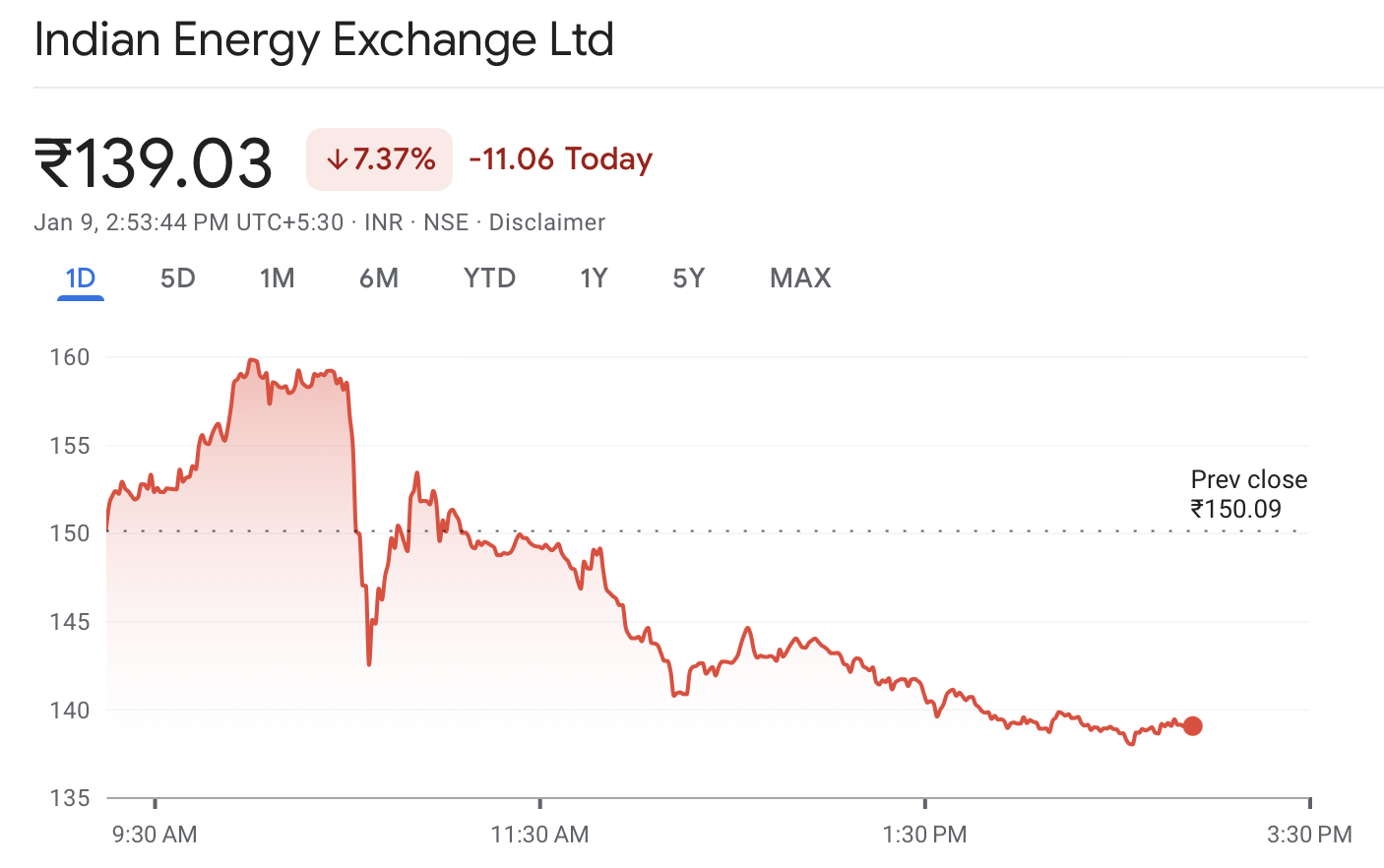
IEX traded with unusually wide intraday moves on Friday. On the exchange screen, the stock ranged from ₹140.22 to ₹160.27 versus a previous close of ₹150.09, and it hovered around the ₹141 to ₹144 area during the weaker part of the session, down roughly 5%.
The context matters. Earlier in the week, IEX jumped sharply as optimism rose that the tribunal process could slow or reshape coupling. On 6 January 2026, the stock spiked about 14% intraday, and it gained roughly 13% across two sessions before giving back part of that move.
IEX is a marketplace business. It earns transaction fees by matching buyers and sellers of electricity. That means its value is tightly linked to market structure: the rules that decide how bids are matched, how the clearing price is set, and how orders flow through the system.
In a normal quarter, investors would focus on volumes, product expansion, and cost control. Right now, the market is focused on something more fundamental: whether coupling changes the value of liquidity on any single exchange, especially in the day-ahead segment.
Market coupling can sound abstract, so here is the simple version.
Before Coupling
Each power exchange runs its own day-ahead auction. Participants place bids on the venue they choose. Each exchange clears its own market price based on its order book.
With Coupling
Bids from multiple exchanges are pooled for a combined clearing process, with the aim of producing one clearing outcome for the day-ahead market. The clearing engine becomes central to price formation, and the link between “my order is on this exchange” and “this exchange sets the price” becomes weaker.
Why this Matters for IEX
IEX has historically benefited from concentrated liquidity. When more orders sit in one pool, price discovery tends to improve, and that can attract more volume. Coupling can dilute that flywheel if the design shifts pricing influence away from the exchange and towards the coupled mechanism and its governance.
This does not automatically mean IEX becomes uncompetitive. It does mean the competitive edge may shift towards reliability, products, member experience, and how orders are allocated after the coupled clearing, rather than pure liquidity concentration in one venue.
The current framework is anchored in the regulator’s 23 July 2025 directions in Petition 8/SM/2025, which set a phased approach and pointed to day-ahead market coupling from January 2026. The framework also describes a round-robin model where operational power exchanges can act as the Market Coupling Operator, with Grid India in a defined backup and audit role. [1]
In early January 2026, an official corrigendum dated 8 January 2026 linked to 8/SM/2025 reinforced that the policy is being advanced via formal directions under the power market rules. That matters for litigation framing and for the market’s sense of momentum.
Against that backdrop, tribunal proceedings are a key swing factor. Reporting around the latest hearing indicates a requested affidavit schedule around 19 January 2026, which becomes a near-term date traders can anchor to.
Coupling risk becomes clearer when it is tied to business levers. Investors are not only debating whether volumes grow. They are debating where the economics settle.
1) Day-ahead Market Share
If clearing becomes more centralised, the day-ahead share can become less sticky. Total exchange-based trading can still rise, but IEX’s portion of the most sensitive segment could face pressure.
2) Fees and Take-rate
A coupled market can make participants and policymakers focus on standardisation. Even without a headline fee cut, the risk can show up as slower fee growth and weaker pricing power, because the market looks more like a single combined pool.
3) Operating Leverage and Cost Base
IEX has historically been valued for operating leverage. Coupling can introduce extra technology integration, coordination, audit, and compliance costs. If those costs rise while pricing becomes harder to expand, margins can tighten.
Mild impact: coupling is phased and largely technical, volumes grow, and IEX stays strong through product depth and execution quality.
Medium impact: day-ahead share becomes less sticky, fee growth slows, and the valuation multiple compresses even if volumes rise
High impact: both share and take-rate face pressure at the same time, and the market values IEX more like a utility-style platform than a high-moat marketplace.

Recent business updates still show healthy growth in traded electricity. In Q3 FY26, IEX reported total electricity traded volume of 34.08 billion units, up 11.9% year on year.
Prices were softer, which is often consistent with improved supply conditions and deeper liquidity. The reported day-ahead market price in Q3 FY26 was ₹3.22 per unit, down 13.2%, and the reported real-time market price was ₹3.26 per unit, down 11.6% year on year.
The mix explains why coupling is so sensitive. Day-ahead volumes were 16,250 MU, down 2.8%, while real-time volumes were 12,650 MU, up 35.7% year on year. Growth is broad, but the segment in the coupling spotlight is day-ahead, where IEX’s historical liquidity advantage is most debated.
IEX also reported 18.63 lakh RECs traded in the quarter and flagged trading sessions on 14 January and 28 January 2026, which can influence near-term activity but are not the main driver of today’s move.
| Timeframe (January 2026) | What happens | Why it matters for IEX share price |
| Around 19 January | Tribunal filing milestone referenced for affidavits | Affects timing risk and confidence on whether coupling is delayed or accelerated |
| Late January | Further tribunal updates and procedural directions | A stay, a narrowing of scope, or a firm timeline can reprice the stock quickly |
| January implementation window | Policy framework points to day-ahead coupling starting in January 2026 | Turns coupling from plan into execution and reduces uncertainty |
| As rules and mechanics are clarified | Operator governance, audit role, and order allocation after clearing | Determines whether coupling is a mild redesign or a structural hit to exchange economics |
These milestones map to the formal coupling framework and the tribunal process currently shaping market expectations.
Why is IEX Share Price Down Today?
Because the market is re-pricing regulatory risk around market coupling, and tribunal developments are keeping the timeline and design uncertain. That uncertainty goes straight to day-ahead market economics.
What is Market Coupling, and Why Does it Matter to IEX?
Market coupling pools bids for day-ahead clearing so the market can settle on a common clearing outcome. If designed in a way that reduces the importance of venue-specific liquidity, it can weaken IEX’s network advantage and pressure fee expectations.
What Should Investors Watch Next?
Watch January 2026 tribunal milestones, including a referenced filing date around 19 January, plus any published detail on the operator model, governance, audit processes, and order allocation. These mechanics decide the real economic impact.
IEX share price is down today because coupling risk sits at the centre of how the exchange creates value in the day-ahead market. Volumes are still growing, but the stock is trading on market structure and rule design, not only on quarterly operating trends.
Until the market gets clear mechanics and a credible timeline, IEX is likely to stay sensitive to legal and regulatory milestones. When that clarity arrives, attention can shift back to fundamentals such as traded volumes, product growth, and the platform’s operating leverage.
Disclaimer: This material is for general information purposes only and is not intended as (and should not be considered to be) financial, investment, or other advice on which reliance should be placed. No opinion given in the material constitutes a recommendation by EBC or the author that any particular investment, security, transaction, or investment strategy is suitable for any specific person.