Published on: 2026-03-30
India's primary IPO market has a clear front-runner in 2026, and it is not technology or consumer goods; it is financial services.
Financial services listings reportedly raised ₹49,795 crore in FY2025-26, the highest annual total for the sector in ten years. That figure alone represents 28% of the ₹1.8 lakh crore raised by 109 mainboard firms, making it the single largest sector in India's primary market this year.
 Key Takeaways
Financial services have become the primary sector driving India's IPO boom
India is now a global leader in IPO deal volumes, surpassing the US and Europe
The BFSI pipeline for 2026 includes some of the most anticipated names in Indian finance
Domestic investor participation is at an all-time high, underpinning the primary market's strength
The next phase of growth will depend on maintaining valuation discipline and ensuring high balance-sheet quality
The four largest offerings, Tata Capital at ₹15,512 crore, HDB Financial Services at ₹12,500 crore, ICICI Prudential AMC at ₹10,603 crore, and Groww at ₹6,632 crore, collectively account for a substantial portion of the sector's dominance.
The pace of change is particularly striking. Financial services IPOs in FY2025-26 raised more than the ₹42,283 crore the sector mobilised over the preceding six years combined.
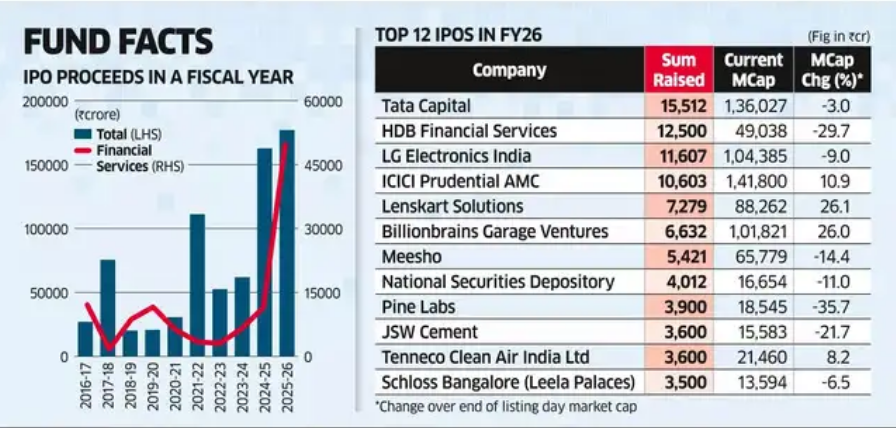
KPMG confirmed that by December 2025, India had already recorded more than 90 listings raising nearly ₹1.6 trillion, with financial services and consumer discretionary leading the chart.
This reflects a structural advancement in how Indian capital markets finance financial businesses, not a routine cyclical rebound.
| Metric | Latest reading | Why it matters |
|---|---|---|
| Financial-services IPO proceeds in FY2025-26 | ₹49,795 crore | Sector leader in fundraising |
| Share of mainboard IPO proceeds | 28% | Financials captured the largest slice of the market |
| Mainboard companies listed in FY2025-26 | 109 | Deal flow stayed broad, not narrow |
| Funds raised by previous six years combined | ₹42,283 crore | FY2025-26 alone exceeded that total |
| India IPO market by Dec. 2025 | 90+ listings, nearly ₹1.6 trillion | Market depth supported execution |
| SIP contributions in Feb. 2026 | ₹29,845 crore | Domestic liquidity stayed substantial |
Indian retail investors are increasingly moving from physical assets into financial instruments, expanding the addressable market for NBFCs, mutual fund houses, and insurance companies.
India's Credit-to-GDP ratio was 93% in Q3 FY2025, one of the lowest among global peers, indicating significant scope for growth in the banking and financial services sector in the coming years.
FY2025 witnessed strong bank balance sheets with record-low Non-Performing Assets (NPAs) and decadal-high Return on Assets (ROAs), placing banks and NBFCs in a favourable position for growth.
The Reserve Bank of India cut the repo rate and reduced the Cash Reserve Ratio in 2025, releasing substantial liquidity into the banking system and accelerating credit growth.
As of November 2025, India's total demat accounts climbed to a record 21 crore, driven by a 22% surge in new accounts in October amid a busy IPO season and rising retail investor participation.
One underappreciated element is deal structure. The Offer for Sale (OFS) accounted for more than half of total IPO proceeds year-to-date through December 2025, with 66% of funds raised in Q3 FY2026 coming from OFS tranches.
That means the sector is doing two jobs at once. In some cases, issuers are raising fresh capital to expand loan books, invest in technology, or strengthen solvency.
At the same time, early investors, parent organisations, and strategic shareholders seek liquidity and structured exits. India's primary market has now developed sufficient depth to accommodate both objectives at scale.
The surge in finance-led issuance reflects a clear shift in institutional and retail investor preferences. The market is demonstrating a genuine willingness to fund regulated businesses with scale, established brand recognition, and transparent financial economics.
The BSE Financial Services index fell more than 1% in FY2025-26, while the Sensex dropped nearly 5%. Yet new financial listings still drove record primary-market fundraising.
This indicates that investors are distinguishing between sentiment in the secondary market and opportunities in the primary market.
The most likely implication is that the IPO boom in India during 2026 will remain selective rather than indiscriminate.
Large BFSI issuers are expected to attract attention, but success will favour those demonstrating credible asset quality, pricing discipline, and a clear use of proceeds. Scale alone will not be enough.
The pipeline of BFSI IPOs scheduled for 2026 is notable for both its scale and the reputation of participating entities:
| Company | Segment | Estimated Price |
|---|---|---|
| PhonePe | Digital Payments | ₹99,600 crore valuation |
| SBI Mutual Fund | Asset Management | Large-ticket listing |
| Groww (Billionbrains) | Wealth Tech | SEBI approved |
| Credila Financial Services | Education Finance | ~₹5,000 crore |
| Navi Technologies | Digital Lending / Insurance | FY26 target |
| Hero FinCorp | NBFC / Retail Lending | ₹3,668 crore |
Hero FinCorp, the financial services arm of the Hero Group, plans an IPO worth approximately ₹3,668 crore, comprising both a fresh issue and an offer-for-sale component.
Navi Technologies, founded by Sachin Bansal, operates across digital lending and insurance, and is targeting a listing before the close of FY26.
Financial services are the top-performing sector in India's IPO market during FY2025-26, accounting for the largest share of total IPO proceeds. This performance was driven by NBFCs, asset managers, and insurance companies entering the public markets.
These IPOs offer regulatory transparency, established business models, and quantifiable financial metrics. In the current market environment, this facilitates more reliable pricing and sustained investor demand compared to businesses primarily driven by narrative.
Not necessarily. FY2025-26 demonstrated that new issues can attract capital even when the listed financial sector experiences downward pressure, as primary and secondary markets frequently assess risk differently.
Not necessarily. FY2025-26 showed that financial IPOs can attract strong capital even when listed financial indices are under pressure.
India is currently among the most active IPO markets globally by deal volume, having surpassed the United States and Europe in the number of listings. Reports projected that India could raise up to $25 billion through IPOs in 2026.
Financial services are dominating India’s 2026 primary market because the sector now sits at the intersection of regulation, scale, liquidity, and investor familiarity.
The record ₹49,795 crore raised in FY2025-26 reflects more than strong demand for new paper. It reflects a broader shift in how India’s capital markets are funding lenders, insurers, AMCs, and fintech platforms.
That is why India financial services IPOs 2026 deserve close attention. They are shaping the financial services IPO trend, defining the IPO pipeline India, and setting the tone for the next phase of the India primary market.
As always, due diligence on valuations and business fundamentals remains non-negotiable. The sector is strong, but selectivity matters more than momentum.
Disclaimer: This material is for general information purposes only and is not intended as (and should not be considered to be) financial, investment or other advice on which reliance should be placed. No opinion given in the material constitutes a recommendation by EBC or the author that any particular investment, security, transaction or investment strategy is suitable for any specific person.