Published on: 2026-02-09
Updated on: 2026-02-09
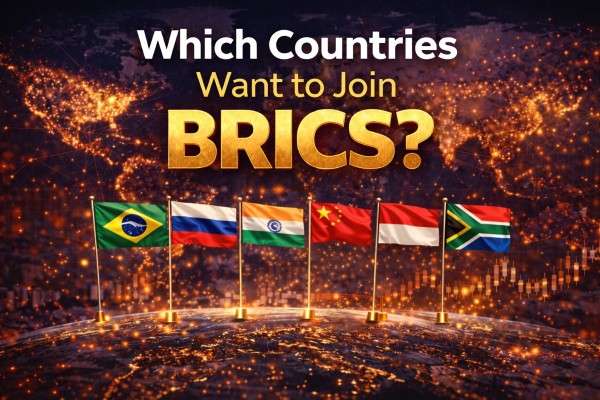
The question of which countries want to join BRICS has shifted from diplomatic curiosity to a measurable market narrative. Membership and partner status now influence trade routing, development finance access, and currency settlement choices across large parts of the Global South.
As India chairs BRICS in 2026, the bloc's next phase will be judged less by communiqués and more by whether its expanding architecture can convert interest into scalable cooperation.
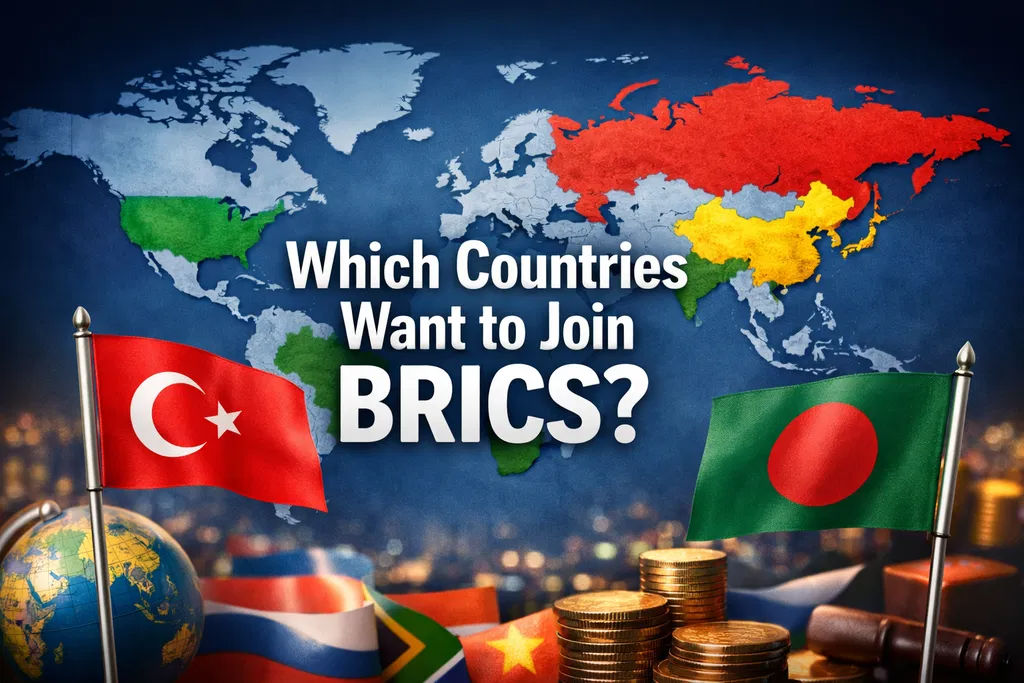
BRICS now comprises 11 major emerging economies that represent roughly 49.5 percent of the global population, around 40 percent of global GDP, and about 26 percent of international trade.
Expansion has also created a formal "partner country" track that serves as an on-ramp for states seeking alignment without the full political exposure of membership. This is why the candidate pipeline looks wider than the official member count.
BRICS has 11 full members in 2026, following the 2024 intake and Indonesia's formal entry in January 2025.
The bloc has 10 official partner countries in 2026, a structure designed to absorb demand without forcing immediate full accession.
The most visible confirmed applicants include Turkey and Azerbaijan, while several others have signaled interest or pursued partner status to manage geopolitical risk.
| Category | Countries |
|---|---|
| Founding members | Brazil, Russia, India, China, South Africa |
| Expansion members | Egypt, Ethiopia, Iran, Saudi Arabia, United Arab Emirates, Indonesia |
BRICS began as Brazil, Russia, India, and China, with South Africa joining in 2010.
A significant expansion began on January 1, 2024, as Egypt, Ethiopia, Iran, Saudi Arabia, and the United Arab Emirates joined as full members.
Indonesia then officially became a full member in January 2025, formalizing an earlier approval process.
| Partner country | Region | Strategic logic for joining BRICS cooperation |
|---|---|---|
| Belarus | Europe | Trade re-routing and finance alternatives under geopolitical pressure |
| Bolivia | Latin America | Commodity development and infrastructure finance optionality |
| Cuba | Caribbean | Trade and development finance diversification |
| Kazakhstan | Central Asia | Energy and logistics positioning across Eurasia |
| Malaysia | Southeast Asia | Trade diversification and supply-chain diplomacy |
| Nigeria | Africa | Scale, regional leadership, and development finance access |
| Thailand | Southeast Asia | Trade and investment hedging across major blocs |
| Uganda | Africa | Regional connectivity and funding channels |
| Uzbekistan | Central Asia | Industrial development finance and regional integration |
| Vietnam | Southeast Asia | Participation benefits with calibrated geopolitical exposure |
BRICS partner countries are invited to participate in key meetings and can join other sessions subject to consultation and consensus.
The modality was created at the Kazan Summit in October 2024 to broaden participation without forcing immediate full membership decisions.
| Country | Public position | Core motivation | Main constraint to watch |
|---|---|---|---|
| Turkey | Applied for full membership; expects partner status | Strategic autonomy and trade diversification | NATO alignment risk management and consensus politics inside BRICS |
| Azerbaijan | Applied for membership | Energy diplomacy and regional positioning | Limited scale relative to existing members and political signaling costs |
| Bangladesh | Formally applied in 2023; continues to express interest | Development finance and trade diversification | Balancing regional politics and credit fundamentals |
| Pakistan | Seeks membership; diplomacy suggests intent | Access to alternative finance and geopolitical hedging | India-related consensus constraints and macro stabilization credibility |
| Bahrain | Reported to have filed an application | Regional hedging and finance diversification | Scale and timing, alongside regional geopolitical sensitivity |
| Senegal | Public interest reported; described as negotiations | Multipolar alignment and development finance | Policy continuity and confirmation through BRICS channels |
Demand to join BRICS is broader than the partner list because many states want either:
Full membership
Partner status
A credible signal of multipolar alignment that strengthens bargaining power with existing allies.
According to communications from BRICS, Brazil's partner country, "over 30 nations have expressed interest in participating as either members or partners."
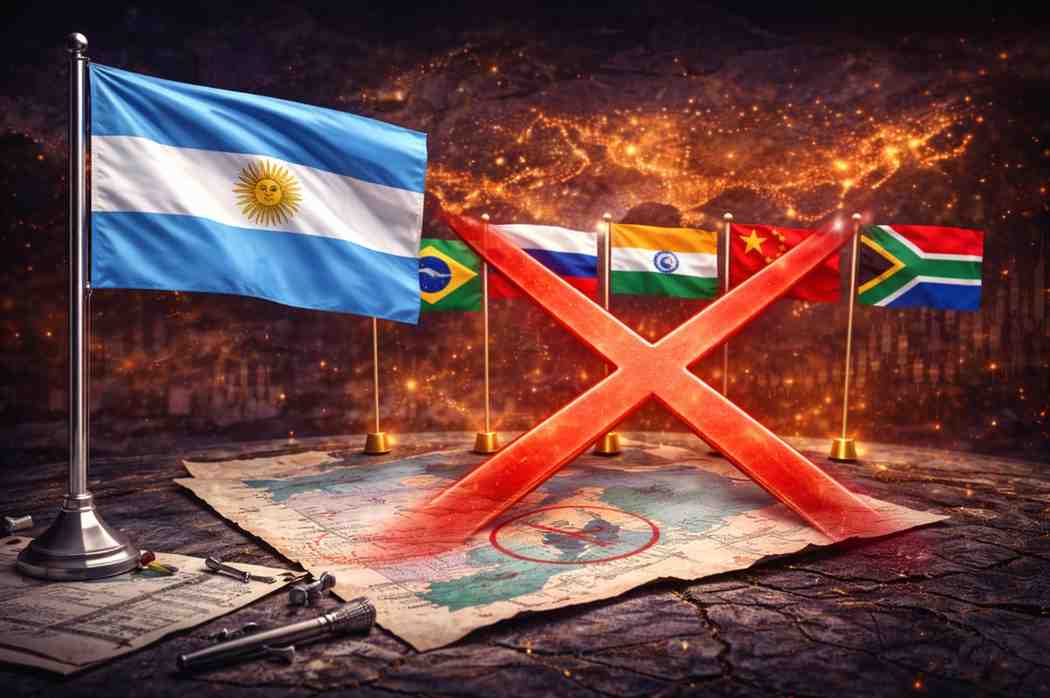
Not every candidate stays in the pipeline. Argentina was invited to join the expanded BRICS starting in 2024, but formally declined in late 2023, citing timing and policy direction.
In 2023, Algeria applied to join the New Development Bank but later announced that it had withdrawn its bid for BRICS membership.
These exits matter because they show that domestic politics and external trade dependencies can outweigh the symbolic benefit of joining.
The New Development Bank offers an alternative channel for funding infrastructure and sustainable development.
As of December 31, 2024, NDB had approved $39.0 billion across 120 projects, spanning energy, transport, water, and climate-linked infrastructure.
For frontier and lower-investment-grade borrowers, the presence of another scalable lender shifts the financing conversation, even if it does not remove macro discipline.
For many applicants, the strategic objective is not "de-dollarization" as a slogan but settlement resilience under sanctions risk, banking friction, or FX volatility.
For example, India's 2026 chairship priorities include pushing interoperability in cross-border digital payments, including CBDC-linked and platform-linked settlement concepts.
This approach enhances the significance of participating in BRICS working groups, even for partner countries.
Expansion has pulled more energy exporters and logistics hubs into the BRICS orbit. That matters for importers that want more stable supply relationships and for exporters that want broader market access and policy reciprocity.
The market effect is often indirect, manifesting in long-term contracting, corridor investment, and the settlement currency mix rather than immediate price formation.
From a market perspective, BRICS expansion matters less as a slogan and more as a set of second-order effects.
Commodity trade routing can shift when producers and importers establish long-term supply agreements.
Local-currency settlement experimentation can reduce friction for some bilateral trade, even if a single BRICS currency remains politically and technically difficult.
Index and portfolio flows can react when a country's BRICS alignment raises sanctions risk, alters diplomatic relationships, or changes the expected policy mix.
The most significant 2026 swing factor is process clarity, because investors will treat any new admissions or a more straightforward accession pathway as a signal that BRICS is becoming more institutional and less ad hoc.
BRICS enlargement increases representativeness but also raises coordination costs. The bloc contains democratic and authoritarian systems, commodity exporters and importers, and states with competing regional ambitions.
The differences among various entities slow down the process of institutionalization and help to explain the existence of the partner model. External pressure also matters, including tariff threats tied to perceptions of BRICS acting against US policy preferences.
BRICS has 11 full members in 2026: Brazil, Russia, India, China, South Africa, Egypt, Ethiopia, Iran, Saudi Arabia, the United Arab Emirates, and Indonesia.
A partner country in BRICS is invited to join the BRICS cooperation, allowing it to participate in key meetings and discussions through consultations and agreements among members.
A partner country is a formal category established in 2024 that permits invited states to participate in key BRICS meetings and selected sessions, contingent on consensus, without attaining full membership. It functions as an official on-ramp to deeper participation.
There is no single BRICS currency in operation. The more actionable direction has been to expand local-currency trade settlement, develop payment interoperability, and increase the role of institutions such as the New Development Bank to reduce reliance on a single channel for financing.
In conclusion, BRICS expansion has created a two-tier reality in 2026: a core of 11 full members and a widening partner ecosystem that absorbs demand from countries seeking diversification in trade, finance, and diplomatic alignment.
The countries that want to join BRICS are not pursuing a single ideology. They are pursuing optionality.
For markets, the signal is clearest where participation translates into infrastructure finance, trade settlement experiments, and corridor investment that reshapes long-cycle flows rather than day-to-day pricing.
Disclaimer: This material is for general information purposes only and is not intended as (and should not be considered to be) financial, investment or other advice on which reliance should be placed. No opinion given in the material constitutes a recommendation by EBC or the author that any particular investment, security, transaction or investment strategy is suitable for any specific person.