Published on: 2026-07-27
Updated on: 2026-07-27
Chegg has lost about $14.6 billion in market value, yet the company returned to GAAP profit and positive free cash flow in Q1 2026. Academic Services revenue fell 57%. Skilling replaced only 2.4% of the revenue lost by Academic Services, while a fresh NYSE warning returned the sub-$1 share price to scrutiny.
The evidence points to a smaller, cash-conscious company that has yet to build a credible replacement for the business generative AI broke.
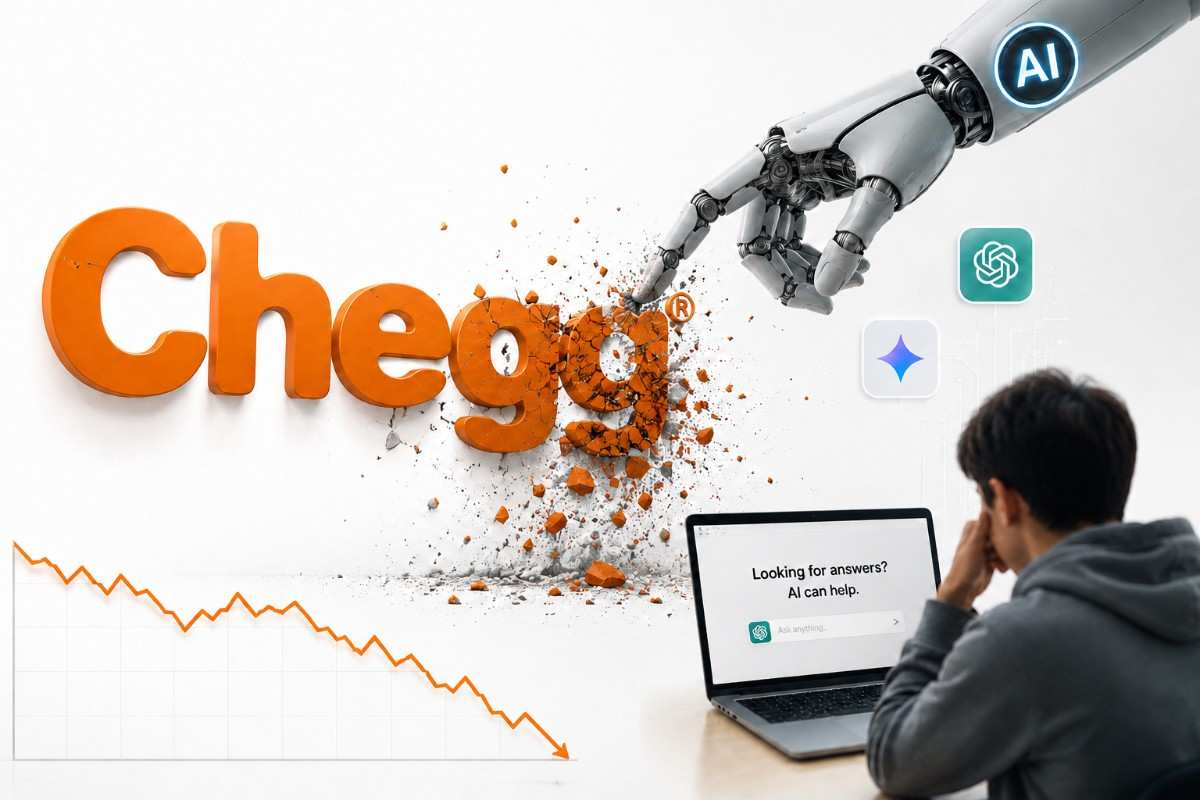
Q1 revenue fell 48% while operating expenses dropped 60%, allowing Chegg to report a profit after shrinking costs faster than sales.
Academic Services lost $59.6 million of year-over-year revenue while Skilling added only $1.4 million.
Chegg has enough liquidity to repay its remaining debt, although a 69% reduction in research and development spending raises questions about the resources available to build Skilling.
The August 6 report is the next decisive test. Q2 guidance leaves little room for Skilling to offset another sharp decline in Academic Services.
Chegg’s revenue peaked at $776.3 million in 2021, more than a year before ChatGPT launched publicly. Lower enrolment and post-pandemic normalisation were already weakening demand before generative AI became a mainstream alternative to paid academic support.
Chegg stock closed at $0.96 on July 24, 2026, down approximately 99.15% from its record close of $113.51 on February 12, 2021. The decline began before the technology changed, although generative AI removed much of the value from charging for searchable homework answers and weakened the Google traffic that had supplied new subscribers.

Chegg turned Google traffic into paid subscriptions by placing complete homework solutions behind a paywall. Free generative AI weakened that model by offering immediate, personalised explanations without another monthly fee.
Google AI Overviews then reduced the number of people reaching Chegg. The company reported that global non-subscriber traffic declines widened from 8% in Q2 2024 to 49% in January 2025, sharply reducing the pool of potential subscribers.
Chegg’s answer library once created scarcity. Generative AI made similar help widely available, while Google retained control over online discovery. Chegg lost the exclusivity of the answer and much of the distribution advantage that supported its subscription model.
The collapse in Chegg’s academic subscription business continued into Q1, while aggressive restructuring returned the company to profit. Revenue fell 48%, and GAAP operating expenses dropped 60%.
Chegg reported $0.2 million of GAAP net income and $15.5 million of adjusted EBITDA. The company can operate profitably at a smaller scale, although Q1 provided no evidence of stabilising demand. Chegg’s own Q2 outlook still implies a return to GAAP losses.
Cost reductions can preserve cash, while only a new revenue engine can stop Chegg from shrinking. Q1 results show that Skilling remains far too small.
| Q1 revenue | 2025 | 2026 | Change |
|---|---|---|---|
| Academic Services | $105.25M | $45.68M | -57% |
| Skilling | $16.14M | $17.58M | +9% |
| Total | $121.39M | $63.26M | -48% |
Source: Chegg Q1 2026 results and Form 10-Q.
Academic Services lost $59.57 million of year-over-year revenue while Skilling added $1.44 million. Skilling replaced only 2.4% of the revenue lost by Academic Services.
Skilling revenue also fell 7% across 2025 before growing 11% in Q4 and 9% in Q1 2026. Q2 guidance of $17.5 million to $18 million implies almost no sequential growth from the first quarter.
Chegg reports Skilling and Academic Services revenue separately but operates as one reporting segment. The company does not disclose whether Skilling is profitable or generating free cash flow on its own.
Chegg ended March with $67.9 million in cash and investments and $34.1 million of net cash. That liquidity should cover the remaining convertible debt scheduled for repayment by September 2026 without an immediate capital raise.
The financial runway came with severe cuts. Chegg eliminated about 640 roles through two 2025 restructuring plans, equal to 56% of its workforce at the time. Q1 research and development spending then fell 69% from a year earlier.
Chegg has enough liquidity to meet its remaining debt obligations. The harder challenge is preventing Academic Services from collapsing before Skilling reaches sufficient scale.
Chegg is not being delisted immediately. The NYSE issued another compliance notice on July 24, 2026 after Chegg’s average closing price remained below $1 for 30 consecutive trading days, giving the company six months to correct the breach.
Chegg must finish a calendar month with both its closing price and 30-trading-day average at or above $1. Failure to regain compliance within the cure period would expose the stock to suspension and delisting procedures.
A reverse stock split could raise the quoted share price without increasing Chegg’s market value or improving revenue. Chegg regained compliance at the end of May, only to fall below the standard again less than two months later.
Not imminently. Chegg has net cash, manageable remaining debt and positive Q1 free cash flow. The more probable near-term risk is prolonged contraction, leaving Chegg operational at a smaller scale while the equity loses further value.
For one quarter, yes. Chegg reported $0.2 million of GAAP net income in Q1 2026, its first quarterly profit in two years. Full-year profitability remains unproven, and Q2 guidance implies a GAAP net loss despite positive adjusted EBITDA.
No. Chegg’s revenue had already peaked in 2021 as enrolment weakened and pandemic-era demand normalised. Generative AI accelerated the decline by making academic assistance cheaper and easier to access while reducing the value of Chegg’s search-driven subscription model.
Yes. Net cash and positive quarterly free cash flow reduce the immediate insolvency risk, but they do not guarantee lasting equity value. Continued Academic Services losses, stagnant Skilling revenue or future dilution could push the stock closer to zero while Chegg remains in operation.
Chegg expects Q2 revenue of $49 million to $50 million, Skilling revenue of $17.5 million to $18 million and adjusted EBITDA of $5 million to $6 million. At the midpoint, Skilling would remain almost unchanged from Q1 while total revenue would fall about 22%, implying another steep contraction in Academic Services. Chegg will release the results on August 6, 2026.
A credible recovery requires Skilling to accelerate, the decline in Academic Services to moderate and free cash flow to remain positive without deeper cuts. Another cost-led earnings beat would confirm survival, not reinvention.
If Skilling remains near its current scale or cash burn returns, Chegg will be preserving a shrinking business rather than building its replacement. Its future must grow faster than its past disappears.



World's Best Broker