Published on: 2025-12-02
Updated on: 2025-12-02
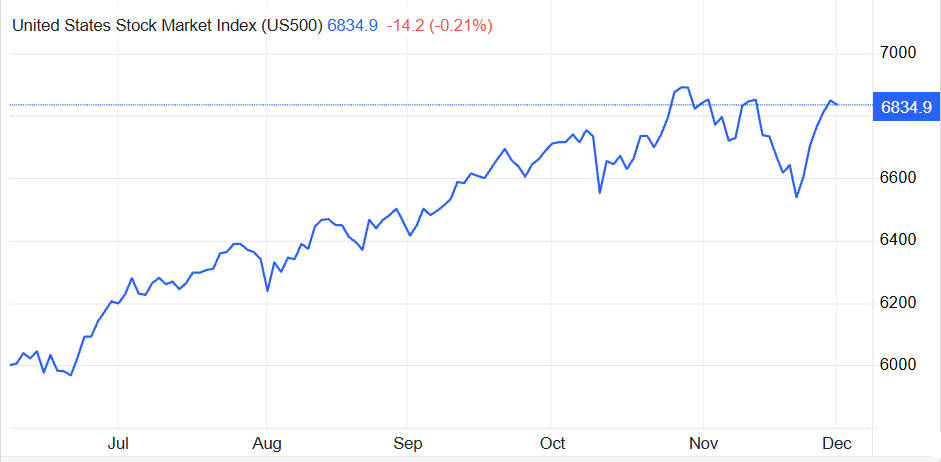
The surge in technology and artificial intelligence (AI) stocks has propelled the U.S. stock market to fresh highs in 2025. Companies widely viewed as beneficiaries of the AI wave have delivered outsized gains.
However, recent volatility and growing concerns over valuations are raising serious questions. The so-called U.S. stock‑market AI boom may not be as sustainable as many believe.
This article reviews the underlying drivers of the rally, examines warning signs, evaluates which companies might survive a pullback and outlines strategies investors can adopt if a correction arrives.
The current AI-driven rally rests on several powerful forces. First, investors expect AI technology, including generative AI, cloud infrastructure, chips and enterprise AI deployments, to transform entire industries, from software to hardware, data centre operations and consumer services. This hope creates demand for so-called high-flying AI stocks.
Second, major players are committing massive capital expenditures into AI infrastructure. For example, firms such as those supplying GPUs, semiconductors and AI data‑centres have enjoyed enormous inflows as markets anticipate sustained enterprise investment.
Third, general investor enthusiasm, media hype and fear of missing out (FOMO) amplify the effect: many buyers are piling into AI‑related equities solely on the expectation of future growth, rather than current profitability.
These drivers together underpin a powerful rally. Companies with direct AI exposure, including chipmakers, cloud providers and enterprise‑AI firms, have seen valuations surge far beyond historical norms.
History offers useful parallels. During the dot‑com bubble of the late 1990s and early 2000s, many firms with little or no earnings soared purely on promise. Similarly, early 2025 witnessed extremely high valuations for many AI‑linked companies.
In recent months a sharper reckoning has begun. A study reported that roughly 95% of organisations implementing generative AI saw zero return on investment so far. That mismatch between lofty expectations and actual outcomes is reminiscent of prior bubbles.
Indeed, as markets begin to demand concrete results rather than visionary promises, the patchy history of AI monetisation suggests caution. The current AI stock frenzy might end up looking in hindsight much like earlier tech rallies — spectacular until the point of collapse.
There are growing signs that the AI rally may be less sustainable than assumed. Key risks include:
Overvaluation:
Many so‑called AI stocks trade at extremely high price‑to‑earnings (P/E) ratios or even forward P/E estimates that assume uninterrupted growth. For instance, some firms see forward P/E metrics that defy historical averages.
Profitability uncertainty:
Despite billions in enterprise and infrastructure spending, real-world returns from AI deployments remain elusive for many. Recent research highlights that a majority of AI‑investing organisations have yet to see meaningful profit gains.
Macroeconomic headwinds:
With interest rates still elevated and economic growth showing signs of slowing, the discount rates applied to future earnings become less favourable. This environment reduces the appeal of growth stocks that rely on long-term payoff.
High concentration risk:
A small number of "AI‑bellwether" firms dominate market valuations. If any of them stumble, the ripple effect could be huge.
These vulnerabilities make a sharp correction increasingly plausible, as recent market gyrations have demonstrated.

Not all AI‑linked companies are equally vulnerable. Some may weather a downturn or even thrive despite broader market turbulence. Key characteristics of potentially resilient firms:
Strong fundamentals and cash flow:
Companies that already generate consistent revenue and profit, rather than relying on future expectation, are better positioned.
Scalable and realistic AI business models:
Firms offering enterprise‑grade AI products and services, with clear monetisation paths via subscriptions, licensing or infrastructure, rather than speculative "vision plays."
Diversified revenue streams:
Firms that combine AI operations with other stable businesses, reducing dependency solely on AI hype.
Moderate valuations relative to growth prospects:
Companies with realistic valuation multiples and demonstrable growth potential, rather than inflated multiples based on optimistic forecasts.
These companies may be better suited for long‑term investing, even if the broader AI euphoria subsides.
Given the elevated risk, investors should adopt cautious and diversified strategies. Consider the following:
| Strategy | Purpose |
|---|---|
| Diversification across sectors | Reduces single‑sector concentration risk if AI falls |
| Balanced portfolio weighting | Avoid overexposure to high‑volatility AI stocks |
| Focus on fundamentals and cash flow | Prioritises companies with real earnings |
| Use of stop-loss and risk controls | Helps limit downside in volatile markets |
| Long‑term perspective with selective entries | Allows recovery beyond short‑term sell‑offs |
Adopting such a disciplined investment approach helps mitigate downside while leaving room to benefit from more resilient AI‑related firms.
The boom is fueled by rapid AI adoption, high investor enthusiasm, media attention, and strong corporate investments in AI technology. Many high-flying AI stocks have surged due to expected future growth and innovation.
Indicators include overvaluation, declining fundamentals, high volatility, and sudden macroeconomic shifts. Historical tech corrections show that sharp rallies often precede rapid downturns, signaling caution for AI-focused portfolios.
Speculative companies with weak earnings, heavy reliance on hype, or limited market share face higher risk. Investors should focus on fundamentals, sustainable revenue, and technological advantage to avoid severe losses.
Diversify across sectors, set stop-loss limits, manage position sizes, and consider both short-term and long-term strategies. Prioritize companies with strong fundamentals and scalable business models to mitigate downside risk.
Yes, resilient AI companies with solid revenue growth, strong technological moats, and sound management may outperform. Market corrections can create buying opportunities for investors who identify fundamentally strong AI stocks early.
The U.S. stock‑market AI boom reflects genuine optimism about the transformative power of AI. Yet soaring valuations, weak evidence of widespread profitability, macroeconomic headwinds and concentration risk make a harsh reversal increasingly plausible.
Smart investors will balance ambition with caution: focus on fundamentals, avoid over-commitment to speculative hype and diversify broadly. By doing so, they preserve upside while guarding against downside — whether the next AI wave soars on or stumbles.
Disclaimer: This material is for general information purposes only and is not intended as (and should not be considered to be) financial, investment or other advice on which reliance should be placed. No opinion given in the material constitutes a recommendation by EBC or the author that any particular investment, security, transaction or investment strategy is suitable for any specific person.