Published on: 2026-08-21
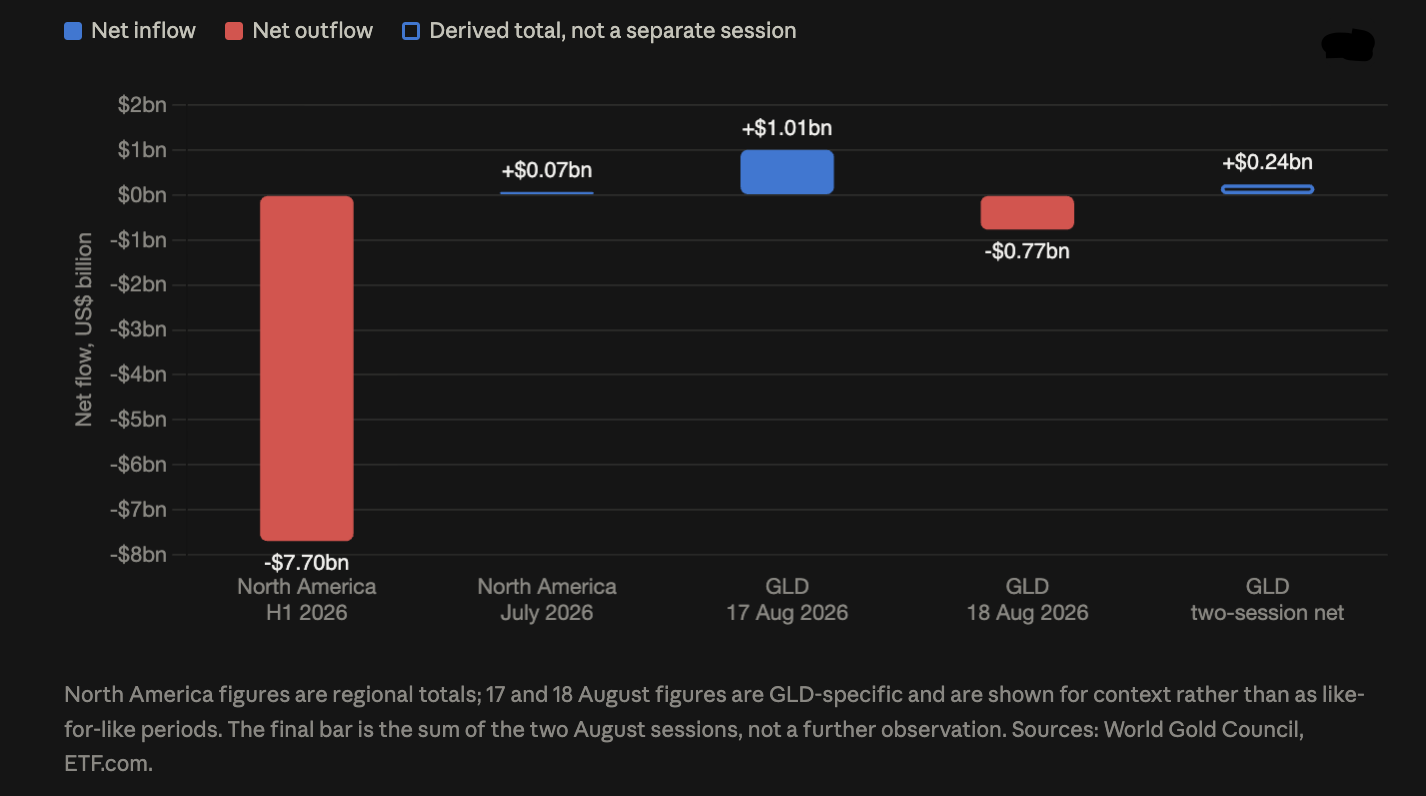
GLD recorded $1.01 billion of net creations on 17 August, roughly 0.69% of its assets and the second-largest creation among US-listed ETFs that day.
GLD then recorded $767.8 million of redemptions on 18 August, reversing roughly three-quarters of the previous session’s inflow.
North American gold ETFs lost $7.7 billion in H1 2026 and added only $71 million in July, while holdings increased by 0.3 tonnes.
A genuine turn needs repeated inflows, confirmation across other US gold ETFs and rising North American gold holdings in tonnes.
North American gold ETFs lost $7.7 billion in the first half of 2026, and July returned only $71 million while holdings increased by 0.3 tonnes. Against that, SPDR Gold Shares (GLD) took in $1.01 billion of net creations on 17 August, more than fourteen times North America’s entire July net inflow. GLD inflows then reversed, with $767.8 million of redemptions on 18 August.

The two-day swing suggests demand for US-listed gold ETFs may be improving from the broader North American weakness seen in the first half, but the evidence falls short of a confirmed allocation shift.
Not yet. GLD’s $1.01 billion inflow was significant, but the $767.8 million redemption a day later left persistence and broader gold ETF participation unconfirmed.
| Test | Evidence | Reading |
|---|---|---|
| Scale | +$1.01bn, about 0.69% of AUM | Meaningful |
| Prior trend | North America -$7.7bn in H1 2026 | Deep deficit |
| Recent trend | +$71mn / +0.3t in July | Marginal recovery |
| Persistence | GLD -$767.8mn on 18 Aug | Failed immediately |
| Breadth | Peer US gold ETF confirmation not yet established | Unclear |
| Physical holdings | Global holdings +23t in July to 4,068t | Improving globally |
| Verdict | One exceptional session, largely reversed | Not confirmed |
Is $1 billion actually large for GLD? ETF.com put the 17 August creation at $1.0069 billion against $145.47 billion of assets, a move of 0.69%. Only one US-listed ETF took in more that session, and GLD supplied roughly four-fifths of commodity ETF inflows.
Judged against fund size, GLD inflows of that scale are meaningful, not transformative. A billion dollars buys a headline, not proof that US portfolios have materially reallocated toward gold.
Daily flows become more useful when scale, persistence and confirmation are considered together, a point developed further in ETF inflows and outflows.
The first half set a low bar. North American gold ETFs shed $7.7 billion and about 60.5 tonnes over the six months, the region’s weakest first half since 2013 on World Gold Council data. June alone accounted for $5.5 billion, which the council attributed to a weaker gold price, hawkish Fed expectations, higher real yields and a stronger dollar.
July brought the first improvement. North American funds added $71 million and 0.3 tonnes, a recovery the council characterised as tentative, leaving it the only major market still carrying year-to-date outflows.
Comparing GLD’s one-day creation with a region’s monthly flow illustrates scale, but the figures are not interchangeable. Redemptions elsewhere can offset GLD creations.
Three tests separate a signal from a print.
Scale passes. A creation worth 0.69% of assets in one session is significant for a fund this size.
Persistence fails. GLD recorded $767.8 million of redemptions on 18 August, the second-largest among US-listed ETFs that day. The two sessions net out at about $239 million, far less dramatic than the billion-dollar headline and insufficient to establish broader reallocation.
Breadth is still unproven. A US gold ETF rotation should eventually appear across GLD, IAU, GLDM and other physically backed funds, or in aggregate North American statistics. Neither has been shown yet.
One structural limit applies. ETF creations do not identify the buyer or the reason behind the demand, because shares are issued through authorised participants. Calling 17 August institutional accumulation would require holder data that flow tables lack.
Gold ETF assets can rise for two reasons: money enters the funds, or the gold price rises. Holdings in tonnes rise only when the fund complex adds physical gold.
July separated the two. Global gold ETF inflows reached $3 billion, holdings climbed 23 tonnes to 4,068 tonnes, and AUM reached $530 billion. The tonnage increase confirms new metal rather than revaluation, though holdings still sit below the record 4,176 tonnes.
Watch tonnes, not just dollars. The most useful month-end question is whether North American gold ETFs hold more metal than on 31 July.
North America has been the missing source of regional ETF demand in this gold cycle. Asia attracted roughly $12 billion in the first half, its strongest on record, and Europe added about $3 billion, while North America lost $7.7 billion.
A sustained North American return would broaden the composition of gold demand rather than merely add a strong month to the global total. ETF demand remains one of the variables in EBC’s 2026 gold price outlook, alongside central-bank buying and US yields.
The rates backdrop still carries weight. Long-dated Treasury yields have stayed elevated through August, and real yields and the dollar remain the main channels through which US policy expectations reach Western ETF demand. Gold’s response depends on what is driving yields, not the level alone, as EBC sets out in how higher yields can pressure gold.
Four observable tests carry more weight than another billion-dollar headline.
Repeated GLD creations. Several positive sessions that are not immediately reversed.
Peer confirmation. Other physically backed US gold ETFs should also attract capital, not one fund absorbing the flow.
Rising North American tonnage. Regional holdings should increase in tonnes, not merely in assets under management.
Monthly confirmation. The World Gold Council’s August regional data should show sustained net inflows, not another marginal print.
Until those conditions appear together, the more defensible description is improving demand, not a confirmed rotation.
Yes. It represented about 0.69% of GLD’s assets and was the second-largest US ETF creation that day, meaningful although not transformative for a fund of GLD’s size.
Not entirely. GLD recorded $767.8 million of redemptions the next session, leaving the two days with a net inflow of roughly $239 million.
Look for positive flows that persist across multiple funds and several periods, accompanied by rising North American physical gold holdings rather than AUM rising only because gold prices rise.
GLD’s $1.01 billion creation was significant, landing after a severe first half and a marginal July recovery. The $767.8 million redemption the next session removed most of it. On the evidence available, 17 August looks like an unusually large flow within an improving but still unstable demand picture, rather than the beginning of a confirmed US allocation trend.
Three developments would change that reading: repeated creations at GLD, comparable inflows across other physically backed US gold funds, and rising North American holdings in tonnes in the council’s next regional update.
Until then, North America has not demonstrated a sustained return to gold ETFs, despite the size of GLD’s 17 August inflow.