Published on: 2026-08-20
Updated on: 2026-08-20
Going long USDTRY means holding a short position in the lira, and with the Central Bank of the Republic of Türkiye at a 37% policy rate as of July 2026, that costs roughly 33 percentage points a year in carry before the price moves at all.
On 0.01 lots, the smallest size EBC allows, overnight swap can consume the entire risk budget of a 1% stop in about three weeks.
EBC caps USDTRY at 1:50 rather than the 1:500 available on major pairs, and that one number tells you how the pair is classified.
Wide spreads punish short holding periods while carry punishes long ones, leaving a narrow band where the trade earns its cost.
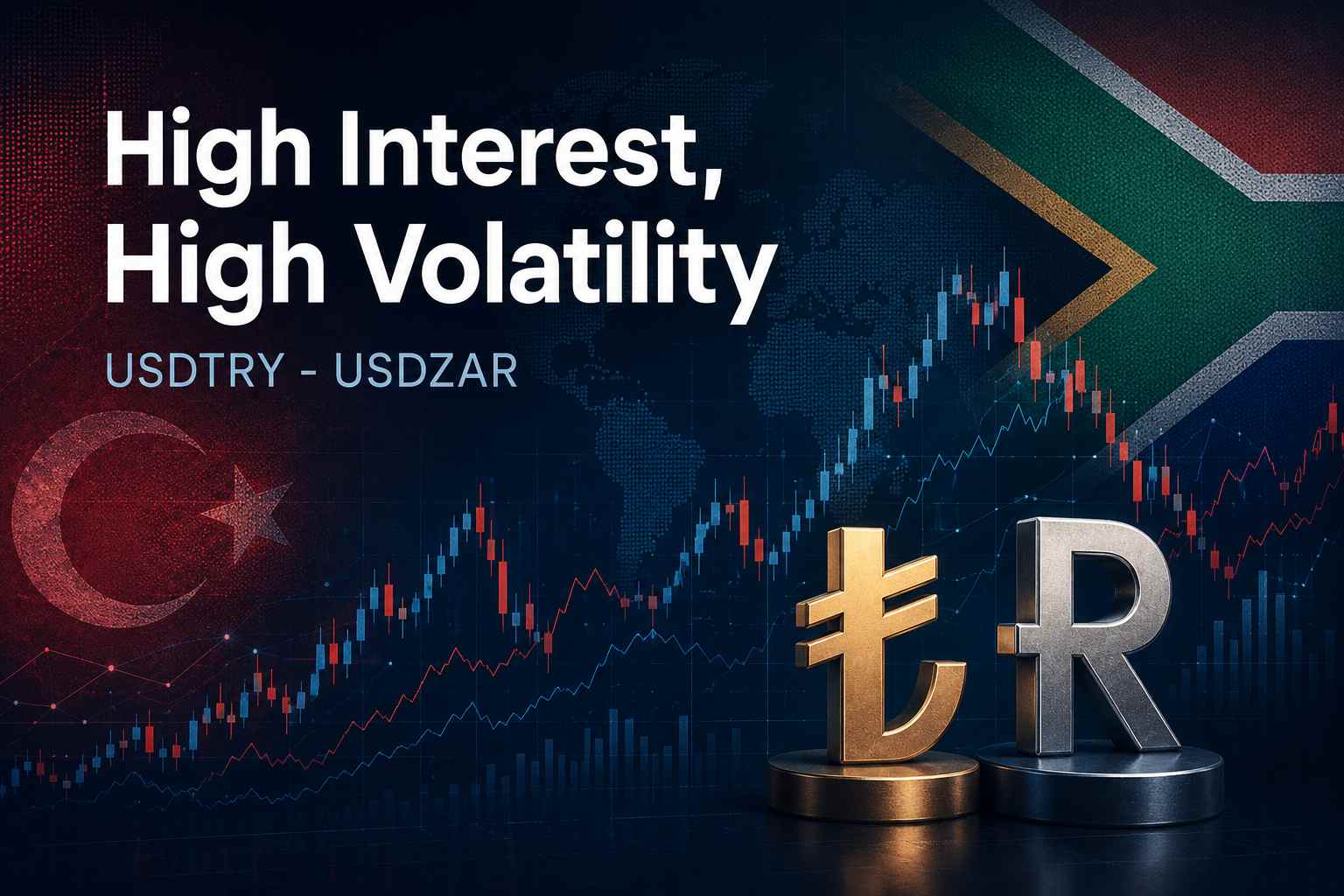
USDTRY is the US dollar priced in Turkish lira, available at EBC as a CFD in contracts of 100,000 units with maximum leverage of 1:50. Trading it starts with carry rather than direction. Türkiye’s policy rate stood at 37% in July 2026, so an overnight long position costs far more to hold than any major pair, and position size decides whether that cost is survivable.
USDTRY is an exotic pair, which in practice means thinner liquidity, wider spreads, and a very large interest rate gap between the two currencies. Each of those carries a price.
Its chart explains the appeal. The lira traded near 10 to the dollar in November 2021 and near 18 by that December. It sat around 42 at the end of 2025 and around 47.9 in August 2026. A history like that suggests an easy one-way trade. The swap line is where that idea usually dies.
Swap is the interest you pay or receive for holding a position past the daily rollover, and it comes from the gap between two countries’ interest rates. Buy USDTRY and you are effectively borrowing lira in order to hold dollars. The lira side is expensive.
Türkiye’s central bank held its one-week repo rate at 37% in July 2026, against a US policy rate in the low single digits. Annual inflation ran at 31.75% in July 2026 according to TÜİK, the national statistics institute, which is the backdrop to a rate at that level.
The differential works out near 33 percentage points, and you pay it nightly on the full contract value rather than on your margin.
For traders who want the live number rather than the arithmetic, USDTRY is listed among the 37 currency pairs on EBC’s forex instrument list, where every instrument carries its own contract specification.
Brokers don’t quote the raw differential. Swap is built from the tom-next forward market with a markup applied, so the charge that lands on your account is somewhat worse than the policy gap implies.
Short positions can receive carry instead, which is why the pair draws traders who want to be paid for holding lira, and why those positions carry a different risk entirely when the lira drops.
Around 2.7% of position value per month, using the August 2026 rate differential.
| Position size | Contract value | Approx. carry per day | Approx. carry per 30 days |
|---|---|---|---|
| 0.01 lots | $1,000 | $0.90 | $27 |
| 0.10 lots | $10,000 | $9 | $270 |
| 1.00 lot | $100,000 | $90 | $2,700 |
These come from the published policy rate differential, not from EBC’s swap table. Treat them as a floor, then read the live figure on your platform.
Set against what the lira actually did, the arithmetic gets uncomfortable. USDTRY rose from about 42 at the end of 2025 to about 47.9 by August 2026, roughly 14% over about seven and a half months, or something near 22% annualized. Carry over that same stretch ran higher.
A trader who bought the obvious direction and waited would have paid more in swap than the move returned.
Exotic spreads run wider than major spreads, and this pair is no exception. EBC quotes USDTRY to five decimal places, and the live spread belongs on the platform rather than in an article, since it moves with liquidity and widens around Turkish data releases and rate decisions.
What results is a squeeze from both ends. Wide spreads make frequent entries costly, so scalping the pair is a poor fit. Heavy carry makes long holds costly, so position trading is a poor fit too. What survives is a middle band measured in days, and that band is where nearly all sensible USDTRY trades live.
Since entry cost and holding cost are set separately, traders weighing that squeeze can compare how EBC’s two account types price spread against commission before deciding which one suits a pair like this.
Size from your stop, never from available margin. Leverage of 1:50 will happily open a position your account cannot absorb.
A worked example at a price near 47.90 in August 2026:
Account balance $2,000, risk per trade 1%, so $20.
Entry at 47.90, stop at 47.40. That’s half a lira, close to a 1% adverse move.
On one standard lot, that stop is 50,000 lira, which converts to about $1,055.
$20 divided by $1,055 gives about 0.019 lots, so the position rounds down to 0.01 lots.
A $2,000 account trading this pair on a sane stop can afford the minimum position size and nothing more. That is the honest answer, and it deserves a moment before anyone reaches for a higher risk percentage.
Then add the carry. At 0.01 lots you’re paying roughly $0.90 a night, so the full $20 risk budget disappears into swap in about 22 days without the price ever moving against you.
The swap number that matters is the one on your own account. A demo runs on live prices at no cost, so the cheapest way to learn what this pair charges overnight is to open its specification in EBC's MT5 demo account and watch it for a week.
Every MT5 installation shows current swap on the instrument itself. Right-click USDTRY in Market Watch, choose Specification, and read the Swap Long and Swap Short values. They move, and they differ sharply by direction.
Two further lines in that window matter here. Margin requirement shows what 1:50 actually ties up. Trading hours show when your stop is sitting unprotected.
Lira repricings have historically arrived as steps rather than slopes. Stops rest during the daily break and across the weekend, and a gap through your level fills at the next available price, not the one you set.
| Specification | USDTRY at EBC |
|---|---|
| Contract size | 100,000 |
| Minimum / maximum lot | 0.01 / 40 lots |
| Maximum leverage | 1:50 |
| Quote precision | 5 decimal places |
| Trading hours (UTC+3) | Monday 00:03 to Friday 23:55 |
| Daily break (UTC+3) | 23:59 to 00:03 |
| Friday restriction | Closing positions only during the final two hours |
That Friday rule catches people out. New positions aren’t accepted in the last two hours before the weekly close, so anything you intend to hold over a weekend needs to be open well before the window shuts.
Yes. EBC lists USDTRY as a CFD, so you take exposure to the price without holding either currency. The contract runs to 100,000 units with a minimum trade size of 0.01 lots, and long and short positions come from the same account. The pair sits among the 37 currency pairs on EBC’s forex product page.
Because Türkiye’s policy rate stood at 37% in July 2026 while US rates sat in the low single digits. A long position means being short the lira and paying most of that gap each night, charged against the full contract value rather than your margin.
EBC caps USDTRY at 1:50, compared with 1:500 on major pairs. The lower ceiling reflects how far this pair can travel, and using all of it on an exotic leaves very little distance between an entry and a margin call. The cap is set on the instrument, so it applies on both Standard and Professional accounts.
Both MT4 and MT5, on desktop, web and mobile under one login. MT5’s Market Watch shows the pair’s current spread, swap and margin requirement before you open anything, which is where the true cost of holding USDTRY becomes visible.
Monday 00:03 to Friday 23:55 UTC+3, with a daily break from 23:59 to 00:03. In the final two hours before the Friday close, EBC restricts accounts to closing positions only, and no new positions are accepted.
For most traders, no. Wide spreads, heavy carry, and step-change moves mean small sizing errors get expensive fast. Traders generally get more from USDTRY once they have handled volatility on one of the majors EBC carries, which cost far less to hold overnight.
This pair rewards a short, specific view and bills you for a long, general one. If you expect a reaction to a particular inflation print or rate decision, USDTRY gives you a clean instrument to express it and a few days of carry is tolerable. If your thesis is that the lira weakens over years, swap will invoice you for the wait at close to whatever the depreciation pays.
Open the specification before the trade, size from the stop, and count the overnight charge as part of your entry cost.
The live minimum to trade USDTRY at EBC is $50. EBC Financial Group (UK) Limited is authorized and regulated by the Financial Conduct Authority under reference 927552, searchable on the FCA register. Open an account with EBC when the numbers make sense to you.