Published on: 2025-12-19
Updated on: 2025-12-19
DJT jumped because the company announced a $6B all-stock merger tied to fusion energy, and that instantly changed the story investors were trading.
The move was backed by clear, measurable activity in the tape. As of the latest available print (Thursday, December 18, 2025, 17:34 UTC), DJT traded at $14.09 after opening at $13.42, with an intraday high of $14.54 and low of $10.49.
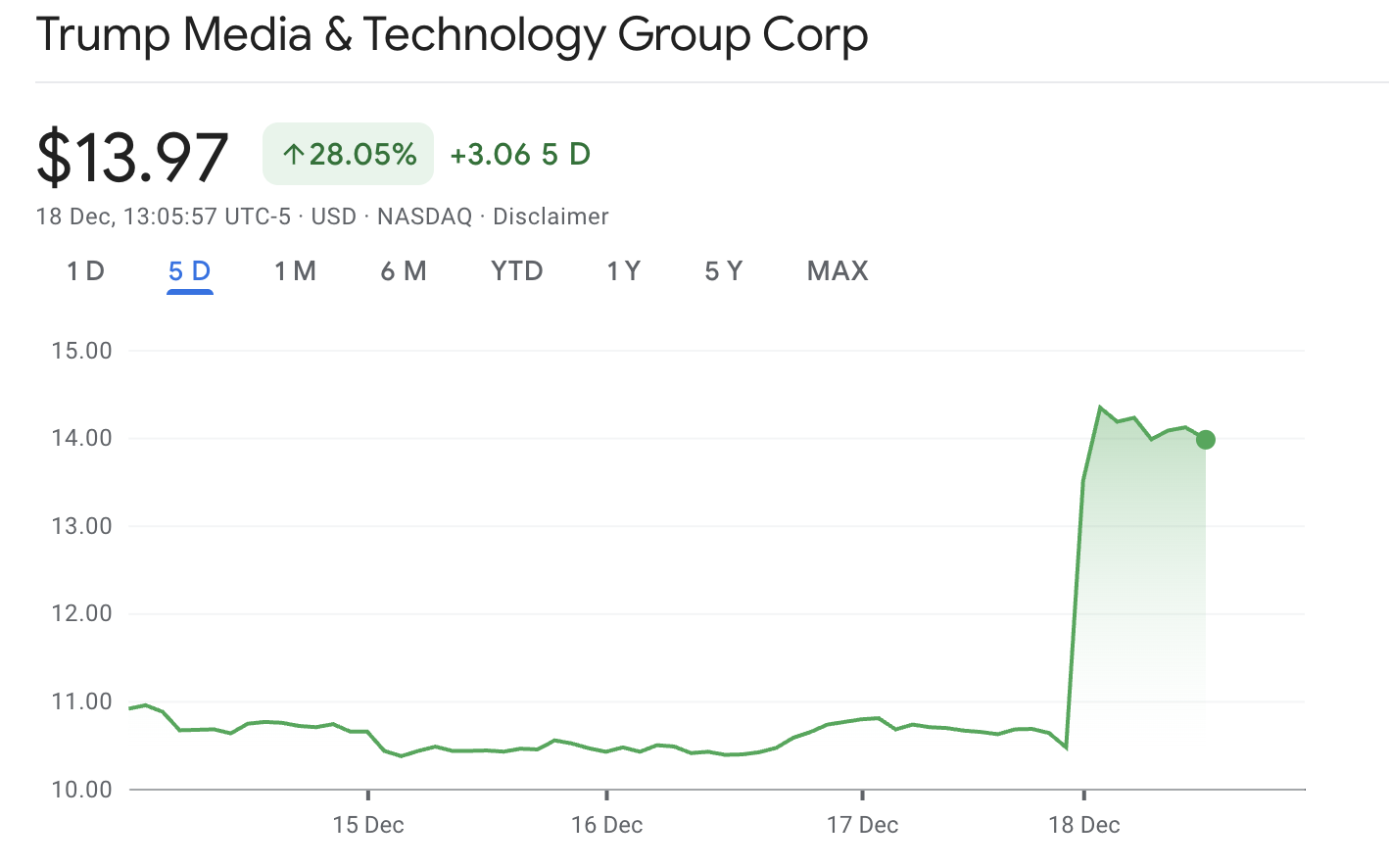
Volume was also outsized at about 67.1 million shares by that timestamp, which is the kind of footprint you see when a stock is being re-priced fast, not when it’s drifting.
DJT announced an all-stock merger valued at more than $6B with a privately held fusion-energy developer. The companies said shareholders on each side are expected to own roughly half of the combined business at closing.
The stated closing window is mid-2026, subject to the usual approvals and closing conditions. That timeline matters because the market is not pricing a finished outcome today, it’s pricing a process and a possibility.
DJT also committed up to $300 million tied to the transaction steps, including funding at signing and additional funding linked to the initial filing of the Form S-4 registration statement.
The Deal Facts That Mattered To The Market
This rally wasn’t powered by vague language. Traders reacted to a short list of hard facts that are easy to understand and easy to price.
Here are the confirmed points:
The first reason is simple: a new narrative can pull in new buyers immediately. A stock that becomes linked to a high-impact energy theme will often see an instant attention shock, even before analysts have time to run long-form models.
The second reason is deal scale. “More than $6B” is not a routine corporate update. Big numbers travel fast across screens, and they force investors to ask a different question than they were asking the day before.
The third reason is that money was attached to the process. When the market sees a stated funding commitment tied to deal steps, it reduces the “this is only talk” discount that often hangs over theme-driven announcements.
On day one, markets don’t price certainty. They price probability, positioning, and the size of the story.
DJT’s surge suggests the market is pricing in that the merger changes what DJT could represent to investors over time, and that the expected mid-2026 close creates a long runway where each milestone can become a catalyst.
At the same time, nothing about a single-session move proves that the merger will close on the timeline stated, or that long-term outcomes will match early optimism. That gap is why this kind of stock can rally hard and still stay volatile.
After the headline spike, the stock usually moves from announcement mode to process mode. The market starts trading the steps.
The three checkpoints that matter most are straightforward:
The Form S-4 filing, because it is where structure, conditions, and risk factors get fully laid out.
The approval pathway, because the stated mid-2026 closing window depends on approvals and closing conditions.
The funding steps tied to the transaction process, because the market will track whether the committed path is being executed cleanly.
This move is fundamentally news-driven, so the cleanest “levels” are the ones the market already printed on announcement day. Traders use those points because they reflect where buyers and sellers actually fought.
Immediate Resistance: $14.54
This was the day’s high. If price revisits it, traders watch closely to see if buyers still have energy or if the move gets rejected again.
Near-Term Risk Line: $10.49
This was the day’s low. If price slides back toward that area and breaks below it, many momentum traders treat it as a sign the pump is fading.
Psychological Level: $15.00
Round numbers matter because humans place orders around them. They often become noisy zones with both profit-taking and breakout attempts.
Targets are not promises. They’re checkpoints.
If DJT holds above its post-news support zone and keeps attracting volume, traders will naturally focus on retesting and potentially clearing $14.54.
If DJT clears and holds above $15.00, the conversation shifts from “one-day pump” to “new range,” which can attract a different wave of participants.
The main takeaway is simple: the news created a new price range, and the market is now deciding whether that range is temporary excitement or the start of a longer re-rating.
Timeline Risk: Mid-2026 is not tomorrow. Long timelines create gaps where sentiment can cool.
Deal Risk: Even good deals can face delays, revisions, or conditions that change market perception.
Volatility Risk: A stock that can swing from $10.49 to $14.54 in one day can do it again. If position size is too large, a normal pullback can feel like a crisis.
Attention Risk: When a move is driven by attention, attention can leave. The market can move on to the next headline quickly.
DJT surged after announcing a $6B all-stock merger tied to fusion energy. The move was amplified by heavy volume and a wide intraday trading range, which signaled rapid re-pricing. Investors reacted to the deal size, the expected mid-2026 close, and the stated funding tied to the process.
The most important confirmed details are the size and structure: a $6B all-stock merger, with an expected roughly 50/50 ownership split at closing. The stated closing window is mid-2026, subject to approvals and closing conditions, which makes this a process-driven story.
The first move is mostly headline-driven because the announcement changes narrative and positioning quickly. Over time, the market typically shifts toward process and details, including filings, approvals, and transaction execution. That’s when pricing often becomes more selective and less emotional.
DJT surged because the market received a single, high-impact catalyst: a $6B all-stock merger tied to fusion energy, with an expected mid-2026 close and a stated funding commitment linked to the transaction steps. That combination was enough to change the narrative and trigger a rapid re-pricing.
From here, the story becomes procedural. The next meaningful moves will likely be driven by filings, approvals, and transaction progress, not by the original headline repeating itself. For traders, the clean reference points remain the announcement-day high near $14.54, the low near $10.49, and the psychological $15 zone.
Disclaimer: This material is for general information purposes only and is not intended as (and should not be considered to be) financial, investment or other advice on which reliance should be placed. No opinion given in the material constitutes a recommendation by EBC or the author that any particular investment, security, transaction or investment strategy is suitable for any specific person.