Published on: 2026-03-26
Updated on: 2026-03-26
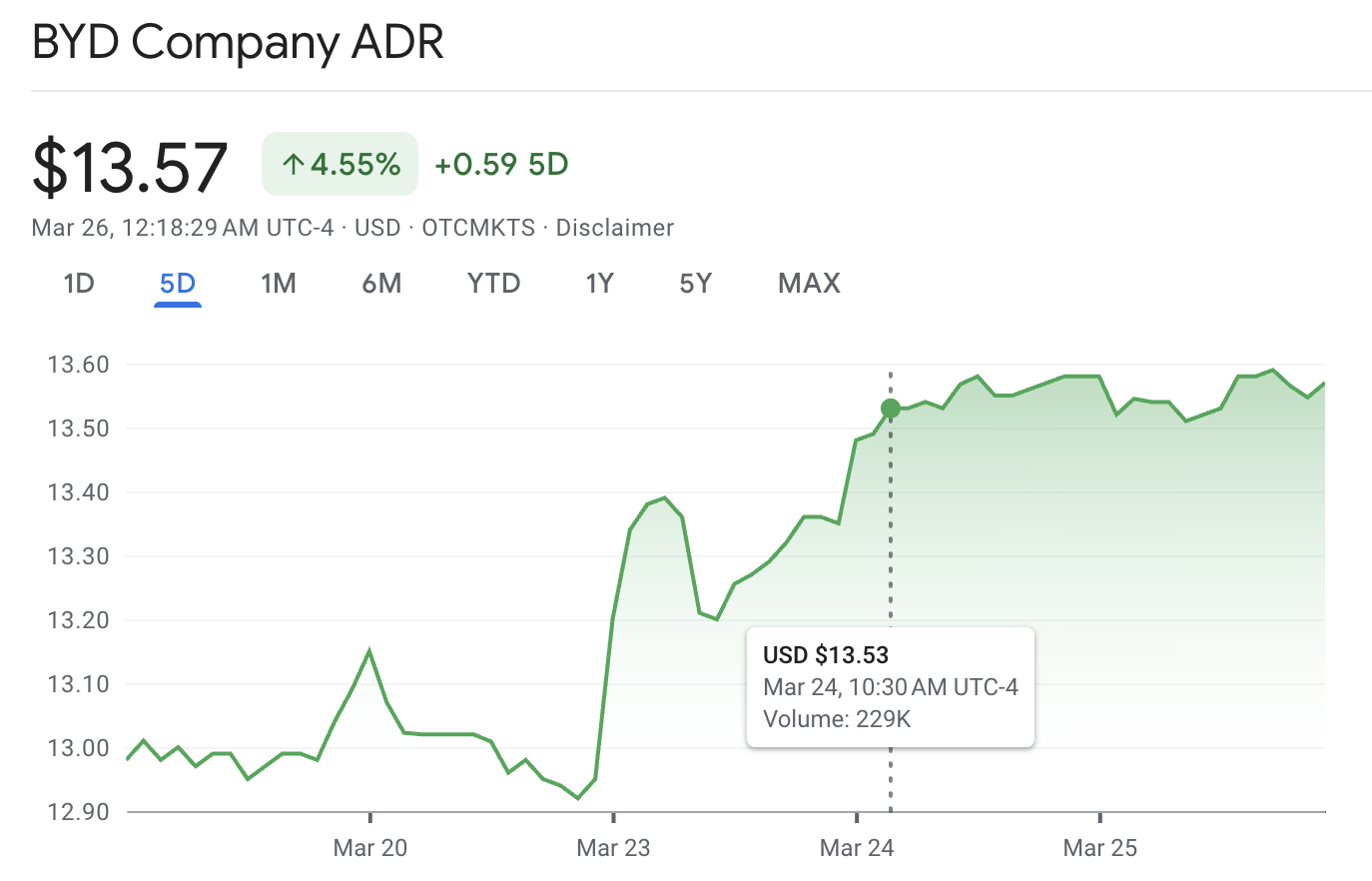
After falling sharply from its 52-week high, BYD’s American depositary receipt has staged a meaningful recovery. BYDDY closed at $13.57 on March 25, 2026, which leaves the stock about 21.2% above its $11.20 52-week low but still about 32.3% below its $20.05 52-week high.

The key question now is whether BYD can turn that rebound into a sustained breakout. The chart has improved, but the backdrop is more demanding.
China sales were weak in the first two months of 2026, even as export volumes remained above 100,000 units in both January and February.
BYDDY has recovered well from its February low, but it is not yet in overbought RSI territory on the latest daily technical readings.
The stock is trading above its key daily moving averages, while MACD and ADX continue to point to positive short-term momentum.
The next major catalyst is BYD’s board meeting on March 27, 2026, when it is scheduled to consider and approve its audited 2025 annual results.
Weak domestic sales in China remain the clearest near-term fundamental risk.
A notable shift in the chart is that BYDDY is now trading above its major daily moving averages. That matters because it suggests the trend has stabilised after the early-2026 selloff, even if the stock has not yet confirmed a full breakout.
| Indicator | Reading | Signal |
|---|---|---|
| Price | $13.57 | Pivot zone |
| RSI (14) | 65.64 | Bullish, not overbought |
| MACD (12,26) | 0.09 | Positive momentum |
| ADX (14) | 39.38 | Trend active |
| EMA 20 | $13.44 | First support |
| EMA 50 | $13.20 | Key swing support |
| EMA 200 | $12.71 | Major trend support |
| R1 | $13.59 | Near-term resistance |
| R2 | $13.61 | Immediate breakout test |
The most important long-term reference point is the 200-day EMA at $12.71. As long as BYDDY holds above that level, the broader recovery remains intact. A decisive break below it would weaken the case that the February low marked a durable base.
The MACD at 0.09 remains positive, while ADX at 39.38 suggests this is an active trend rather than a drifting range. Just as important, RSI at 65.64 is firm but not stretched, which means the stock has bullish momentum without yet flashing a classic overbought signal above 70.
The technical structure appears more robust than recent headlines imply. BYDDY is trading above all three major daily EMAs, the RSI is increasing but not excessively elevated, and the MACD remains positive.
An ADX near 39 further indicates trend strength rather than a stagnant market.
For a breakout, the first requirement is simple. Buyers need to keep the price above $13.44 and then push through the $13.59 to $13.61 resistance zone.
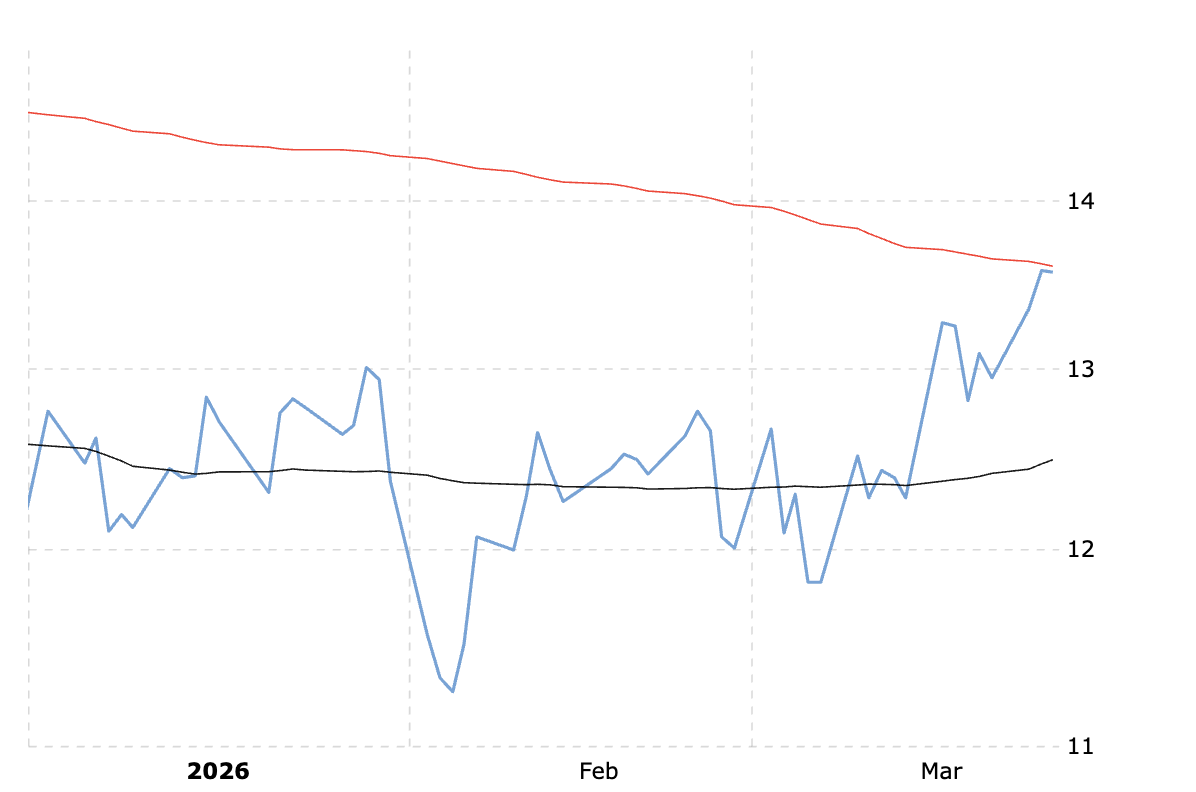
If resistance is surpassed on strong volume, the next upside target is the $14.00 region. Further gains are possible later in 2026 if earnings and guidance are favorable.
The stock remains in a base-building phase rather than showing runaway momentum.
The pullback scenario is also clear. If BYDDY falls below the 20-day EMA, focus shifts to $13.20. A drop below the 50-day EMA would weaken the near-term bullish structure, with $12.71 as the next critical support.
If the ADR breaks the 200-day EMA, the chart would shift from a constructive consolidation to a more serious retracement.
If BYDDY stays above $13.44 and clears $13.61, the chart would support a move toward $14.00 and possibly beyond as the market prices in earnings stability, export growth, and stronger technology leadership.
If the stock breaks below $13.20, momentum would likely cool quickly. A deeper drop under $12.71 would suggest a broader pullback and a reset in sentiment.
Annual results on March 27, 2026: The clearest near-term catalyst is BYD’s audited 2025 results, focusing on margins, cash flow, guidance, and management’s outlook for 2026.
Breakout above resistance: A sustained move through the $13.59 to $13.61 resistance zone would strengthen the bullish technical case and shift attention toward $14.00.
Support at key moving averages: If BYDDY stays above the 20-day EMA at $13.44 and the 50-day EMA at $13.20, the medium-term uptrend remains intact.
Export growth momentum: Stronger overseas delivery growth could offset weaker domestic sales in China and bolster the market's confidence in BYD’s global expansion story.
China demand trends: If domestic sales remain soft, the market may question how quickly BYD can convert technology leadership into stronger earnings momentum.
Margin pressure from competition: Any sign that pricing pressure in China is hurting profitability would make it harder for the stock to sustain a breakout.
A break below support: If the stock slips below $13.20, and especially below the 200-day EMA at $12.71, the pullback scenario would become more convincing.
EBC Financial Group provides a regulated brokerage environment for those seeking to participate in the EV stock market, operating under the oversight of the FCA, ASIC, FSCA, and CIMA.
EBC has received recognition for execution and platform quality, positioning it as “World’s Best Broker” for traders who prioritize a professional and regulated environment.
Yes, the technical outlook is constructive. BYDDY is trading above its 20-, 50-, and 200-day exponential moving averages, and both the RSI and MACD indicate positive momentum.
The immediate catalyst is BYD’s March 27, 2026, annual results release for fiscal 2025. That will shape expectations on margins, growth, and cash flow.
The main drag has been weaker early-2026 sales momentum in China. January sales fell to 210,051 and February sales to 190,190, both below the prior year’s levels.
Technically, the setup is improving, but the stock is approaching near-term resistance. That makes the next move around $13.59 to $13.61 especially important for judging whether the rebound can extend.
BYDDY has cleared important technical hurdles. It is trading above its major daily moving averages, the daily technical summary is Strong Buy, and the February low near the lower end of the 52-week range has so far held.
The next test is close. BYD reports annual results on March 27, and the market will want proof that export strength and earnings resilience can offset soft China demand.
For now, the chart still leans bullish, but the levels are clear: above $13.44, the breakout case stays alive. Below $12.71, the pullback case takes control.
Disclaimer: This material is for general information purposes only and is not intended as (and should not be considered to be) financial, investment or other advice on which reliance should be placed. No opinion given in the material constitutes a recommendation by EBC or the author that any particular investment, security, transaction or investment strategy is suitable for any specific person.