Published on: 2026-09-15
Updated on: 2026-09-15
The Fed has not yet delivered the expected 25bp September hike, but U.S. mortgage rates have already risen 28bp as the 10-year Treasury pushed through 5%. The 10-year reached 5.021% and the two-year 4.676% in early September 15 trading, showing that market rates have moved ahead of the FOMC decision.
A 28bp mortgage increase is not equivalent to a 25bp Fed hike, but the comparison shows how quickly higher Treasury yields have reached real borrowing costs.
| Measure | Latest | Recent move |
|---|---|---|
| Fed funds target | 3.50–3.75% | 0bp |
| 2Y Treasury | 4.676% | +31bp |
| 10Y Treasury | 5.021% | +24bp |
| 30Y mortgage | 7.17% | +28bp |
| IG corporate yield | 5.68% | +16bp |
Treasury changes compare September 4 with early September 15 trading. The mortgage change runs from September 4 to September 14, while the corporate yield change runs from September 4 to September 10, the latest comparable observation used here. The Fed has maintained its target range at 3.50%–3.75% since July.
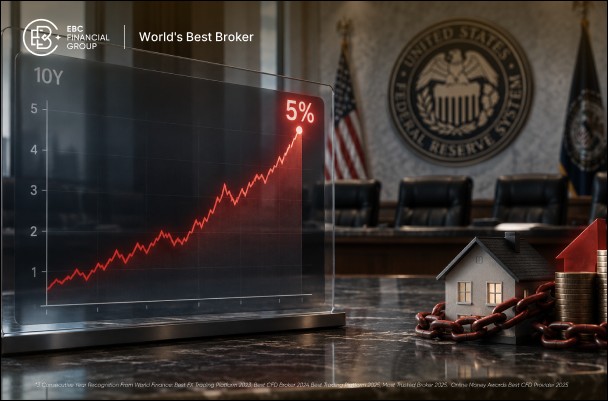
The two-year Treasury has risen about 31bp from its September 4 level of 4.37%, while the 10-year has climbed roughly 24bp from 4.78%. The federal funds target has not moved, meaning several key market rates have already repriced by roughly the size of the expected 25bp September increase.
Those moves are not equivalent to Fed hikes. The federal funds rate governs overnight money, while the two-year reflects expectations for the policy path and the 10-year also incorporates real rates, inflation compensation and compensation for holding longer-duration debt.
The useful comparison is one of magnitude and timing. Market-determined rates have moved before the Fed has changed the rate it directly controls.
Mortgage News Daily’s daily 30-year fixed rate reached 7.17% on September 14, up from 6.89% on September 4 and its highest level in the current 52-week range. Freddie Mac’s September 10 weekly survey was lower at 6.76%, reflecting different methodologies and observation schedules rather than conflicting readings.
The 28bp increase has an immediate cash-flow effect. On a $400,000 30-year mortgage, principal and interest rise from roughly $2,632 a month at 6.89% to $2,707 at 7.17%. That is about $75 more each month, or roughly $904 a year, before taxes, insurance and fees.
Mortgage rates respond mainly to longer-duration Treasury yields, mortgage-backed securities pricing and lender spreads. Housing finance can therefore tighten before the FOMC changes the overnight rate.
The ICE BofA U.S. Corporate Index effective yield rose from 5.52% on September 4 to 5.68% on September 10. Over the same period, its option-adjusted spread edged from 0.81% to 0.80%. Corporate borrowing costs therefore rose even without a deterioration in the broad credit spread.
Corporate yields combine a government-rate base with compensation for credit and liquidity risk. When the Treasury curve rises while spreads remain broadly stable, the all-in cost of issuing debt can still increase.
The effect becomes more consequential for projects requiring large amounts of long-duration capital. Data centres, semiconductor capacity, utilities and AI infrastructure depend on financing decisions whose economics change when debt costs and required returns rise together.
Equities absorb the same rate shock through valuation. The S&P 500 fell 0.5% and the Nasdaq Composite 0.6% on September 14 as the 10-year crossed 5%, although separate AI concerns also weighed on technology shares. The session cannot be reduced to Treasury yields alone.
A higher risk-free rate increases the discount rate applied to future cash flows, allowing valuations to fall even without an earnings downgrade. Businesses whose expected profits lie further in the future are generally more sensitive to that repricing.
Inflation expectations have risen, but they do not explain the entire move in long-term rates. The weekly 10-year breakeven inflation rate increased from 2.34% in the week ending September 4 to 2.38% in the week ending September 11, a 4bp rise. Over the same weekly interval, the inflation-indexed 10-year Treasury yield rose from 2.44% to 2.51%, a 7bp increase.
Both inflation compensation and real yields have therefore moved higher. The nominal 10-year also reflects expectations for future Fed policy, Treasury supply, investor demand and the term premium required to hold longer-duration securities.
The Fed can influence several of those forces, but it does not directly set the return required to own a 10-year Treasury.
That leaves the long end free to move differently from the overnight policy rate, which is why an expected 25bp Fed hike does not predetermine whether the 10-year falls, holds near 5% or rises further afterward.
Markets were pricing more than a 90% chance of a 25bp increase ahead of the September 16 decision. Such a move would lift the federal funds target range to 3.75%–4.00%. With the hike heavily priced, the 10-year’s reaction may reveal more than the policy decision itself.
| 10Y reaction | What it would suggest |
|---|---|
| Falls | Some pre-meeting tightening unwinds |
| Holds near 5% | Long-end pressures remain persistent |
| Rises further | Fed and market tightening compound |
A falling 10-year could relieve some of the pressure already transmitted into mortgage and corporate rates even as the overnight target rises. Holding near 5% would point to persistent real-rate, Treasury-supply or term-premium pressure, while a further increase would tighten long-duration financing at the same time as the Fed raises short-term rates.
The September decision sets the overnight rate. The 10-year’s response will show whether the tightening that arrived before the meeting begins to unwind or becomes more entrenched.
Yes. Mortgage rates respond more directly to longer-term Treasury yields and mortgage-backed securities than to the current federal funds rate. If long yields fall after the Fed decision, mortgage rates could ease even while the overnight target rises.
No. Treasury and mortgage rates have moved by roughly the same number of basis points as the expected 25bp hike, but they are different rates with different maturities and economic effects. The comparison measures how much market repricing has occurred before the Fed acts.
Yes. The Fed directly targets an overnight rate, while the 10-year also reflects real yields, inflation expectations, Treasury supply, investor demand and term premium. Those forces can keep long-term yields elevated after the policy rate changes.
The Fed’s September decision will settle the overnight rate. The more consequential test for mortgages, corporate finance and asset valuations comes afterward.
A sustained retreat in the 10-year would unwind part of the tightening that arrived before the meeting, while persistence near or above 5% would show that forces the Fed does not directly control are still setting the price of long-term financing.