Published on: 2026-03-16
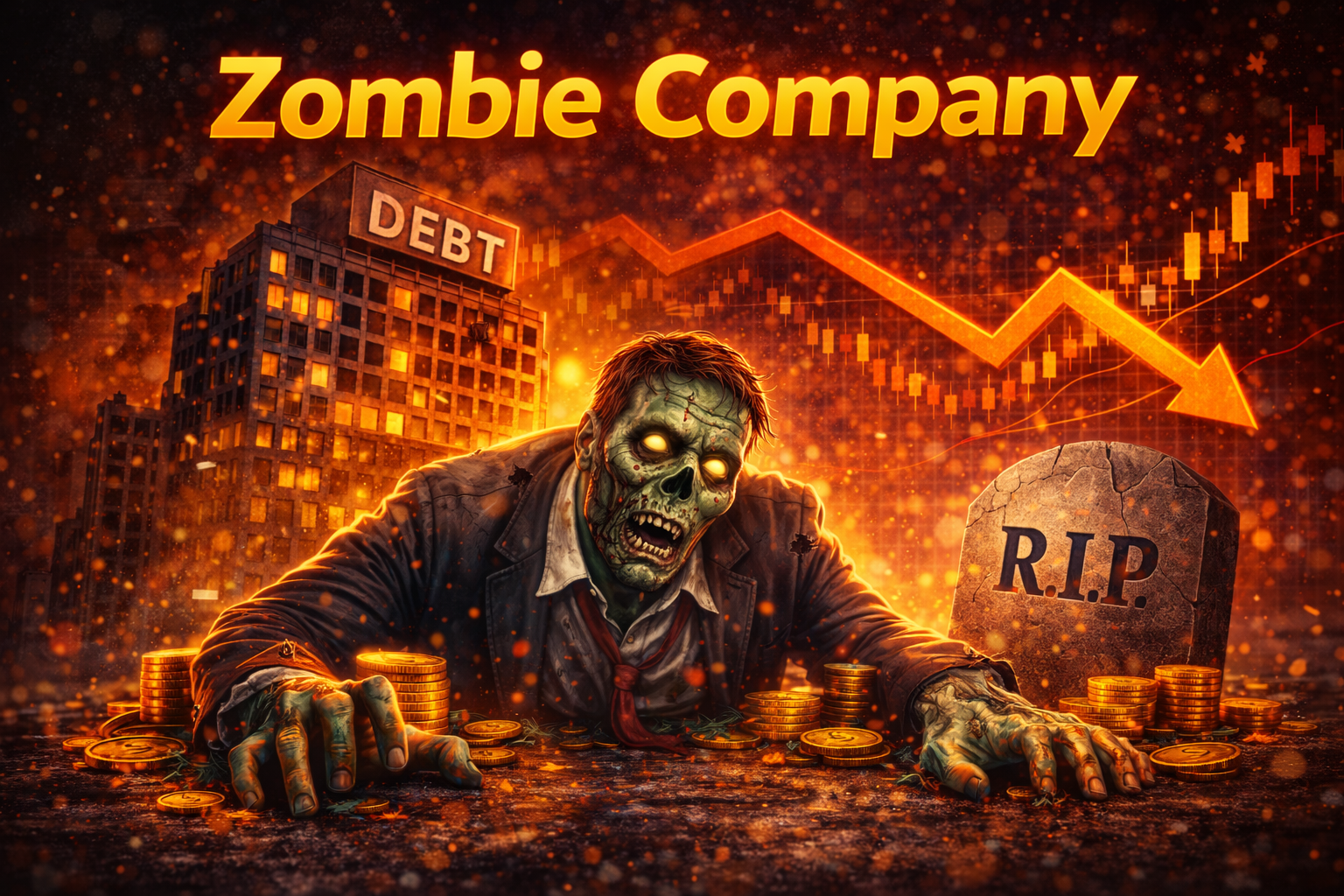
A zombie company is typically defined as a firm that cannot generate sufficient operating profit to cover its interest payments on debt, yet continues to operate by borrowing more money, refinancing existing loans, or receiving ongoing financial support from lenders.
These firms remain active in the economy even though their core operations are not financially sustainable. Rather than growing through strong earnings and productive investment, they survive largely because of continued access to cheap credit and flexible financing conditions.
Zombie companies became more visible in the global economy after major financial crises and prolonged periods of extremely low interest rates. Although these firms are not necessarily on the brink of immediate collapse, they often struggle to expand, innovate, or contribute meaningfully to economic productivity.
A zombie company is a firm that cannot generate sufficient earnings to cover its interest payments on debt but continues to operate through borrowing or refinancing.
These companies are often described as financially alive but economically weak, surviving without sustainable profitability.
Zombie firms became more prominent after the 2008 Global Financial Crisis, when interest rates remained historically low for an extended period.
They typically exhibit high debt levels, weak earnings growth, and limited investment in expansion or innovation.
Investors monitor zombie companies closely because rising interest rates or tighter credit conditions can increase default risk and trigger broader market volatility.
A zombie company is a business that consistently fails to generate sufficient operating profit to cover its interest payments on outstanding debt.
In a financially healthy company, earnings are generally sufficient to fund:
day-to-day operating expenses
interest payments on debt
reinvestment for future growth
Zombie companies, however, struggle to meet these obligations solely through operating income. Instead of reducing debt through profits, they often remain operational by continually refinancing loans or taking on new debt to service existing obligations.
Economists commonly identify zombie companies as firms whose operating earnings remain below their interest expenses for several consecutive years.
Simple Definition: A zombie company is financially alive but economically fragile.
The business continues to operate, but its survival depends more on continued access to credit than on the strength or profitability of its core operations.
The term “zombie company” derives from the popular culture metaphor of a zombie. Like fictional zombies, these businesses exist in a state somewhere between life and death. They are:
Not fully dead, because they have not declared bankruptcy or ceased operations
Not fully healthy, because their profits are insufficient to sustain their financial obligations
While zombie companies continue functioning, they often lack the financial strength required for long-term growth or resilience during economic downturns.
Healthy businesses rely on profits to meet their financial commitments. Zombie companies, by contrast, often rely on financial restructuring and favourable credit conditions to remain operational.
Zombie companies may continue operating through:
Borrowing new funds to service existing debt
Repeatedly refinancing loans
Extending repayment schedules with lenders
Taking advantage of exceptionally low interest rates
In many cases, lenders allow this cycle to continue because forcing bankruptcy could result in immediate financial losses. By refinancing loans or restructuring debt, creditors may delay recognising those losses while hoping the company eventually recovers.
The concept of zombie companies gained widespread attention after the 2008 Global Financial Crisis.
In response to the crisis, central banks implemented aggressive monetary policies to stabilise financial systems and stimulate economic recovery. Institutions such as the Federal Reserve, the European Central Bank, and other major central banks kept interest rates extremely low for extended periods.
Low borrowing costs had two important effects:
Companies could access credit more easily and refinance debt at lower rates.
Lenders were more willing to extend or restructure loans rather than force corporate bankruptcies.
While these policies supported economic recovery and financial stability, they also allowed some financially weak companies to remain operational longer than they might have under normal credit conditions.
Zombie companies can appear across many industries, but they often share several recognisable financial traits.
Economists and analysts have identified several firms across different industries that have exhibited zombie-like characteristics at various times.
Example 1: J.C. Penney
The U.S. department store chain struggled for years with declining sales and rising debt. The company relied heavily on borrowing and restructuring before ultimately filing for bankruptcy in 2020.
Example 2: Chesapeake Energy
The energy producer carried substantial debt while operating in a volatile oil-and-gas market. Despite continuing operations through borrowing and refinancing, the company eventually filed for bankruptcy in 2020 following a sharp decline in energy prices.
Example 3: WeWork
The flexible office provider expanded rapidly but faced persistent profitability challenges. Heavy financing and repeated capital injections allowed the company to continue operating despite significant financial pressures.
These examples illustrate how companies can remain operational for extended periods even when their financial foundations are weak.
Zombie companies can pose broader economic and financial risks beyond the individual firm.
When inefficient firms remain in operation, they may absorb resources, such as capital and labour, that could otherwise flow to more productive businesses. This can slow overall economic growth.
Investment capital that could support innovative or expanding firms may instead remain tied up in struggling companies that rely on ongoing financing to survive.
Zombie companies typically carry large debt burdens. If interest rates rise or credit conditions tighten, these firms may struggle to refinance their obligations, increasing the risk of corporate defaults and financial instability.
Investors monitor zombie companies because they can signal vulnerabilities in both the corporate sector and the broader economy.
When borrowing costs increase, zombie companies face higher interest expenses. This can quickly turn financial strain into insolvency risk.
If a large number of zombie companies fail simultaneously, lenders and corporate bond markets may experience significant pressure.
Corporate bankruptcies, restructurings, and debt defaults can create uncertainty across financial markets, often leading to heightened volatility in equities and credit instruments.
A zombie company is a business that cannot generate enough profit to cover interest payments on its debt but continues operating through borrowing or refinancing.
Zombie companies often exist because lenders prefer refinancing debt rather than forcing bankruptcy, especially when interest rates are low and credit is widely available.
Zombie companies exist in many global markets, particularly in industries with high leverage or during periods when borrowing costs remain unusually low.
Higher borrowing costs make refinancing more difficult. As a result, zombie companies may face financial distress, restructuring, or bankruptcy.
Investors track zombie companies because they can reveal weaknesses in corporate balance sheets and signal potential risks in credit markets.
A zombie company is a business that continues to operate despite being unable to generate enough earnings to cover its interest payments on its debt. These firms survive primarily through refinancing, borrowing, or access to cheap credit rather than through strong operational performance.
The phenomenon became more widely discussed after the 2008 Global Financial Crisis, when prolonged periods of extremely low interest rates allowed financially fragile companies to remain active longer than they might have under normal market conditions.
Although zombie companies may operate for years, they often contribute less to economic growth and can create risks if financial conditions tighten. For investors and policymakers, tracking zombie firms provides valuable insight into corporate debt trends, financial stability, and the overall health of the global economy.
Disclaimer: This material is for general information purposes only and is not intended as (and should not be considered to be) financial, investment or other advice on which reliance should be placed. No opinion given in the material constitutes a recommendation by EBC or the author that any particular investment, security, transaction or investment strategy is suitable for any specific person.