Published on: 2026-01-06
Updated on: 2026-01-07
Reliance Industries Ltd (Reliance) is having a rough session on Tuesday, January 6, 2026. The stock fell sharply after a strong run, and the selling was rapid because it activated both a news catalyst and a technical signal simultaneously.
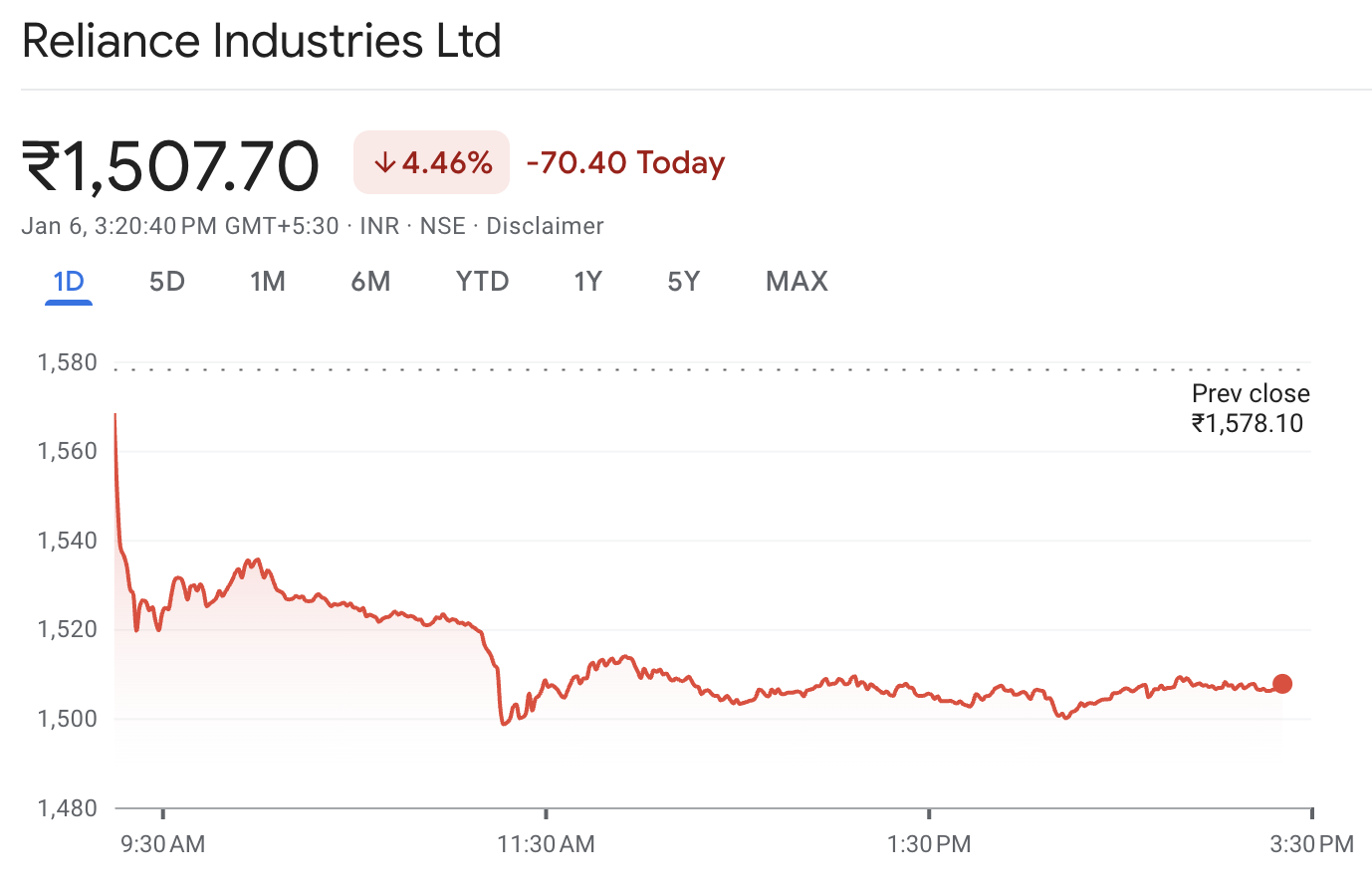
Today, Reliance traded in a wide range of ₹1,496.30 to ₹1,569.00. The stock decreased roughly 4.5% compared to the previous close, with substantial volumes, indicating that this wasn't merely a subtle decline.
Below are the main reasons the Reliance share price dropped today, along with a concise technical analysis table highlighting the current most significant levels.
| Period | Reference prices | Change |
|---|---|---|
| Today | ₹1,578.10 → ₹1,506.90 | -4.51% |
| Past week (since Dec 30 close) | ₹1,539.80 → ₹1,506.90 | -2.14% |
| Past month (since Dec 8 close) | ₹1,543.00 → ₹1,506.90 | -2.34% |
| 1-year change | ₹1,194.72 | +26.13% |
Close/last referenced in daily data: ₹1,506.90, down 4.51%
Day’s range: ₹1,496.30 to ₹1,569.00
Prior close: ₹1,578.10
Volume today: roughly 23 million shares, versus a 3-month average near 10 million, which flags unusual activity
52-week range: ₹1,114.85 to ₹1,611.80
Regardless, even after today's fall, Reliance is still up strongly over the past year, which is why profit-taking can hit harder when the mood changes.
Today's selling started with headlines tied to Reliance's crude sourcing and the wider Russia-oil trade.
For context, Reliance shares fell, and it was a major factor after the company refuted a report related to Russian oil deliveries. Reports also flagged fresh political risk, including talk of higher tariffs on India linked to ongoing Russian oil purchases.
To summarise what happened:
The company described the claim as "blatantly untrue" and stated that it has not received any Russian shipments in the last three weeks, nor does it anticipate any in January.
Why this matters for the Reliance share price:
Reliance's refining and fuels complex is one of its core cash engines.
Any headline that raises doubts about feedstock access, shipping lanes, or policy pressure can quickly hit sentiment.
The market does not wait for a complete fact check during trading hours. It reprices first, then asks questions later.
Even if the operational impact turns out to be limited, the uncertainty is enough to push short-term traders to cut risk.
Discussions about tariffs are a traditional source of volatility since they are challenging to predict. When traders hear "tariffs," they typically decrease their investment in major index leaders first.
It matters here because Reliance ties the Russia-oil issue to potential trade pressure.
While Reliance is not a simple export stock, headlines still hit it for three practical reasons:
Index weight: Reliance is widely held, so it becomes a quick sell when funds reduce India exposure.
Risk premium: Geopolitical stress pushes investors to demand a higher return for holding cyclicals.
Second-order effects: Policy pressure can ripple into energy flows, cracks, and product spreads, which influence refinery earnings.
Today's shift appears to reflect the market incorporating a higher risk premium, rather than simply responding to a single headline.
News may start a move, but charts often decide how far it goes.
For example, technical pages show Reliance trading below its 10-day, 20-day, and 50-day moving averages, which is a common trigger zone for systematic and short-term trading models.
This is important because:
Many traders use the 50-day moving average as a trend filter.
When price breaks below that level with volume, stop-loss orders and hedge adjustments can accumulate.
Once the selling starts, the next buyers often wait near defined support zones, which can leave an "air pocket" in between.
The result is exactly what we saw today: a sharp slide into the lower end of the day's range.
Reliance hit a fresh high very recently, so there was plenty of profit sitting in the trade. For context, Reliance touched a record high in the prior session before the stock reversed lower today.
When a stock is near its highs:
Bad headlines tend to bite harder because traders have profits to protect.
The "sell first" instinct is stronger.
The fall can look larger than the underlying change in long-term value.
This does not mean the story is broken. It means positioning was crowded, and today gave traders a reason to reduce exposure.
| Indicator | Reading | What it suggests right now |
|---|---|---|
| Last traded zone (today) | ~₹1,500–₹1,570 | High volatility day |
| RSI (14) | ~50.7 | Neutral momentum, not "oversold" yet |
| MACD | Positive | Medium-term trend had been supportive, but price shock dominates |
| SMA 20 | ~₹1,551.5 | Price below: short-term trend pressure |
| SMA 50 | ~₹1,534.0 | Price below: key breakdown level |
| SMA 100 | ~₹1,467.7 | Potential support area if weakness continues |
| SMA 200 | ~₹1,418.9 | Long-term trend still intact above this level |
| Pivot support (S1 / S2 / S3) | ~₹1,520.7 / ₹1,505.5 / ₹1,490.0 | Near-term downside reference points |
| Pivot resistance (R1 / R2 / R3) | ~₹1,560.7 / ₹1,590.7 / ₹1,605.9 | Levels bulls must reclaim |
| Volume vs 3M average | ~23M vs ~10M | Strong participation in the sell-off |
*This table focuses on what most traders check first: momentum, trend, and key levels.
In short, Reliance stock is not deeply oversold on RSI. However, the break below major averages increases the chance of follow-through selling unless the price stabilises quickly above the nearest resistance band.
If headlines cool down and the market accepts the company's stance, some of today's risk premium can unwind.
Reliance's next results are expected around January 16, 2026, which is close enough that many investors will not want to carry big uncertainty without fresh numbers.
A sustained move back above ₹1,560–₹1,570 would calm the chart.
If the price continues dropping, traders often look toward the ₹1,490 area first, and then the 100-day average zone near ₹1,468.
Reliance is declining today primarily due to traders responding to headlines regarding Russia's oil, increasing concerns over tariff risks in market discussions, and a noticeable technical breakdown beneath important moving averages.
Immediate support is located around ₹1,505, followed by ₹1,490. Near-term resistance is around ₹1,560, then ₹1,590.
Not clearly. The RSI value hovers close to the neutral area of 50, typically indicating that the stock hasn't reached a typical "oversold" state.
The long-term trend is still positive on a one-year view, but today's drop increases short-term risk until the stock stabilises above key resistance levels.
In conclusion, Reliance's drop today resulted from a combination of headline-driven risk and technical damage, amplified by heavy volume and swift profit-taking after a strong run.
If the news flow settles and the stock reclaims key levels, the fall can fade. If it doesn't, traders will continue to concentrate on the following support range and the impending earnings driver.
Disclaimer: This material is for general information purposes only and is not intended as (and should not be considered to be) financial, investment or other advice on which reliance should be placed. No opinion given in the material constitutes a recommendation by EBC or the author that any particular investment, security, transaction or investment strategy is suitable for any specific person.