Published on: 2025-12-03
Updated on: 2026-01-28
In an investment world often defined by turbulence and uncertainty, SHV stands out for its forthright simplicity. SHV offers investors direct exposure to ultra‑short‑term U.S. Treasury securities while delivering solid liquidity, minimal risk and consistent yield.
For those seeking a secure parking space for idle cash or a stable buffer in a broader portfolio, SHV delivers clarity and steadiness in an environment where few assets remain predictable.
SHV is an exchange‑traded fund managed by BlackRock under the iShares umbrella. The fund tracks the ICE Short US Treasury Securities Index (USD), which comprises U.S. Treasury securities with maturities of less than one year.
Here are some of the key current facts (as of November 2025):
| Metric | Value |
|---|---|
| Net assets | ≈ USD 20.0 billion (as of 27 January 2026) |
| Inception date | 05 January 2007 |
| Benchmark index | ICE Short US Treasury Securities Index (USD) |
| Number of holdings | 15 (as of 26 January 2026) |
| Weighted average maturity | 0.30 years, about 3.6 months (as of 23 January 2026) |
| Effective duration | 0.29 years (as of 23 January 2026) |
| 30-day SEC yield | 3.54% (as of 26 January 2026) |
| 12-month trailing yield | 4.08% (as of 26 January 2026) |
| Expense ratio | 0.15% |
| Listing note | Effective 23 February 2026, primary listing moves to NYSE and SHV will no longer be listed on Nasdaq |
Those metrics reflect that SHV invests almost exclusively in short‑term U.S. government securities. The brevity of maturities and the quality backing of U.S. Treasuries lend SHV its hallmark stability.

SHV delivers stability and security for several reasons.
First, its holdings are U.S. Treasuries, which typically carry lower credit risk than corporate bonds. Because the securities are short-dated (one year or less), the fund’s price is generally less sensitive to interest-rate changes than longer-maturity bonds. An effective duration of around 0.29 years suggests that price moves from rate shifts are usually smaller than in intermediate- or long-duration bond funds, but they can still happen.
Second, SHV tends to be liquid. iShares reports a 30-day average volume of about 2.63 million shares and a 30-day median bid-ask spread of 0.01% (both as of 26 January 2026).
Third, historical volatility has been low. iShares reports a 3-year standard deviation of 0.21% and a 3-year equity beta of 0.00 (as of 31 December 2025).
As a result, SHV is often used as a cash-like allocation inside a brokerage account, closer in behaviour to cash alternatives than to longer-duration bond funds. This can suit investors who prioritise liquidity and capital stability, while accepting that returns and prices can still change over time. (Related: Key Characteristics of Money Market Funds)
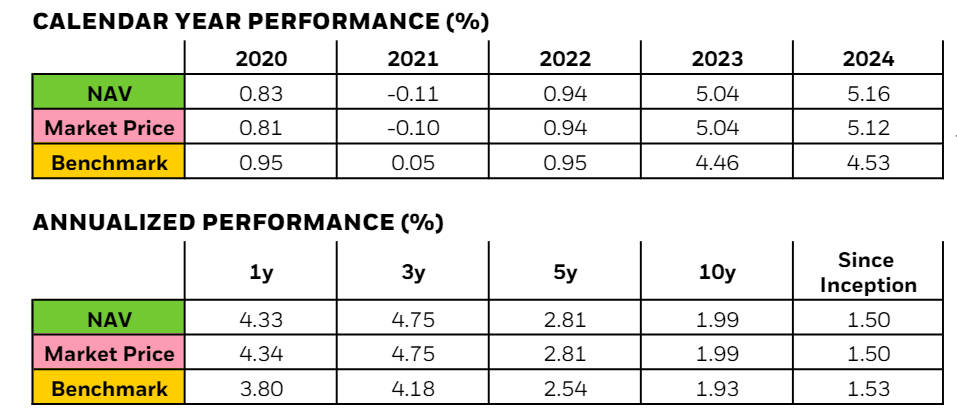
One of SHV's main appeals lies in the balance of yield and safety.
As of 26 January 2026, iShares reports a 30-day SEC yield of 3.54% and a 12-month trailing yield of 4.08%. Yields change as interest rates move and as the fund rolls its short-term Treasury holdings.
Expense ratio is 0.15% per year. Because returns come largely from interest income rather than price appreciation, costs matter.
The brevity of maturity also means duration risk is extremely limited. With an effective duration of roughly 0.30 years, SHV is far less exposed to price swings from rate changes compared with intermediate‑ or long‑term bond funds.
In short, for investors seeking a blend of yield, liquidity and safety, SHV presents a compelling "cash‑plus" alternative.
SHV is especially suited to several investor scenarios:
If you are awaiting deployment of cash into other investments but want to earn a yield meanwhile, SHV can act as a temporary cash parking spot.
In a volatile equity or bond market, SHV can serve as a stabilising component in a broader portfolio, preserving capital when other assets swing widely.
For investors with a short-term horizon such as upcoming expenses, a planned purchase, or near-term financial goals, SHV's ultra-short duration makes it a low-risk, liquid option.
For income-focused investors, SHV's monthly dividend distribution provides regular cash flow, in contrast to typical long‑term bonds or equities whose dividends may be less frequent or more variable.
Because of these characteristics, SHV often functions as a hybrid between savings accounts or money-market funds and traditional bond or equity holdings, combining yield, liquidity and lower volatility.

While SHV brings many strengths, it also carries limitations that investors must understand.
Most notably, SHV offers little capital appreciation potential. Because the holdings are short‑dated and prices remain stable, growth beyond yield is minimal. Over the long run, this limits its attractiveness for investors seeking wealth accumulation.
Moreover, yield may fail to keep pace with inflation in high-inflation environments. SHV’s yield can rise or fall with short-term rates, so investors should focus on the current yield metrics published by the fund provider and consider real (inflation-adjusted) outcomes over time.
Finally, SHV offers no exposure to corporate bonds, equities or other assets; it is purely a tool for capital preservation and liquidity. Investors seeking growth, diversification, or higher long‑term returns will likely need additional instruments.
In essence, SHV excels as a "cash‑plus" instrument and is not intended as a growth engine.
It can be instructive to compare SHV with other common alternatives for short‑term, low‑risk holdings such as cash, money‑market funds, and other bond ETFs. Here is a simplified comparison:
| Investment option | Yield (approx) | Risk and volatility | Liquidity | Best for |
|---|---|---|---|---|
| Cash / bank deposit | Often low real yield (varies by interest rate environment) | Very low (but subject to inflation) | Very high | Short-term needs, zero market risk |
| Money market fund | Modest yield (similar to short-term rates) | Low (some market risk) | High | Cash-equivalent allocations, liquidity |
| SHV ETF | 30-day SEC yield 3.54% (as of 26 January 2026); yield changes with rates | Very low, minimal duration and credit risk | High, tradable on an exchange | Cash parking, liquidity, short-term investments |
| Longer-term bond ETFs | Potentially higher yield or return | Higher interest rate risk, more volatility | Moderate to high | Income yield, diversification, long-term investing |
Compared with cash or money market funds, SHV often offers better yield while maintaining similar liquidity and risk profile. Compared with longer‑term bond ETFs, SHV sacrifices yield and return potential in exchange for safety and stability.
This positioning makes SHV a useful tool for investors seeking a "cash-plus" solution: something safer than bonds but more productive than cash at very low rates.
Investors may consider incorporating SHV in various ways depending on their broader financial goals. Some common strategies are:
Cash Reserve Allocation:
Use SHV to store idle cash from savings or proceeds from sales until you identify better investment opportunities.
Liquidity Cushion:
Maintain a portion of portfolio in SHV to cover near‑term expenses, emergency funds or planned purchases, without sacrificing yield or safety.
Defensive, Conservative Allocation:
For conservative investors, SHV can serve as a stable backbone of a portfolio, balancing more volatile holdings like equities.
Laddering or Short‑Term Bond Strategy:
Combine SHV with other short‑term bond funds to manage risk, yield, and maturity exposure, though one must be mindful of correlation with interest‑rate movements.
Because SHV trades on the open market, it can be bought and sold easily like a share of stock, giving investors flexibility to adjust holdings as needs evolve.

SHV distributes income monthly, and distribution amounts can vary from month to month. The fund provider publishes record dates, ex-dates, and payable dates.
As of 26 January 2026, iShares reports a 12-month trailing yield of 4.08%, but distributions and yields change over time. U.S. Treasuries have low default risk, but SHV is still subject to market price changes and inflation risk, so it should be treated as a cash alternative rather than a guaranteed cash product.
Reinvesting dividends can compound returns over time, though given the low volatility and short maturity, capital growth remains limited.
SHV tends to look more attractive when short-term Treasury yields are competitive versus deposit rates, and less attractive when short-term rates fall. Because the portfolio rolls frequently, SHV’s yield can adjust relatively quickly as the rate environment changes, which is why it is often used for tactical cash allocations.
This environment enhances the appeal of ultrashort Treasury ETFs like SHV as a safer alternative to holding idle cash or low-yield savings.
In periods of market volatility or economic uncertainty, SHV's low duration and solid liquidity make it a reliable shelter. For investors anticipating rate cuts or shifts in yield-curve dynamics, holding SHV provides flexibility and insulation from interest‑rate risks that plague longer‑dated bonds.
Consequently, for both individual investors and financial planners, SHV continues to offer a compelling balance of safety, liquidity and yield, especially in environments where cash yields have regained respectability.
SHV invests exclusively in U.S. Treasury securities that mature in less than one year. This gives investors exposure to the ultra‑short end of the Treasury market with minimal credit and interest‑rate risk.
SHV distributes income monthly. This regular payment schedule makes it useful as a cash‑equivalent instrument that produces a steady income stream rather than leaving cash idle.
SHV offers high liquidity, low volatility, modest but reliable yield and extremely short duration. These features make it ideal for capital preservation and as a safe cash‑parking alternative.
SHV has limited growth potential and returns typically fall behind long‑term bonds or equities. In a high‑inflation environment real returns may be muted, and yield may fluctuate with short‑term interest rates.
Use SHV when you want a liquid, low‑risk location for idle cash but aim for slightly higher yield than typical savings accounts. It is particularly useful during market volatility or while awaiting investment opportunities.
SHV is best suited for investors who prioritise capital preservation, liquidity and modest income over long‑term growth. If you need a short‑term parking spot for idle cash, wish to keep funds accessible for near‑term needs, or want a stable, low‑risk anchor in a diversified portfolio, SHV is a sensible choice.
However, for investors with long‑term growth goals, those seeking inflation-beating returns, or those seeking equity-like returns, SHV's conservative profile will likely disappoint. In such cases, more diversified bond funds, equities, or long‑term fixed income may be more appropriate.
Disclaimer: This material is for general information purposes only and is not intended as (and should not be considered to be) financial, investment or other advice on which reliance should be placed. No opinion given in the material constitutes a recommendation by EBC or the author that any particular investment, security, transaction or investment strategy is suitable for any specific person.