Placing an order does not mean that a trade will necessarily be completed immediately, in full or at the price displayed on screen. Between submission and execution, an order passes through validation, routing or quoting, matching and execution.
Partial fills, requotes and rejected orders describe different outcomes within that process. They also need to be distinguished from multiple fills and slippage, which affect execution in different ways. Understanding where each outcome occurs makes it easier to interpret what actually happened to an order.
An order is an instruction to buy or sell under specified conditions. A fill is an execution generated from that instruction.
One order can therefore produce no fills, one fill or several fills. It can also be partially executed before the remaining quantity is cancelled or left active.
A simplified order lifecycle looks like this:
Submitted → validated → routed or quoted → matched → executed → reported
Different outcomes can appear at different stages.
| Stage | Possible outcome |
|---|---|
| Validation | Rejection |
| Price confirmation | Requote |
| Matching and liquidity | Partial fill |
| Execution | Multiple fills or slippage |
| Post-trade | Filled, partially filled, cancelled or rejected status |
The exact sequence varies across brokers, venues and instruments, but the framework shows why an accepted order does not always become a completed trade.
Execution outcomes do not work identically across every market or platform.
Under market execution, an order generally proceeds at the prices available when it reaches executable liquidity. If prices change before completion, the final price may differ from the one initially displayed.
Instant execution and request execution, more commonly seen in some retail foreign exchange and CFD arrangements, may instead require the requested price to be confirmed, rejected or replaced before the trade proceeds.
Exchange execution depends on the prices and quantities available through the relevant venue or order book.
These differences explain why a similar market movement may result in slippage on one system, a requote on another or several fills on an exchange. Requotes, in particular, are not a universal feature of financial markets.
These concepts are related, but they describe different things.
| Outcome | What changed? | Was a trade completed? |
|---|---|---|
| Partial fill | Quantity | Yes, partly |
| Multiple fills | Execution was split | Yes, potentially fully |
| Slippage | Execution price | Yes |
| Requote | Price offered before execution | Not yet |
| Rejection | Order acceptance or execution | No |
A partial fill is a quantity outcome: only part of the requested amount trades.
Multiple fills describe execution fragmentation. The full order may still be completed, but through several separate transactions.
Slippage concerns price. It occurs when the execution price differs from the price expected when the order was submitted.
An order can therefore experience multiple fills and slippage without being partially filled.
A partial fill occurs when only part of an order is executed.
Suppose an investor places an order to buy 8,000 shares with a limit price of £10.02. The available sell orders are:
2,000 shares at £10.00;
3,000 shares at £10.02;
5,000 shares at £10.05.
Because a buy limit at £10.02 cannot execute above that price, only the first 5,000 shares are eligible for execution.
The result is:
5,000 shares filled and 3,000 shares unfilled.
That is a genuine partial fill.
What happens to the remaining quantity depends on the order type, time-in-force instruction, fill policy and venue rules. It may remain active, be cancelled immediately or execute later if suitable liquidity becomes available.
The defining feature is always quantity: some of the order trades, but not all of it.
Market depth explains why a large order does not necessarily execute at one price.
Suppose a 10,000-share market order encounters the following liquidity:
4,000 shares at £20.00;
3,000 shares at £20.03;
3,000 shares at £20.06.
All 10,000 shares execute, so the order is fully filled.
However, it has generated three separate fills, and the weighted average execution price is higher than the initial £20.00 offer.
For a buyer, that difference may represent adverse slippage relative to the expected price. The transaction therefore involves multiple fills and a different average execution price, but it is not a partial fill.
This is especially relevant for larger orders because the volume shown at the best bid or offer may represent only one layer of the available market depth.
Liquidity alone does not determine whether an order can be partially executed. Fill instructions can change the result.
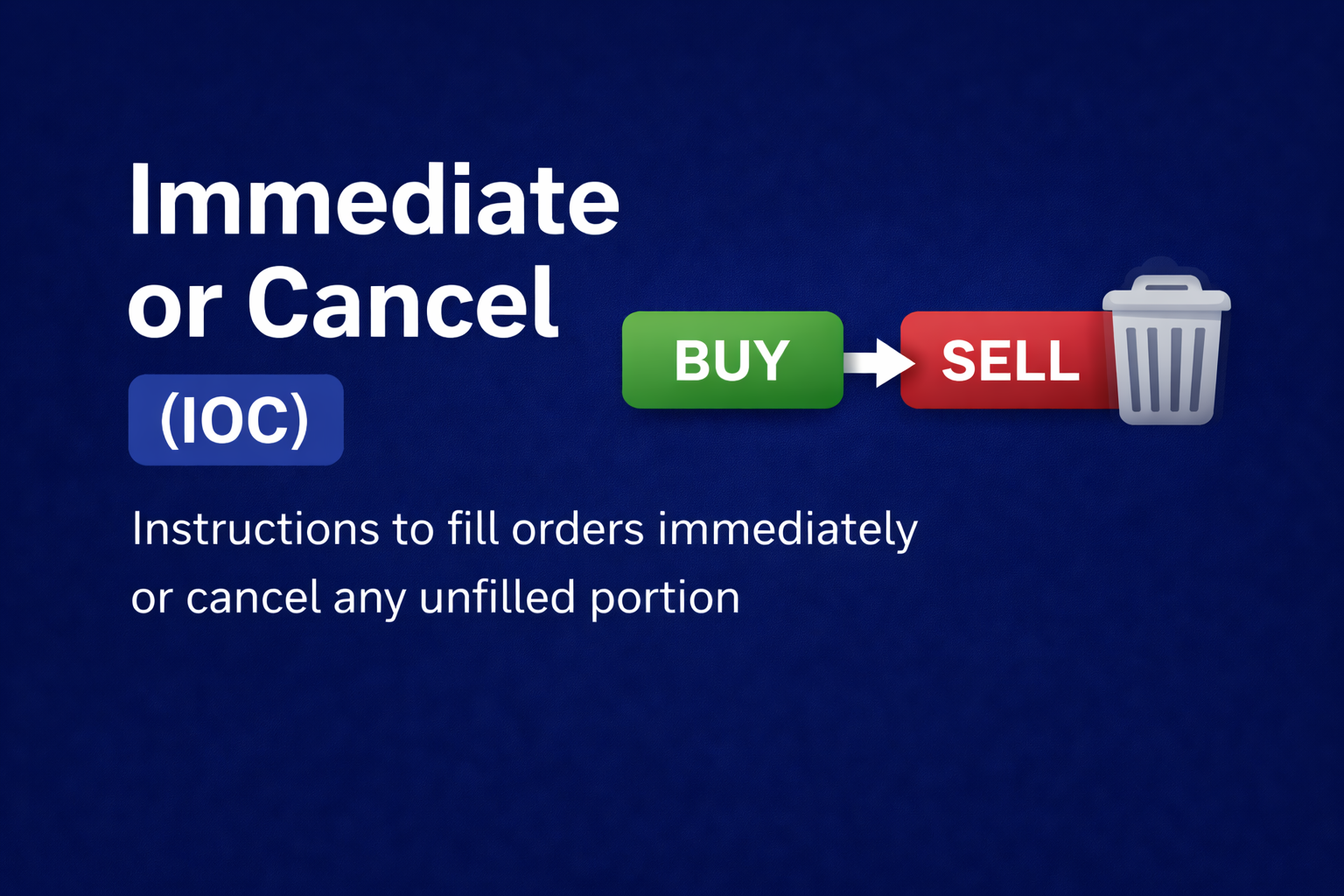
Two common instructions are Fill or Kill (FOK) and Immediate or Cancel (IOC).
| Instruction | If the full quantity is unavailable |
|---|---|
| FOK | The required quantity must execute immediately or none of the order executes |
| IOC | Available quantity can execute immediately; the remainder is cancelled |
| Return or resting behaviour | Unfilled quantity may remain active, depending on the venue, broker and order type |
Suppose two 10,000-unit orders face only 6,000 units of eligible liquidity.
An IOC instruction could allow 6,000 units to execute and cancel the remaining 4,000. A FOK instruction would require the full 10,000 units to be available under the permitted conditions or no execution would occur.
The market liquidity is the same, but the outcome differs because the filling instructions are different.
Not every platform or instrument supports the same policies, so fill rules need to be considered alongside the headline order type.
A requote occurs when the requested price cannot be accepted and another price is presented before execution.
Suppose an order is submitted to buy a currency pair at 1.2500. Before the trade is confirmed, the executable price moves to 1.2503. Under an arrangement that supports requoting, the new price may be returned for confirmation instead of automatically executing the original instruction.
At that point, no trade has yet occurred at the revised price.
Requotes are most closely associated with certain instant- or request-execution arrangements in retail FX and CFD trading. They should not be treated as a standard outcome across all markets.
With a requote, another price is presented before execution proceeds.
With slippage, the trade has already been executed at a price different from the one expected.
For example, a market buy order entered when the best offer is 100.00 may execute at 100.04 if the original liquidity disappears. If the order proceeds automatically at the available price, the difference is slippage rather than a requote.
Slippage can also be favourable if the execution price improves.
A rejected order does not proceed to execution.
Possible causes include insufficient margin, invalid order parameters, unsupported order sizes, trading restrictions, market closures or an instrument being unavailable.
Execution rules can also play a role. Under some fill policies or broker models, unavailable liquidity or an invalid requested price may result in rejection rather than execution elsewhere. Under other arrangements, a market order may continue through available market depth and trade against the next executable liquidity.
A rejection therefore does not automatically indicate a platform fault. The cause may lie with the account, order settings, venue, execution model or current market conditions.
A market order seeks execution at the best available price. It generally offers more execution certainty, but less certainty over the final price.
A limit order provides greater price control, but less certainty that the full order will execute.
A buy limit at £25.00, for example, can execute at £25.00 or below. If only 500 shares are available within the limit and the order requests 1,000, a 500-share partial fill may occur if the order instructions permit it.
If the market then moves above the limit and does not return, the remaining quantity may stay unfilled.
The trade-off can be summarised as:
Market order: more execution certainty, less price certainty.
Limit order: more price control, less execution certainty.
Execution becomes less predictable when market depth is thin or prices are moving quickly.
Economic releases, central-bank decisions, company announcements and unexpected news can cause quotes and available quantities to change rapidly. Quieter trading periods can also produce wider spreads and thinner order books.
For larger orders, shallow depth may require execution across several price levels. For limit orders, the same conditions may leave part of the requested quantity unfilled.
The result depends on both the market conditions and the rules attached to the order.
The execution report is usually the clearest record of what happened to an instruction.
Useful fields can include:
requested quantity;
filled quantity;
requested or limit price;
individual execution prices;
average execution price;
remaining quantity;
order status;
cancellation or rejection reason.
An order for 10,000 shares might show several fills that together equal the full requested amount. Another report could show 6,000 shares executed and 4,000 cancelled under an IOC instruction.
These records help distinguish a fully completed order split across several trades from a genuine partial execution.
Partial fills, multiple fills, slippage, requotes and rejections describe different parts of the execution process.
A partial fill concerns quantity. Multiple fills describe how execution was divided. Slippage concerns price. A requote presents another price before execution under models that support it, while a rejection means the instruction did not proceed to a trade.
Reading these outcomes alongside the order type, fill instruction, liquidity and execution model gives a clearer picture of what occurred between submitting the order and receiving the final execution report.