Published on: 2026-08-21
Updated on: 2026-08-21
EBC quotes EURCAD in 100,000-euro lots, with a 0.01 minimum, pricing each pip at 10 Canadian dollars. A 50-pip move on a full lot is CAD 500.
Canada exported 80.5% of its crude oil production in 2024, about 96% of it to the United States (Statistics Canada). Oil reaches this pair through the Canadian dollar, and EBC carries WTI (XTIUSD) and Brent (XBRUSD) on the same account.
The European Central Bank and the Bank of Canada both sit at 2.25%, so no rate advantage is pulling the pair one way.
A full lot ties up 200 euros of margin at 1:500, the highest ratio EBC offers on the pair. The ratio that frees up your cash also magnifies losses at the same speed.
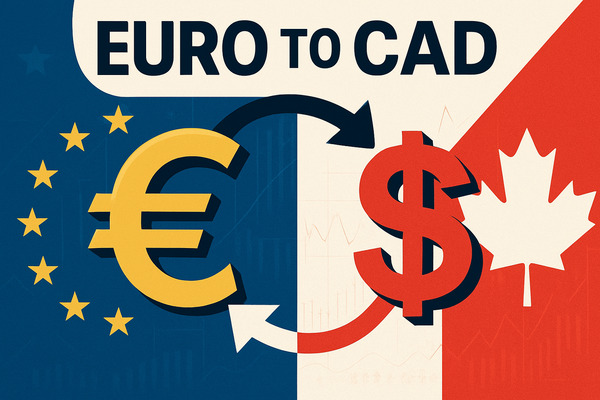
To trade EURCAD, you buy or sell the euro against the Canadian dollar with no US dollar in between. One standard lot is 100,000 euros, so one pip is worth 10 Canadian dollars. Two forces set the price. Crude oil drives the Canadian dollar, and the policy gap between the European Central Bank and the Bank of Canada sits level at 2.25%.

EURCAD is a cross pair, meaning a quote between two currencies without the US dollar in the ticker. The euro is the base and the Canadian dollar is the quote currency. Your screen shows how many Canadian dollars one euro buys. On 20 August 2026, the Bank of Canada published that rate at 1.6098.
Banks still build the price from two dollar legs. EURUSD divided by USDCAD gives you EURCAD, which is why a broad dollar move can shake a pair that contains no dollar at all.
Depth follows the size of each leg. In its April 2025 Triennial Survey, the Bank for International Settlements put global currency turnover at 9.6 trillion dollars a day. Within that total, the US dollar accounted for 89% of all trades, with the euro second at 28.9%. Canada is far smaller, and the Bank of Canada reported the country's share of global turnover at 1.9% in 2025.
That scale gap has a practical effect. A spread, the small distance between the buy and sell price, runs wider on EURCAD than on EURUSD, and quotes thin out once London closes.
If you would rather trade the cross than either dollar leg, EURCAD sits among the 37 pairs on EBC’s forex instruments page, listed alongside EURUSD and USDCAD for anyone who wants to watch the derivation directly.
Canada sells oil to one customer, at scale. Statistics Canada reports that in 2024 the country exported 80.5% of its crude oil production, with about 96% of those exports going to the United States. The Canada Energy Regulator put energy exports to the US at CAD 169.8 billion that year, or 21.7% of all Canadian goods exports.
Higher crude usually firms the Canadian dollar, which pushes EURCAD down, because the quote currency is gaining ground.
The link is well known. Its strength is not. A Bank of Canada staff analytical note published in 2017 measured the Canadian dollar's correlation with Brent and WTI crude at about 0.4, and added that some but not all oil price changes matter for the exchange rate.
That number deserves a plain reading. Oil is a strong input and a weak trigger. It explains moves better than it predicts them. Use it to size a view you hold, not to open one. WTI spot settled at 86.48 dollars a barrel on 18 August 2026 according to the US Energy Information Administration.
Traders who want the driver on the same screen as the pair can find both crude benchmarks listed as separate CFDs, XTIUSD for WTI and XBRUSD for Brent, on EBC's commodities platform. Putting the two side by side shows whether that 0.4 relationship is holding right now, which is crucial before sizing a EURCAD position around it.
The European Central Bank raised its deposit facility rate to 2.25% at the 11 June 2026 meeting, effective 17 June, with the main refinancing rate at 2.40%. On 15 July 2026, the Bank of Canada left its overnight rate target at 2.25%, a sixth consecutive hold.
Both benchmarks now sit on the same number. That parity is recent, and it closed a gap that had favored the Canadian side, so carry logic written before mid-2026 no longer applies to this pair.
Inflation decides the next divergence. Euro area annual inflation ran at 2.9% in July 2026 on the Eurostat harmonized measure, with energy up 10.0% over the year. Canadian CPI ran at 3.0% in the same month, gasoline up 25.7%, according to Statistics Canada.
Both banks are reading one energy shock from opposite ends of an oil trade. Read the two inflation releases together, not one at a time.
Start with the contract. One EURCAD lot is 100,000 euros, and the smallest tradeable size is 0.01 lots. The pair quotes to five decimal places, so the pip is the fourth decimal, and the fifth digit is a fractional pip. Because the Canadian dollar is the quote currency, pip value is fixed in Canadian dollars. It does not move with the rate.
| Position Size | Contract Value | Value of 1 Pip | Value of a 50 Pip Move |
|---|---|---|---|
| 1.00 lot | EUR 100,000 | CAD 10.00 | CAD 500 |
| 0.10 lot | EUR 10,000 | CAD 1.00 | CAD 50 |
| 0.01 lot | EUR 1,000 | CAD 0.10 | CAD 5 |
If your account is in US dollars, the platform converts at the prevailing rate when you close.
Margin is the deposit set aside to hold a position. It scales off the contract value rather than the pip value.
| Leverage | Margin on 1.00 Lot | Margin on 0.10 Lot | Margin on 0.01 Lot |
|---|---|---|---|
| 1:20 AM | EUR 5,000 | EUR 500 | EUR 50 |
| 1:50 AM | EUR 2,000 | EUR 200 | EUR 20 |
| 1:100 | EUR 1,000 | EUR 100 | EUR 10 |
| 1:200 | EUR 500 | EUR 50 | EUR 5 |
| 1:500 | EUR 200 | EUR 20 | EUR 2 |
EBC lists a maximum of 1:500 on this pair, and your account decides the ratio you get. Check the leverage and margin specifications first. At 1:500, roughly 200 euros of margin controls 100,000 euros of currency, and a 20 pip move against the position costs about as much as the margin holding it. Leverage enlarges losses at the same rate it enlarges gains.
A stop-loss, an order that closes the trade automatically at a level you set, belongs on the ticket before the position opens.
Swap is the other cost, a small interest adjustment applied to any position still open at the daily rollover. It tracks the interest difference between the two currencies, and with both banks at 2.25%, there is no meaningful carry either way. The live figure sits in the platform's symbol specification. Check it before any multi-week hold.
A demo account runs on the same live prices with none of your money at risk. That makes it the cheapest way to watch EURCAD through a full London to New York session. Both Standard and Professional accounts start at a 50-dollar live minimum.
Liquidity peaks between roughly 13:00 and 16:00 UTC, while London and New York are both open. Canadian data lands at 8:30 a.m. Eastern and Bank of Canada rate decisions at 9:45 a.m. Eastern, both inside that window. European numbers usually print by then, so the overlap is the one stretch when both currencies are awake, and both sets of news are priced.
EBC quotes the pair from Monday 00:03 to Friday 23:55 on server time, which runs at UTC+3, with a short break at midnight. Trading accounts are also restricted to closing positions only in the final two hours before the Friday close. A trade you meant to open late on Friday may simply not be available.
Outside the overlap, this pair gets thin. Asian hours can produce wide quotes on very little volume, and a stop placed casually into that stretch can fill at a price you would never accept at 14:00 UTC.
Both banks publish their calendars a year ahead, which makes this the easiest risk to plan around.
| Date, 2026 | Event |
|---|---|
| 2 September | Bank of Canada interest rate announcement |
| 10 September | ECB monetary policy decision |
| 28 October | Bank of Canada announcement, with Monetary Policy Report |
| 29 October | ECB monetary policy decision |
| 9 December | Bank of Canada interest rate announcement |
| 17 December | ECB monetary policy decision |
October is the awkward month. A position opened ahead of the Bank of Canada decision on the 28th carries ECB risk into the next session, planned or not.
Spreads on any instrument can widen around a scheduled release. That is ordinary market behavior, not a platform fault. The answer is to trade smaller with a wider stop, or stand aside.
EURCAD travels further in an average session than EURUSD, because a smaller quote-currency market absorbs the same news with less depth. Check the pair's own average daily range on the platform before you set a stop. A distance that looks wide on EURUSD can sit inside the noise here.
The technical approach that suits this pair is the plain one. Support and resistance drawn from daily closes hold up better than intraday lines because most real movement happens within a three-hour window, and the rest of the day fills in around it.
Treat moving averages and momentum readings such as RSI as context, not signals. That is more important on a cross than on a major, since a clean-looking technical break can turn out to be a dollar move passing through the EURUSD leg.
Check your correlations before you add the pair. If you already hold USDCAD, GBPCAD or a crude position, a EURCAD trade may be the same bet wearing different clothes. Two positions that look independent on the platform can lose together on one production headline.
Risk appetite adds a third layer. The Canadian dollar tends to soften when global growth expectations fall, while the euro often holds up better in the same conditions, so EURCAD can climb on a risk-off day with no Canadian news.
Register on ebc.com and verify. The process is online and needs a government-issued ID and proof of address.
Fund the account. Deposits arrive as a US dollar balance, and the live minimum is 50 dollars.
Open MetaTrader 4 or MetaTrader 5 on desktop or mobile.
Find EURCAD in the market watch panel. Open its symbol specification to read the current spread, swap and margin requirement.
Decide the size first, the stop second, the entry third. Reversing that order is how traders end up holding what they cannot afford to hold.
Place a market or pending order and confirm.
EBC Financial Group (UK) Limited is authorized and regulated by the Financial Conduct Authority under reference 927552. The group also holds licenses with ASIC in Australia, CIMA in the Cayman Islands and the FSCA in South Africa. Each number is searchable on that regulator’s own public register, and the check takes about a minute.
A verified account and 50 dollars. EBC’s Standard and Professional accounts open at the same minimum, and EURCAD trades from 0.01 lots, so you can open a small first position with the initial deposit. Testing the pair first on a free demo costs you nothing but time.
EBC lists a maximum of 1:500 on EURCAD, which puts the margin on a full 100,000 euro lot at roughly 200 euros. The ratio your account receives depends on your account type. That same ratio works against the position when the market moves the other way.
Yes. EBC carries EURCAD on both MetaTrader 4 and MetaTrader 5, across desktop, mobile and web, with one login on every device. The symbol specification in the Market Watch panel shows the live spread, swap, and margin requirements for the pair.
It can be, at a small size. The pair covers more ground than EURUSD in an average session, and its spread is wider, so an identical lot carries more risk. A demo account with EBC, run through one ECB decision and one Bank of Canada decision, is a sensible way to find out.
EURCAD has two drivers, and they share a calendar. Crude oil sets the Canadian dollar’s tone, while the 2.25% standoff between the European Central Bank and the Bank of Canada sets the rate story. Next decisions: 2 and 10 September 2026.
The arithmetic does not move with the news, whatever the news does: 100,000 euros a lot, 10 Canadian dollars a pip, and margin that scales with the ratio you pick.
On EBC, EURCAD clears through the same account as the crude benchmarks that drive it, one line in a catalog of more than 200 instruments across five asset classes on MT4 and MT5. Positions run long or short from 0.01 lots, and a funded account opens at 50 dollars. You can open an account online, or watch the pair through one decision day on demo first.