Published on: 2026-08-26
Updated on: 2026-08-26
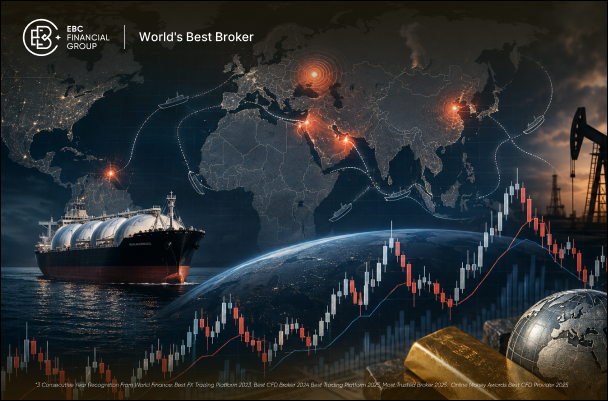
Financial markets rarely wait for geopolitical events to produce measurable economic damage before reacting. Oil can rise before supply is disrupted, equities can fall before earnings estimates change, and government borrowing costs can move before a conflict has affected fiscal accounts. What changes first is often the probability investors assign to adverse outcomes.
The resulting adjustment is commonly described as a geopolitical risk premium. It represents the additional compensation or price adjustment associated with uncertainty over geopolitical events and their potential economic consequences. Understanding that premium helps explain why markets can react strongly to threats, why different assets respond in different ways, and why some price moves reverse even when the underlying geopolitical problem has not disappeared.
Geopolitical risk refers broadly to the possibility that wars, diplomatic disputes, sanctions, trade restrictions, political instability or other international tensions disrupt economies and financial markets. These events can affect trade, supply chains, corporate earnings, inflation and capital flows.
A geopolitical risk premium is the additional compensation markets demand, or the pricing adjustment they make, when geopolitical uncertainty increases.
The way that premium appears depends on the asset involved. In crude oil, geopolitical uncertainty may contribute to higher prices because buyers become concerned about future supply. In equities, the same uncertainty can contribute to lower valuations if future cash flows become less certain or investors demand a higher return. In sovereign debt, it may appear through wider credit spreads or higher borrowing costs, particularly for countries directly exposed to the shock.
The term should therefore be understood as a pricing adjustment for geopolitical uncertainty, rather than a universal surcharge that simply pushes all asset prices higher.
It is also not directly observable. There is no market quote showing that exactly $5 of an oil price, for example, represents geopolitical risk. Analysts instead infer the premium by comparing market pricing with underlying economic and physical conditions.
Put simply, the premium is the market’s price for what might happen, not necessarily for damage that has already occurred.
That forward-looking nature is what allows geopolitical risk to influence markets before its economic consequences are fully visible.
Markets price potential outcomes rather than waiting until the worst-case scenario occurs. The mechanism can be simplified as:
Geopolitical threat → greater uncertainty → higher probability of disruption → revised economic expectations → asset repricing
Consider a conflict near a major oil-producing region. Production may initially remain unchanged, but the probability of damaged infrastructure, sanctions or interrupted shipping has increased. Buyers may become willing to pay more for oil because future supply is less certain.
The price can therefore rise before a single barrel has actually disappeared.
Several factors determine how large the adjustment becomes.
The first is the probability of escalation. A diplomatic dispute with little risk of military conflict will normally be treated differently from one involving direct attacks on infrastructure or major transport routes.
The second is the potential economic impact. Tensions involving a strategically important oil producer, major trading economy or critical shipping route usually create greater market exposure than events with limited global economic connections.
Duration also matters. A disruption expected to last several days is priced differently from one that could persist for months.
Markets additionally consider available buffers. Oil inventories, spare production capacity, alternative shipping routes and substitute suppliers can reduce the economic consequences of disruption.
Finally, prior expectations matter enormously. A serious development can cause a surprisingly modest reaction if it was widely anticipated. A smaller shock can trigger a much larger move when markets were positioned for stability.
Geopolitical risk therefore affects prices through both the event itself and the difference between the event and what markets had already expected. Once that repricing begins, the effects can spread well beyond the market initially exposed to the geopolitical shock.
The same geopolitical shock can influence several markets at once, but the direction depends on which economic channel dominates.
| Market | Typical Transmission Channel |
|---|---|
| Oil and natural gas | Potential supply disruption |
| Equities | Earnings uncertainty and higher required returns |
| Government and corporate bonds | Safe-haven demand, inflation or wider risk spreads |
| Gold | Demand for perceived stores of value |
| Currencies | Capital flows, trade exposure and monetary-policy expectations |
Energy markets provide perhaps the clearest example. Oil and gas depend on physical production, pipelines, ports and shipping routes. If a conflict threatens any of these, markets can begin pricing possible shortages before current supply is fully affected. Higher freight rates, insurance costs, sanctions and rerouting can add further pressure.
For equities, the impact varies by company and sector. Higher uncertainty can weaken earnings expectations, raise input costs or increase the return investors demand for holding risky assets.
An energy producer may benefit from higher commodity prices while an airline faces higher fuel costs. Defence companies may respond to expected military spending, while manufacturers reliant on global supply chains may face greater logistical expenses.
Bond markets are more complicated because two opposing forces can operate simultaneously.
Geopolitical uncertainty can create demand for highly rated government bonds, pushing prices higher and yields lower. But an energy shock can also raise expected inflation, increase concerns about government spending and complicate monetary policy. In that case, longer-term yields can rise instead.
That tension was visible on August 18, 2026, when long-term borrowing costs across major economies reached multi-decade highs amid concerns about government debt, geopolitics and inflation. The US 30-year Treasury yield reached an intraday high of 5.321%, its highest since 2007, as rising oil prices added to inflation concerns.
Government bonds therefore do not automatically rally during geopolitical crises. The outcome depends on whether safe-haven demand or the inflation and fiscal consequences of the shock exert the stronger influence.
Gold can attract demand as a perceived store of value, but its response still depends on interest rates, the US dollar and positioning.
Currencies are similarly conditional. Capital may move toward currencies perceived as relatively liquid or insulated from the conflict, while currencies belonging to energy-importing, trade-dependent or directly exposed economies may face pressure.
Across these markets, geopolitical shocks can also spread through a broader chain:
Geopolitical disruption → higher energy prices → higher inflation expectations → changing interest-rate expectations → bond, equity and currency repricing
The key question is therefore not simply whether geopolitical tension exists, but whether markets are pricing a feared outcome or responding to economic damage that has already occurred.
One of the most important distinctions is between pricing a possible disruption and pricing a disruption that has actually happened.
Suppose oil rises because markets believe a major shipping route could close. If shipments continue normally, much of that move may reflect compensation for uncertainty.
If the route subsequently closes and physical supply falls, the situation changes. Oil is no longer rising purely because of what might happen. The underlying supply-demand balance has also deteriorated.
| Situation | What the Market Is Pricing |
|---|---|
| Conflict threatened, supply unchanged | Expected disruption and risk premium |
| Probability of disruption rises | Potentially larger risk premium |
| Physical supply is lost | Risk premium plus changed fundamentals |
| Supply normalises but tensions remain | Fundamental pressure eases while some premium may remain |
| De-escalation becomes credible | Risk premium can contract |
The Strait of Hormuz in August 2026 provides a particularly clear example of how those forces can coexist.
Physical shipping remained severely constrained. Kpler recorded only five commodity-vessel transits on August 15 and none on August 16, compared with 31 over the previous weekend.
Yet oil prices continued to move sharply with changing expectations about how long that disruption might persist.
Brent and West Texas Intermediate had fallen more than 7% in the week before August 10 as hopes increased that negotiations could lead to a reopening of the strait. On August 10, both benchmarks then settled about 5% higher after competing US and Iranian demands reduced expectations of an agreement. Brent closed at $87.72 and WTI at $82.13.
Later in August, oil again declined as diplomatic signals improved. On August 25, Brent and WTI fell more than 3% as signs of possible de-escalation reduced concerns about renewed escalation, despite shipping through Hormuz remaining heavily disrupted.
The physical problem did not need to disappear for prices to fall. What changed was the market’s assessment of how severe or persistent the disruption was likely to become.
That is the geopolitical risk premium at work alongside existing fundamentals. Oil prices can reflect today’s constrained supply while simultaneously rising or falling as expectations about tomorrow’s supply change.
The distinction also explains why analysts need more than geopolitical headlines to judge whether a premium is expanding.
Because geopolitical risk premiums are not directly observable, analysts typically look for several market and physical signals together.
| Signal | What It Can Reveal |
|---|---|
| Oil futures curve | Whether immediate supply concerns are becoming more urgent relative to later delivery |
| Options skew and implied volatility | How much markets are paying for protection against unusually large price moves |
| Freight and war-risk insurance costs | Whether geopolitical stress is raising the real cost of transporting goods |
| Sovereign and CDS spreads | Whether country-specific political and credit risk is being repriced |
| Inventories and shipping flows | Whether feared disruption is becoming an actual physical shortage |
| Reaction to new headlines | Whether further escalation still surprises the market |
No single indicator proves that a geopolitical premium exists.
For example, a sharply backwardated oil futures curve can indicate immediate scarcity, but that scarcity might also reflect strong demand, low inventories or production cuts. Higher implied volatility can signal growing uncertainty without identifying geopolitics as its sole cause.
The strongest analysis therefore compares several signals.
Futures curves and physical data can help separate anticipated shortages from realised tightness. Freight and insurance costs show whether geopolitical danger is affecting actual transportation. Credit spreads can reveal whether investors are demanding additional compensation for exposure to particular countries.
Market reaction to new information can be particularly revealing.
If progressively worse geopolitical headlines cause increasingly small price movements, much of the feared outcome may already be incorporated into prices. Conversely, a relatively modest development that produces a large move can suggest that markets had previously assigned little probability to that scenario.
The aim is not to calculate one definitive geopolitical-premium figure, but to determine whether markets are increasing or reducing the compensation they demand for uncertainty.
A geopolitical risk premium is not permanent. It changes as markets continually reassess the probability, severity and duration of adverse outcomes.
The premium may increase when:
a conflict escalates;
sanctions become more restrictive;
infrastructure is damaged;
major shipping routes are threatened;
disruption appears likely to last longer;
alternative supplies are limited.
It can fall when negotiations progress, supply continues more smoothly than feared, alternative routes become available, inventories provide a buffer or the expected duration of disruption shortens.
This explains why prices can recover even while geopolitical tensions remain elevated.
The conflict itself does not have to disappear. Conditions merely need to become less damaging than markets previously expected.
For example, if oil has already risen sharply on expectations of severe supply losses, evidence that exports may recover sooner than feared can reduce the premium even while the underlying geopolitical dispute remains unresolved.
The reverse also applies. Markets that have largely ignored a persistent geopolitical threat can experience abrupt repricing when the probability of disruption suddenly increases.
In both cases, the premium changes because expectations change, not simply because geopolitical tension exists.
A geopolitical risk premium reflects the financial market’s attempt to put a price on uncertain geopolitical outcomes before their full economic consequences are known.
Its impact depends on the asset. Oil may rise because future supply looks less secure, equity valuations may fall as required returns increase, sovereign borrowing costs may move in either direction depending on safe-haven and inflation forces, and capital may shift across currencies or gold. Those relationships are not automatic, because monetary policy, existing valuations, supply buffers and prior market expectations continue to influence prices.
The central distinction is between risk and reality. A market can move because disruption is feared, because disruption has actually occurred, or because both forces are operating simultaneously.
Understanding that difference, and the market signals that reveal changing expectations, helps explain why geopolitical shocks can produce large cross-asset moves, why the premium can change rapidly, and why prices can reverse long before the geopolitical issue itself has been fully resolved.