Published on: 2023-09-08
Updated on: 2026-07-03
Stocks still offer stronger long-term growth potential, but higher bond yields have made fixed income more useful for investors seeking income, stability, and portfolio balance.
Stocks and bonds are both ways for companies and governments to raise capital. The difference is that buying a stock means becoming a part-owner of a company, whilst buying a bond means lending money to an issuer. That single distinction shapes everything else, from income and risk to bankruptcy priority and long-term return potential.
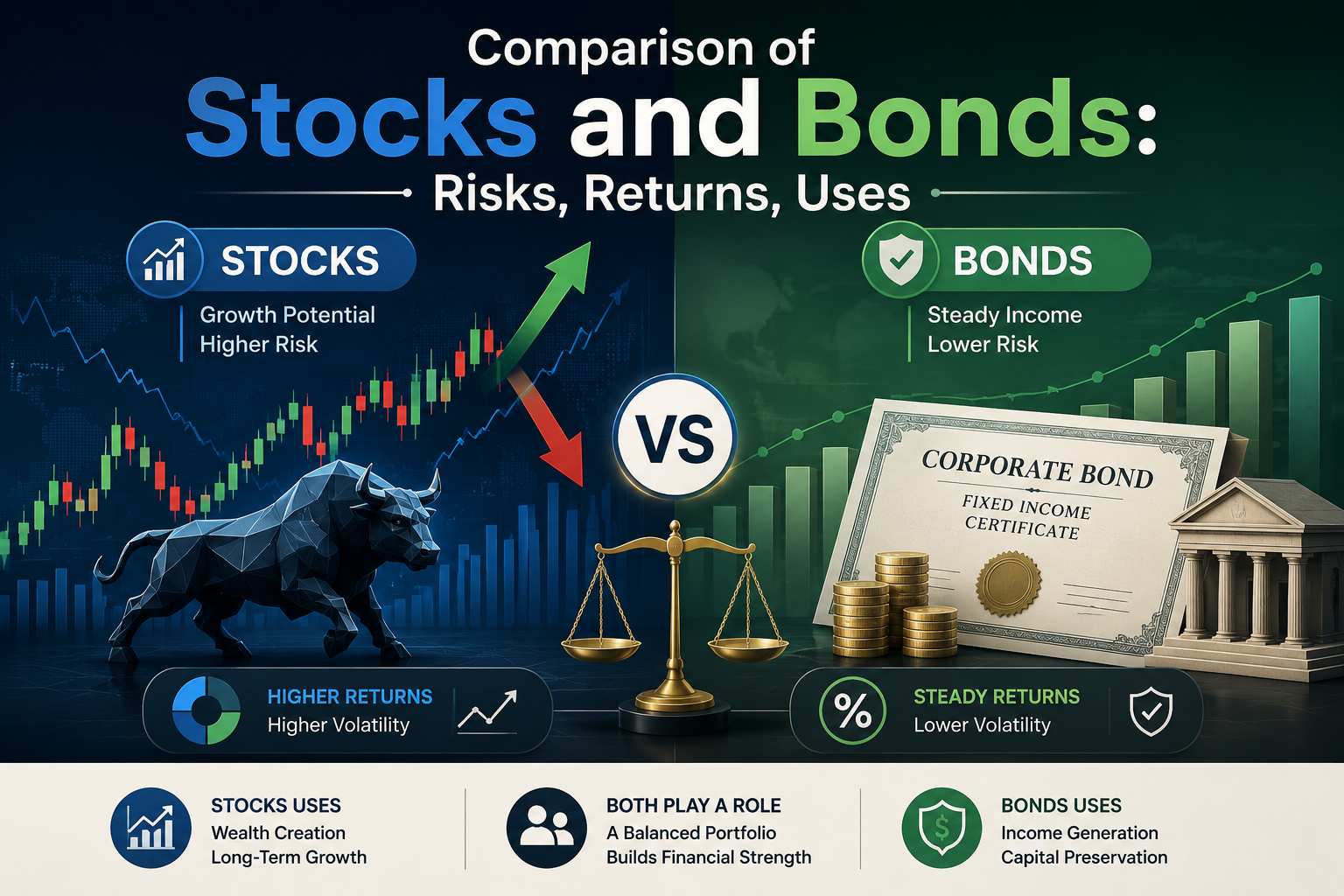
Stocks represent ownership, while bonds represent debt.
Stocks can generate capital gains and dividends, but returns are not guaranteed.
Bonds usually provide scheduled interest and principal repayment at maturity, if the issuer remains solvent.
Stocks tend to outperform over long periods because investors accept higher business and market risk.
Bonds can reduce portfolio volatility, but they can lose value when interest rates rise.
In 2025, both assets performed well: the S&P 500 returned 17.9%, while the Bloomberg U.S. Aggregate Bond Index returned 7.3%.
A stock is a share of ownership in a company. When investors buy stocks, they become shareholders. They may benefit if the company grows revenue, improves profits, pays dividends, or becomes more valuable in the market.
For example, if a company issues 10,000 shares and an investor owns one share, that investor owns 1/10,000 of the company, or 0.01%. The value of that share changes as investors reassess the company’s earnings, cash flow, products, management quality, and future growth prospects.
Stocks do not promise fixed income. Some mature companies pay regular dividends, especially those with stable cash flow. Others reinvest profits into expansion, research, technology, acquisitions, or debt reduction. Growth companies may pay no dividends at all, yet still attract investors because their future earnings could rise sharply.
The main advantage of stocks is that if a successful company grows over many years, shareholders can benefit from rising share prices and dividend growth. The drawback is volatility, where stock prices can fall sharply during recessions, earnings disappointments, valuation corrections, or market shocks.
A bond is a loan made by investors to an issuer. The issuer may be a government, municipality, bank, or corporation. In return, the issuer usually promises to pay interest, known as a coupon, and repay the principal when the bond matures.
For example, if a company issues a 10-year bond with a face value of $1,000 and a 6% annual coupon, the investor normally receives $60 per year. At maturity, the issuer repays the $1,000 principal, assuming it has not defaulted.
Bonds are often considered more stable than stocks because their cash flows are defined in advance. But they are not risk-free. Corporate bonds carry default risk. Government bonds carry interest-rate and inflation risk. A bond can also see its market value fall before maturity if newer bonds offer higher yields.
This is why bond prices and yields move in opposite directions. When market interest rates rise, older bonds with lower coupons become less attractive, so their prices fall. When market rates decline, older bonds with higher coupons become more valuable.
Stocks and bonds occupy different places in a company’s financial structure. Bonds are liabilities. Stocks are equity.
This matters most when a company faces financial stress. Bondholders have a higher claim on company assets than common shareholders. If a company goes bankrupt, creditors are paid before shareholders. Common shareholders receive value only after debt and other senior claims are satisfied. In many bankruptcies, shareholders recover little or nothing.
That priority helps explain why bonds usually offer lower expected returns than stocks. Bondholders have limited upside, but they stand ahead of shareholders in the repayment order. Shareholders take more risk because they participate directly in the company’s growth, but they also absorb losses first when conditions deteriorate.
| Factor | Stocks | Bonds |
|---|---|---|
| Investor role | Owner | Lender |
| Return source | Price gains and possible dividends | Coupon income and principal repayment |
| Income certainty | Dividends are optional | Interest payments are usually scheduled |
| Risk level | Higher market and business risk | Usually lower volatility, but credit and rate risk remain |
| Bankruptcy priority | Paid after creditors | Paid before shareholders |
| Main advantage | Long-term growth potential | Income and stability |
| Main weakness | Larger price swings | Lower upside and rate sensitivity |
| Best suited for | Growth and wealth building | Income, capital preservation, and diversification |
The better choice depends on time horizon, risk tolerance, income needs, and investment objective.
Stocks are suited for investors seeking long-term growth. Younger investors often hold more stocks because they have time to recover from downturns. Over time, compounding can be powerful when companies grow earnings and reinvest capital successfully.
Bonds are suited for investors who need income, lower volatility, or capital preservation. Retirees, conservative investors, and institutions often use bonds to reduce portfolio swings and match future cash-flow needs.
Many portfolios use both. Stocks provide growth. Bonds provide income and risk control. Cash covers near-term spending needs. A balanced portfolio is not about choosing the asset with the highest return every year. It is about building a structure that investors can hold through changing market conditions.
Rebalancing is also important. When stocks rally strongly, investors may need to trim equity exposure to avoid taking too much risk. When bonds sell off and yields rise, income opportunities may become more attractive. A disciplined mix helps investors avoid buying at peaks or selling during panic.
Bonds are usually less volatile than stocks, especially high-quality government and investment-grade bonds. They still carry risks, including inflation, interest-rate changes, and issuer default. Safety depends on the bond’s maturity, credit quality, yield, and the investor's ability to hold it to maturity.
Stocks usually return more because shareholders face more uncertainty. They participate in company growth, but they also absorb losses first when business conditions weaken. Bonds have scheduled payments and higher repayment priority, so their expected return is usually lower.
Yes. Stocks and bonds can both fall when inflation rises quickly, and central banks raise interest rates. In that environment, stock valuations may compress while existing bond prices decline because newer bonds offer higher yields.
Beginners should first define their goal. Long-term growth usually requires stock exposure. Short-term goals and income needs may require more bonds or cash. Many beginners use a diversified mix because it reduces the pressure to predict which asset will perform best.
The comparison of stocks and bonds comes down to ownership versus lending. Stocks offer growth, dividends, and long-term compounding, but they carry higher volatility. Bonds offer income, repayment priority, and potential stability, but they remain exposed to inflation, interest rates, and credit risk.
The strongest approach is usually not choosing stocks or bonds in isolation. It is understanding what each asset is designed to do. Stocks build wealth. Bonds manage income and risk. A disciplined balance between the two gives investors a clearer way to navigate changing markets.
Disclaimer: This material is for general information purposes only and is not intended as (and should not be considered to be) financial, investment or other advice on which reliance should be placed. No opinion given in the material constitutes a recommendation by EBC or the author that any particular investment, security, transaction or investment strategy is suitable for any specific person.