Published on: 2026-07-28
Updated on: 2026-07-28
Zhongji Innolight is asking Hong Kong to pay HK$980 a share after raising HK$53.41 billion in gross proceeds. Its optical modules help stop costly GPU clusters from sitting idle, yet its growth depends on a concentrated customer base and a product cycle carrying high expectations.
The July 30 debut will show whether demand reflects confidence in Zhongji’s next technology upgrade or scarcity around a limited new H-share float.
High-speed products generated 94.6% of first-quarter 2026 revenue, leaving Zhongji’s earnings closely tied to faster AI network connections.
China Insights Consultancy estimates Zhongji held 28.1% of the high-speed datacom optical-interconnect market in 2025, but five customers generated 81.9% of first-quarter revenue, leaving growth exposed to a handful of procurement decisions.
Gross margin reached 45.5% in the first quarter, creating a demanding benchmark for the shift from 800G to 1.6T.
HK$980 implied a 6.5% discount to the July 28 Shenzhen close, yet an illustrative group valuation near 86 times 2025 profit remains demanding.
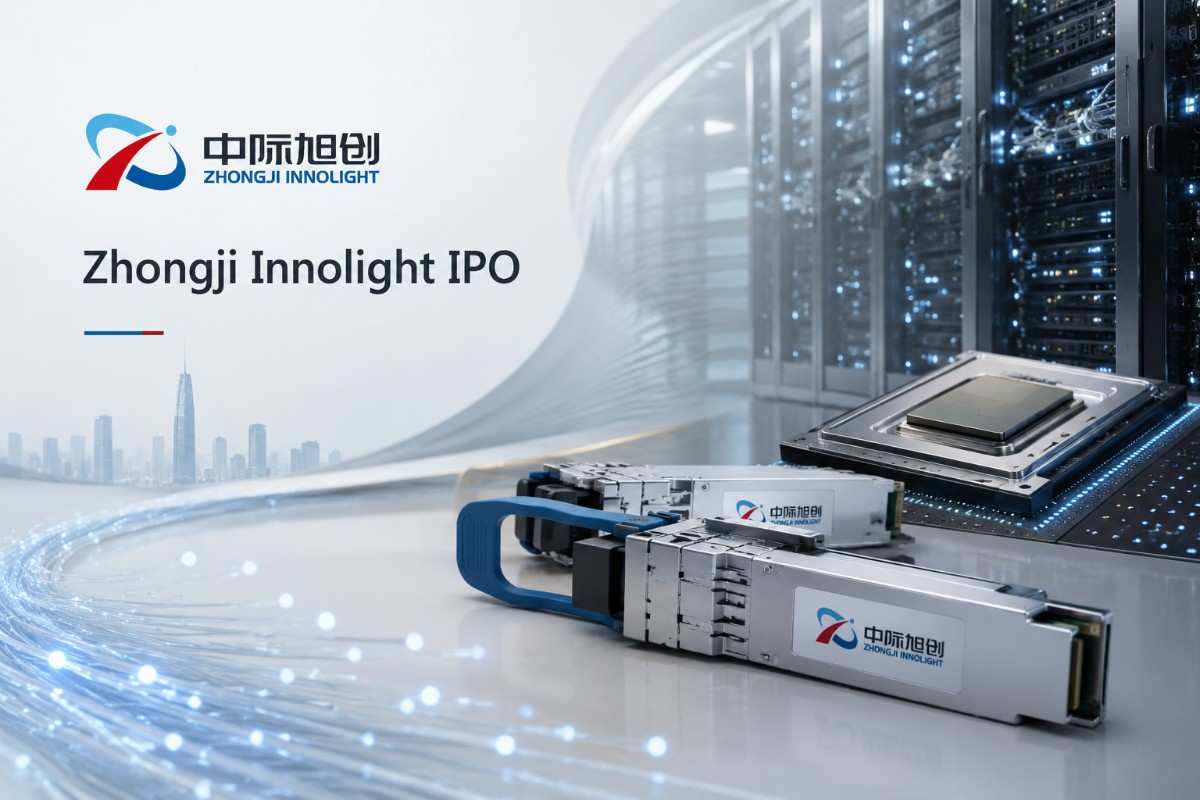
Zhongji Innolight supplies optical transceivers that move data between processors, servers and network switches inside AI data centres. Its portfolio spans 400G, 800G and 1.6T modules, converting electrical signals into light for transmission through fibre.
Zhongji is raising expansion capital, not repairing a weak balance sheet. The company produced RMB11.58 billion of IFRS profit in 2025. At the July 28 exchange rate, the base offering’s gross proceeds equal roughly four times that annual profit.
Most of the funds are earmarked for optical research and global production, with smaller allocations for supply-chain resilience, acquisitions and working capital. New capacity creates value only when customer orders keep it productive.
A GPU waiting for data is expensive idle capacity. Zhongji’s transceivers convert electrical signals into light and move information between processors and switches through fibre.
Optical links become more valuable as AI clusters grow larger and faster. They keep data moving quickly enough for costly processors to remain productive, making network capacity part of the return generated by every GPU installed.
A 1.6T module carries twice as much data per port as an 800G module, allowing more network capacity through each connection. Zhongji can benefit from stronger pricing during the early stage of adoption.
That advantage narrows as production expands and rival products qualify. Higher bandwidth also raises power, heat and manufacturing demands. Zhongji launched 1.6T products in 2023, while gross margin reached 45.5% in the first quarter of 2026. The new cycle must protect that profitability as supply broadens.
Five customers generated 81.9% of first-quarter revenue. That concentration connects Zhongji to major AI infrastructure budgets while leaving growth exposed to a handful of purchasing decisions.
High-speed transceivers must pass lengthy testing before entering large data-centre networks. Replacing a qualified supplier can require new validation and deployment risk, making established relationships difficult to displace. The same concentration can reverse growth quickly when one major programme slows.
Yes. At the July 28 close and official exchange rate, the HK$980 H-share offer converted to RMB848.94, placing it 6.5% below Zhongji’s RMB908 Shenzhen price.
| Comparison | Value |
|---|---|
| H-share offer | HK$980 |
| RMB equivalent | RMB848.94 |
| July 28 A-share close | RMB908 |
| Indicative discount | 6.5% |
| Share conversion | Not freely available |
The discount had already narrowed after Zhongji’s A-shares fell 15.69% on July 28. Against the previous close of RMB1,076.94, the same H-share offer would have represented a discount of about 21.2%.
The gap offers no guaranteed gain because the share classes cannot be freely converted. Applying HK$980 to the roughly 1.17 billion shares expected after the base offer gives an illustrative equity value of HK$1.15 trillion, or about 86 times 2025 IFRS profit. A discount to the A-shares does not make the H-shares cheap in absolute terms.
The United States accounted for 61.7% of first-quarter revenue. New procurement restrictions, tariffs or export controls could reduce orders even while global AI spending remains strong. Zhongji was added to the US Section 1260H list in June 2026, although the company said its orders, production and supply chain remained unaffected at the time of the announcement.
Zhongji’s largest supplier represented 38.3% of first-quarter purchases. Disruption at that source could restrict production during a major product ramp, when reliable delivery protects customer qualifications.
Co-packaged optics creates the longer-term technology risk. Moving optical components closer to the networking chip can reduce power use and signal loss while weakening demand for standalone pluggable modules. Zhongji is developing both product types, though leadership in its existing market does not guarantee leadership after the architecture changes.
A first-day gain will show demand for Zhongji’s limited H-share float. It will not prove that current earnings and margins can last through a full product cycle.
The clearest signals will be the closing price against HK$980 and the relative price of Zhongji’s Shenzhen shares. A narrower gap would show stronger international demand, while a wider gap would show Hong Kong assigning a lower valuation to the same company.
Trading is expected to begin on July 30 under Hong Kong stock code 3308. The Shenzhen-listed A-shares continue to trade under stock code 300308.
One board lot contains 50 H-shares. At HK$980 per share, the shares cost HK$49,000 before brokerage, exchange fees and transaction levies.
NVIDIA publicly includes Innolight among the companies supporting pluggable optical-transceiver technology for AI factories. Zhongji does not disclose revenue by named customer, so the financial size of any relationship cannot be verified publicly.
No. Zhongji has traded on Shenzhen’s ChiNext market since 2012. The Hong Kong offering adds newly issued H-shares alongside the existing mainland listing.
The first post-listing results will carry the decisive evidence. Shipment growth, high-speed product mix, gross margin, customer concentration and returns on new capacity will show whether the IPO-funded expansion is creating value. Sustained earnings measure the value of the network behind AI.