Published on: 2026-03-11
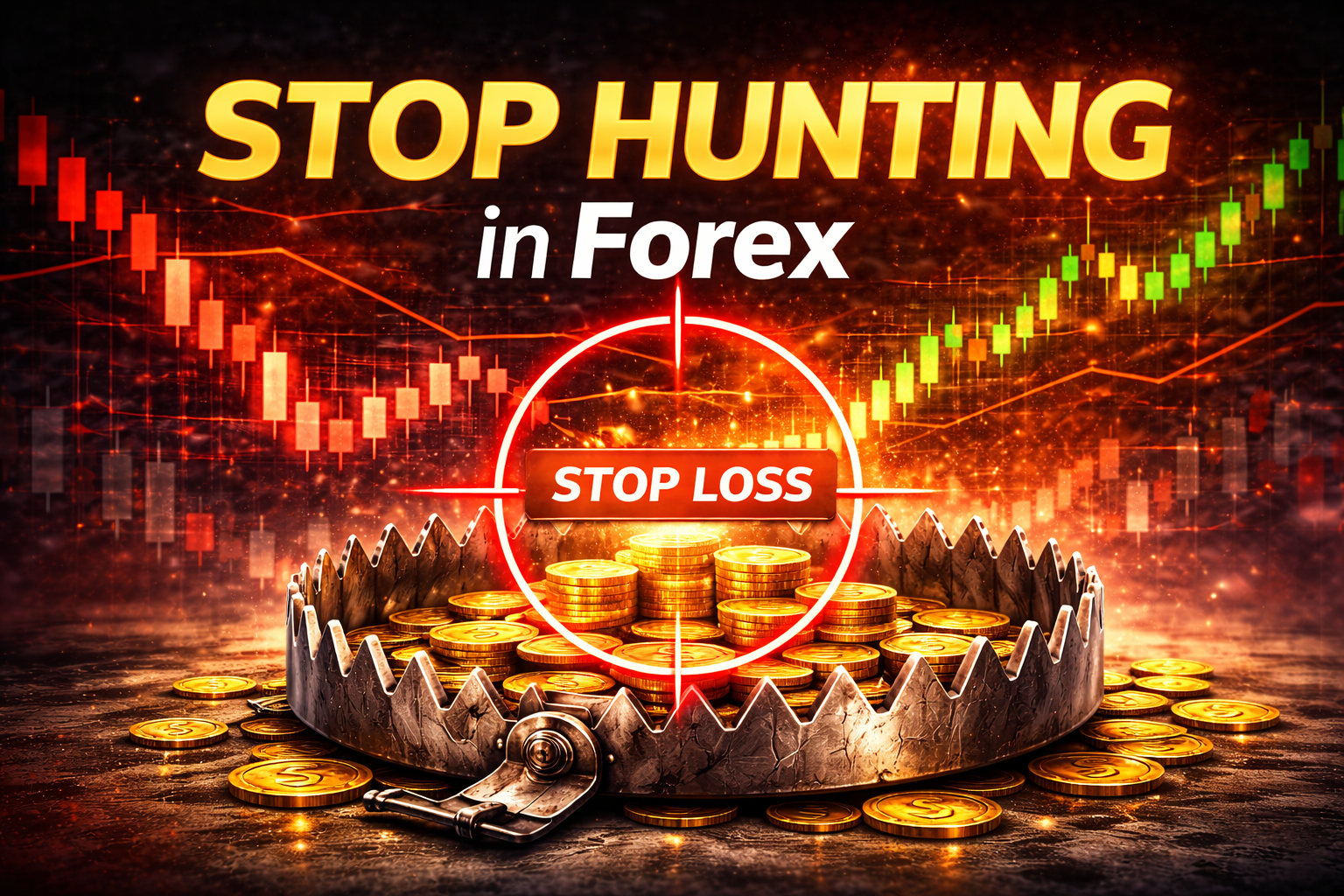
One concept that frequently appears in trading discussions is stop hunting. In simple terms, stop hunting refers to situations where price moves toward areas where many stop-loss orders are placed, triggering those orders and creating a surge of trading activity.
For new traders, these movements can seem sudden or even unfair, as prices can briefly move against their positions before reversing. However, these events are closely related to a fundamental principle of financial markets: liquidity.
Stop hunting refers to price movements that trigger clusters of stop-loss orders.
These clusters often form around support, resistance, swing highs, and psychological price levels.
When stops are triggered, they create liquidity that allows large traders to execute positions more efficiently.
Stop hunting can produce short-term spikes or dips, sometimes followed by quick reversals.
Understanding this concept helps traders interpret market behaviour and improve risk management.
Stop hunting refers to situations where price moves toward clusters of stop-loss orders, triggering them and creating a burst of market activity.
When stop-loss orders are triggered, they convert into market orders, meaning they must be executed immediately at the best available price. This sudden influx of orders increases market liquidity.
For large traders who need to execute substantial positions, these moments can provide the liquidity required to enter or exit trades more efficiently.
It is important to note that not every movement toward stop levels is deliberate manipulation. In many cases, markets naturally move toward areas with liquidity because transactions can occur most easily there.
A stop-loss order is a risk management tool used by traders to limit potential losses on a trade.
When placing a stop-loss, a trader selects a price level where their position will automatically close if the market moves against them. This helps control downside risk and prevents losses from growing too large.
For example:
A trader buys EUR/USD at 1.1000
They place a stop-loss at 1.0985
If the price falls to 1.0985, the position automatically closes.
Stop-loss orders are commonly placed near technical levels, including:
Support levels
Resistance levels
Recent highs or lows
Psychological round numbers (such as 1.1000)
Because many traders rely on similar technical analysis techniques, stop-loss orders often accumulate in the same areas. Over time, these orders form clusters of stop-losses, which become pockets of liquidity in the market.
Before exploring stop hunting, it is important to understand liquidity.
Liquidity refers to how easily an asset can be bought or sold in the market without causing significant price changes. Highly liquid markets have many buyers and sellers, enabling transactions to proceed smoothly and efficiently.
Examples of highly liquid markets include:
Major forex pairs such as EUR/USD
Large-capitalization stocks
Major stock index futures
For institutional traders, liquidity is especially important. When a bank or hedge fund wants to execute a very large trade, it needs enough counterparties on the opposite side of the transaction.
If sufficient liquidity is not available, a large order can push prices sharply in one direction. As a result, large market participants often look for areas where many orders are concentrated. These areas are commonly referred to as liquidity pools.
One of the most common sources of liquidity in financial markets comes from stop-loss orders.
Stop hunting is most commonly observed near key technical levels where traders frequently place stop-loss orders.
Common locations include:
Support levels
Resistance levels
Swing highs and swing lows
Breakout levels
Psychological round numbers, such as 1.1000 in forex
For example, imagine that EUR/USD has been holding above a support level at 1.1000. Many traders who bought near this level may place their stop-loss orders slightly below it, perhaps around 1.0995.
If the price dips briefly below 1.1000 and then reaches 1.0995, these stop-loss orders may be triggered simultaneously. This can produce a sharp but short-lived downward movement, followed by a market stabilisation.
When stop-loss clusters are activated, they create a temporary surge in liquidity. This surge can cause the market to spike above or below a key level before reversing direction.
Because of this, liquidity grabs sometimes appear as false breakouts, in which the price briefly breaks a level but then quickly returns to its previous range.
Although stop hunting cannot be identified with complete certainty, several market behaviours are often associated with it.
Traders commonly look for:
Sudden price spikes beyond support or resistance
Quick reversals after a breakout
Increased volatility near important technical levels
Price is briefly moving beyond a level before returning to its range.
However, these patterns can also occur due to genuine buying or selling pressure. For this reason, traders usually combine multiple forms of analysis rather than relying on a single signal.
Provides context for sudden price movements that might otherwise appear confusing. When traders recognise that stop-loss clusters often exist near key levels, these movements become easier to understand.
Improve risk management. Traders may become more careful about where they place their stop-loss orders and how tightly they position them around obvious technical levels.
Reduce emotional reactions to short-term volatility. Instead of assuming the market is behaving irrationally, traders can recognise these movements as part of the normal process of liquidity discovery.
Stop hunting refers to situations where price moves toward areas where many stop-loss orders are placed, triggering those orders and creating a surge of trading activity. This movement increases market liquidity and may lead to temporary price spikes or reversals.
Not necessarily. In many cases, markets naturally move toward areas with concentrated liquidity, including stop-loss clusters. While deliberate manipulation is prohibited in regulated markets, many stop-triggering price movements occur simply because large traders require liquidity to execute orders.
No. A stop hunt can occur in any financial market where traders place stop-loss orders. Similar dynamics can be observed in stock, futures, commodity, and cryptocurrency markets whenever clusters of orders accumulate near key price levels.
Traders often reduce the risk of being stopped out by placing stop-loss orders slightly beyond obvious technical levels and avoiding overly tight stops. Combining technical analysis with broader market context can also help traders position their stops more strategically.
Stop hunting is a market phenomenon where price moves toward clusters of stop-loss orders, triggering them and creating a surge of liquidity. These movements often occur near widely observed technical levels such as support, resistance, and psychological round numbers.
Traders can better interpret sudden price movements and avoid reacting emotionally to short-term volatility by understanding stop hunting. While these events can be disruptive, they are also part of the natural process through which markets discover liquidity and execute large transactions.
Disclaimer: This material is for general information purposes only and is not intended as (and should not be considered to be) financial, investment or other advice on which reliance should be placed. No opinion given in the material constitutes a recommendation by EBC or the author that any particular investment, security, transaction or investment strategy is suitable for any specific person.