Published on: 2026-08-13
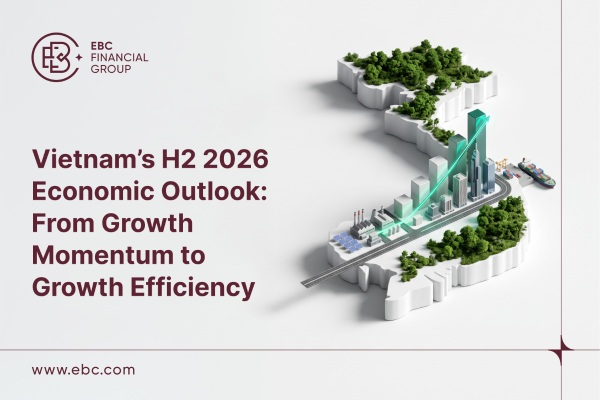
Vietnam enters the second half of 2026 from a position of considerable economic strength. GDP expanded by 8.39% year on year in the second quarter, bringing first-half growth to 8.18%. The Index of Industrial Production rose by 10.8%, with manufacturing and processing output increasing by 11.4%.
Gross capital formation increased by 15.2%, while total investment capital realised across the economy rose by 12.9%. Registered foreign direct investment reached USD 34.65 billion, up 61%, while realised FDI rose by 11.2% to USD 13.03 billion. The International Monetary Fund ("IMF") has raised its 2026 growth forecast for Vietnam to 7.5%, supported by technology exports and domestic demand. The Government, meanwhile, continues to pursue GDP growth of at least 10% while maintaining macroeconomic stability.
Strong growth has, however, been accompanied by emerging pressures. Merchandise imports increased by 33.4%, outpacing export growth of 21% and shifting the trade balance to a deficit of USD 16.65 billion. Average consumer-price inflation reached 4.38% in the first half, while credit growth stood at 7.41% compared with deposit growth of 5.02% as of 26 June.
According to EBC Financial Group ("EBC"), Vietnam's second-half outlook remains constructive. The central issue is increasingly how efficiently the rising volumes of investment capital, credit and imported inputs can be converted into output, productivity and domestic value creation, while preserving buffers in inflation, liquidity and the external balance.
Sana Ur Rehman, Senior Market Analyst at EBC Financial Group, commented,: "Vietnam enters the second half of the year with strong economic momentum. The question now is how much additional capital, credit and imported input will be required to generate each additional unit of growth. The efficiency with which resources are allocated will increasingly determine the durability of this cycle."
Final consumption expenditure increased by 8.15% in the first half, while gross capital formation rose by 15.2%, indicating a growing role for investment in the composition of economic expansion. Manufacturing and processing contributed 8.9 percentage points to overall industrial production growth, reinforcing their central position at the intersection of FDI, production and exports.
Part of the increase in capital formation reflects imported raw materials and components intended for subsequent production cycles. At the same time, registered FDI increased by 61%, compared with an 11.2% rise in realised FDI. Together, these trends place greater emphasis on the economy's capacity to absorb and execute investment: businesses need to convert inputs into orders and production, while investment projects need to move from commitments and approvals into operation. The pace of land clearance, power connectivity, logistics development and industrial infrastructure will directly affect how quickly investment translates into new productive capacity.
Rehman said, : "The strength of registered investment demonstrates continued investor confidence. Its ultimate economic value, however, will be determined by how quickly committed capital is converted into factories, infrastructure and productivity. The second half of the year will increasingly be a story of execution."
Vietnam's merchandise exports reached USD 266.52 billion in the first six months of 2026, an increase of 21%, while imports rose by 33.4% to USD 283.17 billion. The goods trade balance consequently shifted from a surplus of USD 7.95 billion in the same period of 2025 to a deficit of USD 16.65 billion. Yet capital goods and production inputs accounted for 94.2% of total imports during the first four months of the year. Higher imports of machinery, components and raw materials may therefore also indicate an expansion in future productive capacity; their ultimate economic impact will depend on how effectively these inputs are converted into output and exports.
The share of value retained within the domestic economy also warrants closer attention. The FDI sector recorded export growth of 26% and accounted for 79.9% of Vietnam's total export turnover, while exports by domestic enterprises increased by 4.6%. Domestic businesses recorded a trade deficit of USD 24.95 billion, compared with a surplus of USD 8.3 billion generated by the FDI sector. These figures underscore both the scale of foreign-invested production networks and the remaining gap in domestic supply-chain capacity.
The World Bank has highlighted the importance of increasing the domestic value retained from production and strengthening linkages between foreign-invested companies and Vietnamese enterprises. From EBC's perspective, the efficiency with which imported inputs are converted into domestic economic value should therefore become an increasingly relevant indicator: how much output, export revenue and domestic value added can Vietnam generate from each unit of imported productive input?
"A trade deficit is not necessarily a sign of economic weakness when a large share of imports is supporting production and investment. The more important question is how quickly these inputs are converted into productive capacity, higher productivity and future foreign-currency earnings. If that conversion takes too long, pressure can emerge first through the external balance and demand for foreign currency,." - Rehman explained.
Average consumer-price inflation reached 4.38% in the first half, approaching the Government's full-year target of around 4.5%, while core inflation stood at 4.12%. Prices of raw materials, fuels and other inputs used in production rose by 5.4%, while industrial producer prices increased by 4.18%, adding pressure to corporate margins.
Credit to the economy increased by 7.41% as of 26 June, compared with deposit growth of 5.02%. The gap does not in itself indicate systemic liquidity stress, but it makes funding conditions, deposit rates and borrowing costs increasingly relevant variables for the second half. EBC believes that stronger investment execution, faster resolution of project bottlenecks and productivity improvements can share more of the burden of supporting economic activity, allowing monetary policy to preserve greater flexibility.
According to Rehman, "The policy trade-offs are becoming more visible. Monetary policy needs to support economic activity while retaining sufficient flexibility to respond to changes in energy prices, the exchange rate and global financial conditions."
State budget revenue reached VND 1.5682 quadrillion in the first half, equivalent to 62% of the full-year estimate and 17.4% higher than a year earlier. By the end of June, public investment disbursement had reached VND 356.9 trillion, equivalent to 35.5% of the plan assigned by the Prime Minister and approximately VND 38.4 trillion higher than in the same period last year.
The remaining investment pipeline provides meaningful room for further execution in the second half, although its contribution to growth will depend on both project quality and implementation speed. Transport, energy and logistics infrastructure can support demand in the near term while lowering operating costs for the private sector once completed. Similarly, Vietnam's substantial pipeline of registered FDI will require reliable electricity supply, efficient logistics, skilled labour and stronger domestic supplier networks if commitments are to be translated into productive assets.
The IMF has identified two opposing forces shaping the global outlook: investment associated with artificial intelligence is supporting economies integrated into technology value chains, while energy shocks are raising costs for fuel-importing economies. Vietnam is exposed to both trends. Its position within technology supply chains continues to support manufacturing exports and FDI, while higher energy and transportation costs could exert renewed pressure on production expenses.
Vietnam's economic outlook for the second half of 2026 remains broadly positive. Manufacturing continues to expand at a strong pace, domestic demand remains supportive, investment is accelerating and FDI continues to reinforce Vietnam's position as a major production base. The principal areas to monitor are the import intensity of growth, input-cost pressures, the pace of credit relative to funding and the effectiveness with which investment is translated into additional productive capacity.
EBC believes the quality of growth in the coming quarters can increasingly be assessed through three conversions: capital into productivity, imported inputs into domestic value added, and economic growth into greater macroeconomic resilience.
"When capital translates into productivity, imports generate greater domestic value, and growth strengthens macroeconomic buffers, a high growth rate becomes the foundation for a longer development cycle. That is what will allow Vietnam to move closer to its high-income ambitions without accumulating imbalances that could constrain the next phase of expansion,." - Rehman concluded.