Published on: 2026-03-30
Updated on: 2026-03-30
IVV and VOO both exchange-traded funds track the same benchmark, yet subtle differences in structure, efficiency, and execution can still influence long-term results.
For investors searching for the best S&P 500 ETF, the decision often comes down to small but meaningful details rather than headline performance. Understanding these nuances can help you make a more confident, informed investment decision.
IVV and VOO both track the S&P 500 Index and deliver nearly identical returns.
Both ETFs offer extremely low expense ratios of 0.03 per cent.
Differences lie in structure, securities lending, and dividend efficiency.
IVV may have a slight edge in operational efficiency, while VOO is favoured for simplicity.
For most investors, consistency matters more than choosing between the two.
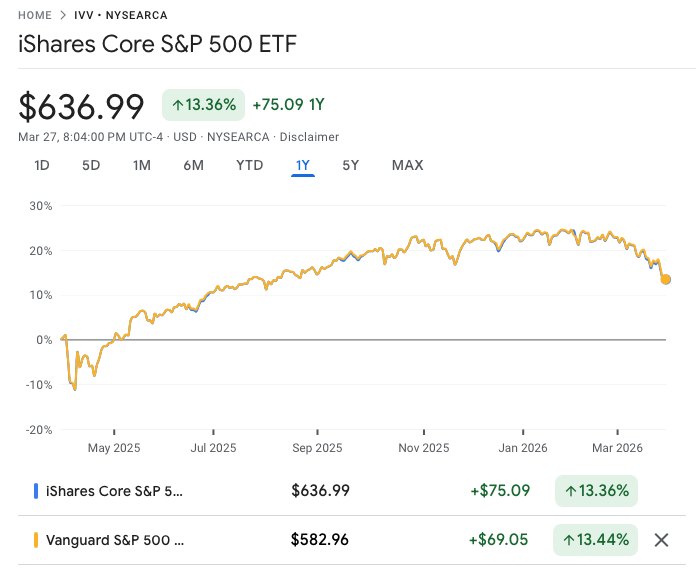
From a performance standpoint, IVV and VOO are nearly identical because they track the same index.
Long-term returns closely mirror the S&P 500
Short-term performance differences are negligible.
Tracking error is extremely low for both funds.
In practical terms, a $10,000 investment in either IVV or VOO over a decade would result in almost identical portfolio values. The difference is typically measured in a fraction of a per cent.
Both IVV and VOO offer an expense ratio of 0.03 per cent, making them among the cheapest ETFs available globally.
This cost efficiency is critical for long-term investors because even small fee differences can compound significantly over time. However, in this case, there is no meaningful cost advantage between the two.
Both ETFs pay dividends quarterly, reflecting the underlying companies in the S&P 500.
IVV may show a slightly higher yield in certain periods
VOO’s yield is typically very close, but can be marginally lower
Differences often stem from differences in distribution timing and fund management practices.
These variations are not driven by holdings, since both funds own the same stocks, but rather by operational efficiency and dividend handling.
BlackRock’s IVV engages more actively in securities lending, which can generate additional income for the fund. This can slightly improve returns over time.
Vanguard also participates in securities lending but typically returns more of the revenue to investors in a different structure.
Both ETFs track the S&P 500 very closely, but IVV has historically shown slightly tighter tracking due to its operational structure.
While the difference is extremely small, institutional investors may still consider this factor.
IVV operates with a structure optimised for flexibility and reinvestment efficiency
VOO benefits from Vanguard’s unique ownership model, which aligns the company with investor interests
Both are highly efficient, but the structural nuance can matter at scale.
IVV may maintain slightly lower cash positions, allowing it to stay more fully invested. This can improve performance marginally in strong markets.
VOO is also efficient but may hold minimal cash depending on flows and redemptions.
In the current market environment, where investors are focused on long-term growth and cost efficiency, both IVV and VOO remain excellent choices.
The United States equity market remains driven by large-cap companies, making S&P 500 ETFs a core portfolio holding.
However, the reality is simple:
The performance gap between IVV and VOO is negligible.
Structural differences are minor for most investors.
The choice will not significantly impact long-term wealth.
The more important decision is whether you are consistently investing, not which ETF you choose.
To understand the real impact of choosing between IVV and VOO, consider a practical long-term scenario.
Imagine two investors who each invest $1,000 per month over a ten-year period. One investor chooses IVV, while the other chooses VOO. Since both funds track the S&P 500, their annual returns remain closely aligned throughout the investment horizon.
Assuming an average annual return of 8 per cent, both portfolios would grow to roughly $185,000 by the end of the ten years. The difference between the two portfolios would likely be negligible, often less than a few hundred dollars, due to small variations in tracking and dividend timing.
Now consider a third investor who spends twelve months comparing IVV vs VOO before investing. By delaying market entry, this investor misses a full year of compounding. Even with the same monthly contribution afterwards, the final portfolio value could fall short by several thousand dollars.
The real risk is not selecting the wrong ETF. The real risk is waiting too long to start.
Overanalysing Small Differences: Investors often focus too much on minor variations such as yield differences or trading volume, which have little real impact.
Delaying Investment Decisions: Spending too much time deciding between IVV and VOO can lead to missed market opportunities. Time in the market is more important than perfect selection.
Ignoring Long-Term Strategy: The success of an investment strategy depends on consistency, diversification, and discipline, not minor ETF differences.
The main difference lies in the issuer and fund structure. IVV is managed by BlackRock, while VOO is managed by Vanguard. Both track the same index and deliver nearly identical performance.
Both IVV and VOO are excellent for long-term investing. The choice depends more on personal preference than performance, as both funds provide low-cost exposure to the S&P 500.
Yes, both ETFs pay quarterly dividends based on the underlying companies in the S&P 500. The yield is very similar, with only minor variations over time.
Switching between IVV and VOO is generally unnecessary. The performance difference is minimal, and switching may trigger transaction costs or taxes.
Both are suitable for beginners. VOO is often preferred for its simplicity and strong brand recognition, while IVV offers the same benefits with similar efficiency.
The comparison of IVV vs VOO shows that both ETFs are fundamentally similar and highly effective for gaining exposure to the S&P 500. While IVV may offer slight advantages in tracking efficiency and operational precision, VOO remains a preferred choice for many long-term investors due to its simplicity and structure.
Disclaimer: This material is for general information purposes only and is not intended as (and should not be considered to be) financial, investment or other advice on which reliance should be placed. No opinion given in the material constitutes a recommendation by EBC or the author that any particular investment, security, transaction or investment strategy is suitable for any specific person.