Published on: 2026-06-08
Updated on: 2026-06-08
The Alligator Indicator is a technical analysis tool that helps traders see whether a market is trending or moving sideways. Trader Bill Williams created the Alligator Indicator using three smoothed moving averages. These lines are known as the Jaw, Teeth, and Lips.
The indicator works on a simple idea. When the three lines are close together, the alligator is “sleeping,” and the market likely has no clear direction. When the lines move apart, the alligator is “waking up” or “eating,” suggesting a trend may be starting or already underway.
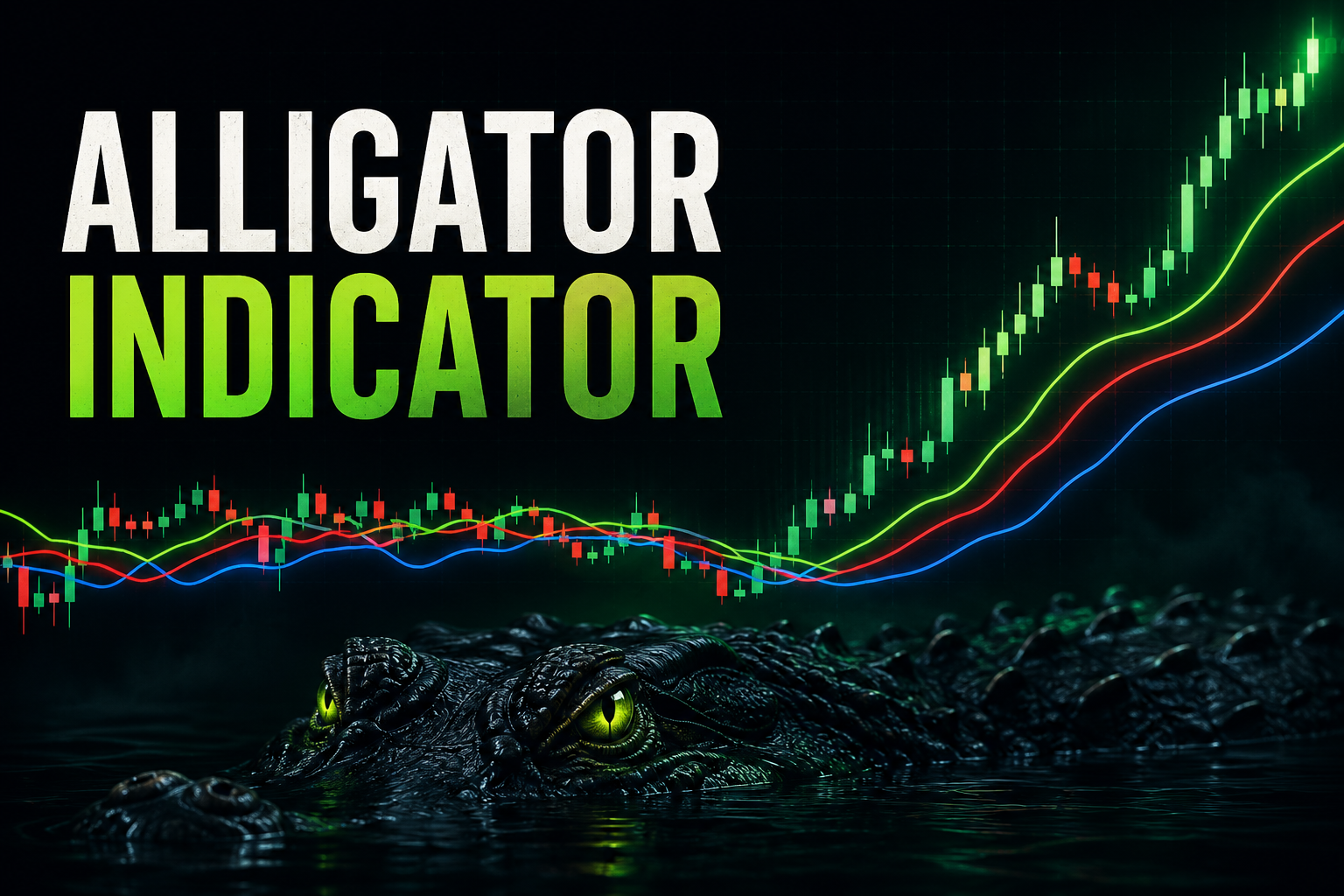
The Alligator Indicator has three lines:
Jaw, blue line: the slowest line, usually a 13-period smoothed moving average.
Teeth, red line: the middle line, usually an 8-period smoothed moving average.
Lips, green line: the fastest line, usually a 5-period smoothed moving average.
When the price starts to move, the green line reacts first, followed by the red line, and then the blue line, which is the slowest. This setup gives traders a quick way to see which direction the market is moving.
If the lines are close together, the market is probably moving sideways. Prices might fluctuate without forming a strong trend, so traders often wait rather than jump in.
When the lines start to separate, it can mean momentum is building. This is often an early sign that the market is moving out of a sideways phase.
If the lines are clearly spread out and moving in the same direction, the trend is stronger. Traders often use this as a sign to stick with the trend.
When the lines begin to come together again, it can mean the trend is getting weaker.
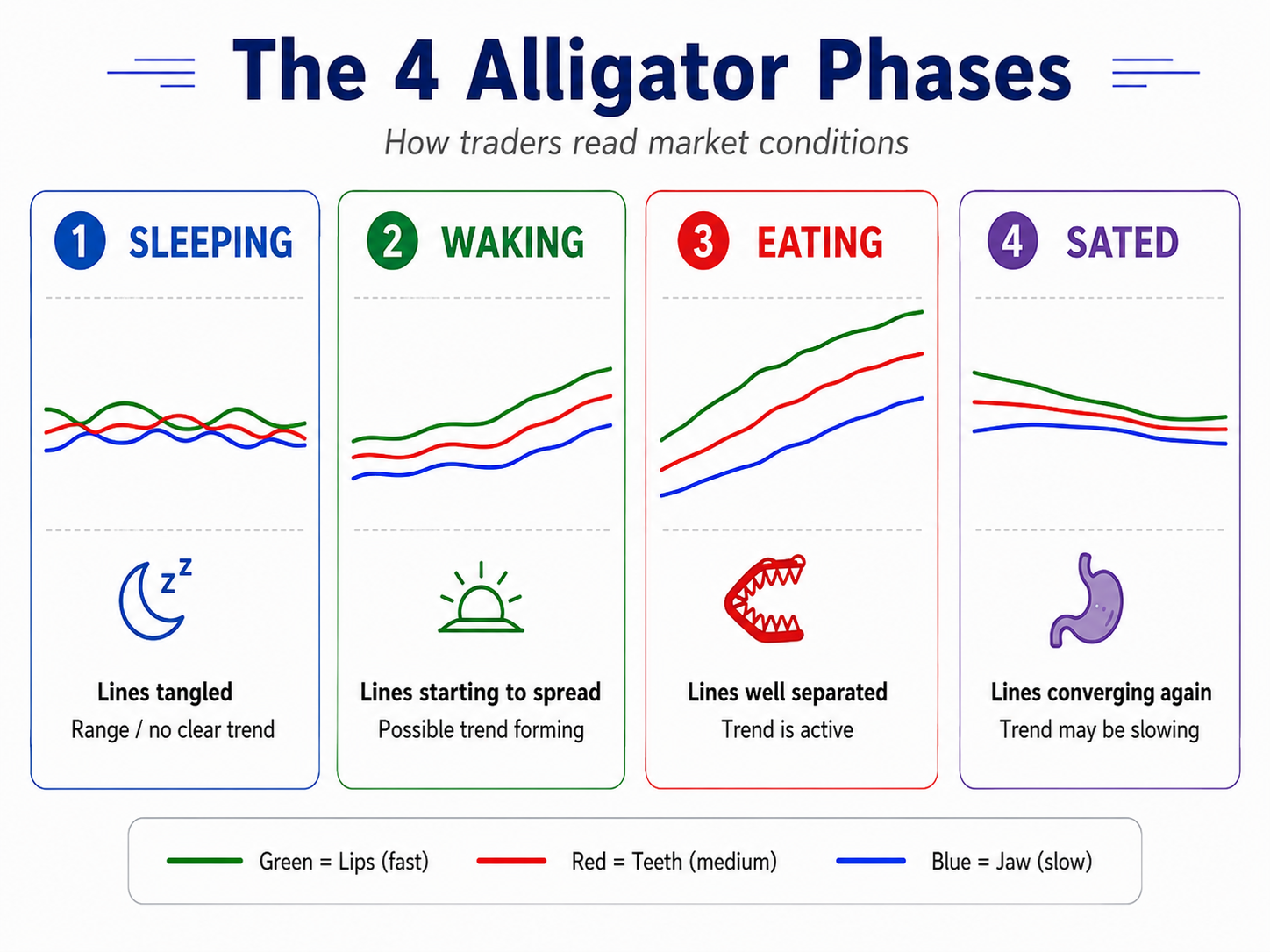
The Alligator Indicator is often explained through four market phases:
Sleeping: The three lines are tangled together. This usually points to a sideways or uncertain market.
Waking: The lines begin to separate. This may suggest that a new trend is starting.
Eating: The lines are spread apart and moving in the same direction. This usually means the trend is active.
Sated: The lines move closer together again. This can suggest that the trend is slowing down.
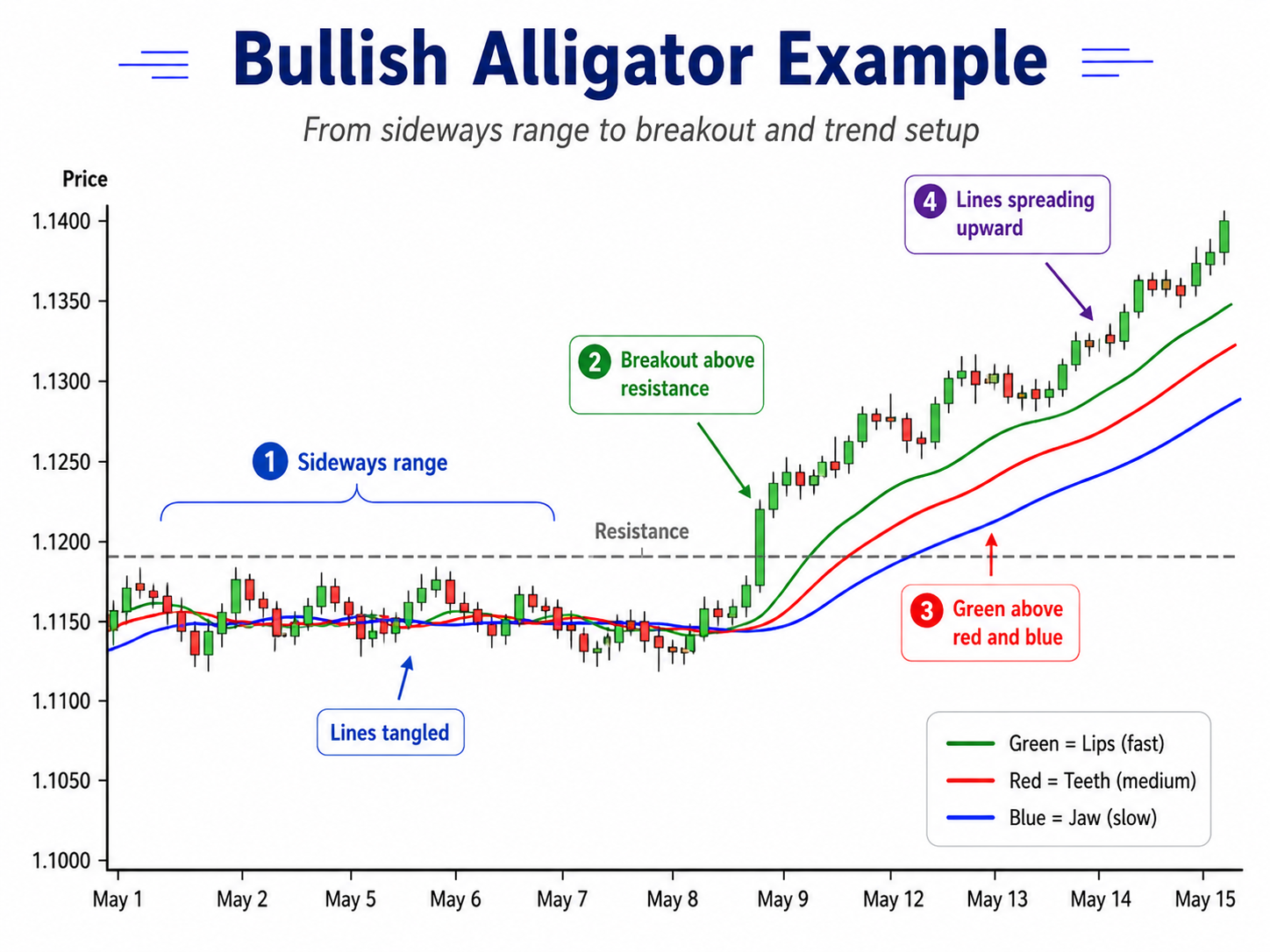
A bullish signal happens when the green Lips move above the red Teeth, and the red Teeth move above the blue Jaw. This means the faster-moving average is leading the slower ones upward.
A bearish signal happens when the green Lips move below the red Teeth, and the red Teeth move below the blue Jaw. This shows that downward momentum is stronger.
For example, suppose a stock has been moving sideways for a few days, and the Alligator lines are tangled. If the price breaks above recent resistance, the green line moves above the red and blue lines, and the lines continue to spread upward, traders might see this as a possible bullish trend setup.
The signal is stronger if price action supports it. A clear breakout, higher trading volume, or a pattern of higher highs and higher lows can make the setup more reliable.
Traders use the Alligator Indicator because many losses occur during choppy market conditions.
A market might seem active even if there’s no real trend. Prices can go up for a few candles and then quickly reverse. The Alligator Indicator helps traders avoid mistaking every small move for a new trend.
It can help traders:
Identify when a market is ranging.
Spot when a trend may be starting.
Confirm the direction of an existing trend.
Avoid entering too early when price action is unclear.
Stay in a trend while momentum remains strong.
This indicator is especially helpful for traders who like clear, visual signals.
The Alligator Indicator is a lagging tool. It uses past price data, so it usually confirms a move after the price has already started to change.
It can also give false signals when the market is moving sideways. If the lines keep crossing, traders might receive repeated buy and sell signals without a real price move.
The indicator does not explain why the market is moving. It does not show metrics such as earnings, interest rates, economic news, liquidity, or investor sentiment.
Because of this, traders usually combine the Alligator Indicator with other tools like support and resistance, candlestick patterns, volume, and risk management.
Moving Average: A tool that smooths price data to show the average price over a selected period.
Trend: The general direction of price movement, which can be upward, downward, or sideways.
Support and Resistance: Price areas where buying or selling pressure may appear.
Momentum: The strength or speed of a price move.
False Signal: A trading signal that appears valid but does not lead to the expected move.
Lagging Indicator: An indicator that reacts after price movement has already begun.
Yes. The Alligator Indicator is good for beginners because it’s visual and easy to understand. It helps traders spot trends or sideways markets. Still, beginners shouldn’t use it on its own and should always follow basic risk management.
The three lines are different smoothed moving averages. The green Lips react the fastest, the red Teeth move at a medium speed, and the blue Jaw is the slowest. Their positions help traders judge market direction and trend strength.
The indicator is less effective in sideways markets. When the lines are tangled and cross often, prices usually lack direction. In these cases, the indicator may give false signals, so traders often wait for a clearer breakout.
No. The Alligator Indicator does not predict future prices. It looks at past price data to show trend direction and market conditions. It can help traders spot possible opportunities, but it does not guarantee profits.
The Alligator Indicator is a trend-following indicator that uses three smoothed moving averages: the Jaw, Teeth, and Lips. When the lines are tangled, the market may be sideways. When the lines begin to separate, a trend may be forming. When the lines are clearly spread apart, the trend may already be active.
The indicator is helpful for beginners because it gives a simple, visual way to read market conditions. Its main weakness is that it reacts slowly and can give false signals in choppy markets. The best way to use the Alligator Indicator is as a trend filter, alongside price action, support and resistance, volume, and sound risk management.