Published on: 2025-12-12
Updated on: 2025-12-12
"What the best CFD trading tips are" is a question that consistent success depends on disciplined risk management, structured analysis and controlled execution.
These principles protect traders from the amplified risks associated with leverage and volatile price movements. This foundation is crucial because recent data shows that a majority of retail CFD traders lose money, and this confirms the importance of sound practice and realistic expectations.
Below, the article will explore risk control methods, analysis techniques, strategic approaches, psychological discipline, common mistakes and practical tools that support competent and sustainable trading.

CFDs allow traders to speculate on price movement without owning the underlying asset. A strong understanding of how the product functions helps traders avoid unnecessary mistakes.
Leverage and margin: Leverage cuts capital requirements, but margin needs constant monitoring to prevent forced liquidation.
Bid ask spreads: Tight spreads improve efficiency and reduce friction costs. Wider spreads increase entry and exit expenses.
Financing charges: Overnight swaps influence long holding periods. Traders must factor these costs into strategy planning.
Contract sizing: Different assets use different contract values and pip calculations. Understanding these prevents sizing errors.
A trader chooses a stock CFD with high volatility. In this case:
Margin rises during volatile events
Spread widens around announcements
Larger price gaps become more likely
Understanding these mechanisms helps traders better plan timing, entry and risk management.
EBC offers clear pricing models and consistent execution behaviour, allowing traders to observe CFD mechanics in real market environments. This transparency helps both beginners and advanced traders understand how margin, spreads and costs influence long term outcomes.
Analysing the market environment is essential because conditions directly influence strategy effectiveness. A trend focused strategy works well during directional phases but performs poorly in choppy markets.
Trend direction and quality: Strong, clean trends offer higher probability setups.
Volatility measurement: Tools such as ATR help assess whether the market is quiet or aggressive.
Liquidity considerations: Major sessions offer tighter spreads and clearer behaviour.
Economic events: High impact releases such as CPI, NFP or central bank speeches create unexpected volatility.
Sector correlations: For example, gold correlates with USD movement, while indices respond strongly to earnings season.
A trader can create a daily structure that includes:
A morning review of overnight movements
A scan for breakout or pullback levels
A check of the economic calendar
A review of correlated assets to confirm direction
EBC provides stable data feeds that remain consistent during major volatility spikes. This reliability supports traders who depend on accurate live prices to evaluate conditions effectively.

A well structured risk reward model ensures that even with a moderate win rate, a trader can remain profitable.
A strong system defines where to exit before entering.
Fixed risk per trade, often 1 to 2 percent of account size
Logical stop placement based on structure rather than emotion
Realistic profit targets aligned with the nature of the asset
Continuous review of win rate and expectancy
A trader with a 40 percent win rate can be profitable if most wins are larger than losses.
For example:
Risk 100
Average loss 100
Average gain 200
Over ten trades, the trader may still finish with a positive result.
EBC offers consistent margin policies and negative balance protection, giving traders a predictable risk environment. This stability makes risk reward calculations clearer and helps prevent unexpected account stress.
Leverage is useful, but it becomes risky if applied without structure. Responsible leverage applications ensure traders maintain control even in volatile markets.
Start with lower leverage until your strategy proves stable
Never size positions based solely on available margin
Adjust leverage according to market conditions
Increase position size only when the trade meets strict criteria
High leverage often leads to emotional pressure, premature exits and fear driven decisions.
A balanced approach:
Reduces stress
Encourages rule based trading
Improves clarity and focus
EBC offers multiple account configurations with flexible leverage levels. Traders can choose settings that align with their experience level and trading approach, supporting more responsible use of exposure.

Success in CFD trading relies less on predicting the market and more on applying a disciplined structure.
Pre market preparation: Identify zones, trends and scenarios.
Execution rules: Conditions for entry, confirmation tools and stop placements.
Risk rules: Maximum loss per day or per trade.
Review cycle: Analyse completed trades, screenshots and mistakes.
Traders who maintain structure:
Experience fewer emotional trades
Develop clearer analytics
Improve strategy refinement
Reduce random behaviour
EBC's stable infrastructure helps traders maintain discipline by reducing disruptions such as platform freezes or inconsistent execution.
Both forms of analysis help traders interpret the market from different perspectives and improve timing accuracy.
Effective technical analysis often includes:
Identifying multi timeframe trends
Using confluence of indicators
Tracking volume changes during breakouts
Mapping liquidity zones and institutional levels
Studying market cycles within each asset class
Strong fundamental preparation includes:
Analysing global economic cycles
Tracking central bank expectations
Studying commodity supply and demand
Reviewing earnings trends for indices
Understanding geopolitical risk shifts
EBC offers powerful charting tools, reliable streaming data and analytical resources that support both technical and fundamental workflows.
Choosing a suitable broker shapes overall trading experience, from cost to platform reliability.
Quality of customer service
Strength of regulatory framework
Execution consistency under stress
Access to a range of instruments
Clarity of cost structure
EBC combines competitive spreads, fast execution and solid client fund protection. The platform structure provides institutional grade stability, which benefits both beginners and experienced participants.
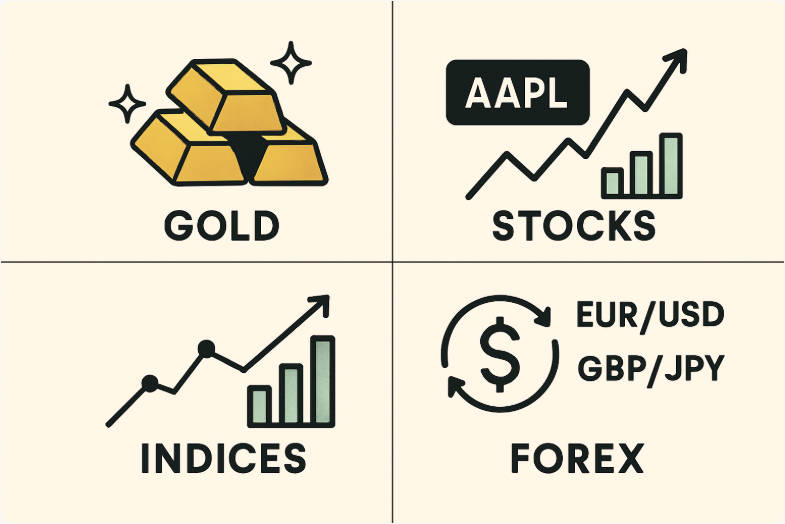
A multi asset approach helps traders adapt to changing cycles. When one sector slows, another may enter a strong phase.
Traders may diversify by:
Index CFDs for broader momentum
Forex CFDs for macro themed moves
Commodity CFDs for supply demand opportunities
Equity CFDs for earnings and trend follow setups
Reduces concentration risk
Increases exposure to new opportunities
Helps traders understand market relationships
Allows strategy rotation across assets
EBC provides a wide range of CFD products across major asset categories, enabling traders to construct broader and more adaptive portfolios.
CFD success requires consistent improvement rather than chasing short term results.
They track data and adjust strategies carefully
They accept drawdowns as part of the process
They prioritise stable performance over quick wins
They build psychological resilience through review and preparation
Keep a journal
Review all trades weekly
Test adjustments in a controlled environment
Maintain realistic expectations
EBC's stable environment and transparent conditions help traders build confidence as they refine long term strategies and invest time into steady improvement.
Traders often adopt a ratio of at least 1 to 2 to ensure potential reward exceeds potential risk. This ratio provides enough breathing room for price fluctuation while maintaining clear profit objectives.
Beginners are encouraged to start with lower leverage to reduce exposure during early learning. Lower leverage helps traders focus on decision making and risk control rather than managing excessive volatility.
A stable and transparent broker ensures consistent spreads, clear pricing and secure fund protection. Reliable execution helps traders carry out strategies without unexpected slippage or platform interruptions.
EBC can be a practical choice for beginners because it offers straightforward account options, competitive spreads and reliable execution. These features help new traders focus on learning without dealing with unnecessary platform complications.
Emotional bias can be reduced through structured routines, journaling, predefined rules and regular post trade reviews. These practices help traders maintain clarity and avoid impulsive decisions caused by stress or excitement.
CFD trading becomes more effective when traders combine disciplined risk management, structured analysis and a clear understanding of market conditions. A reliable broker also plays a vital role in shaping consistency and execution quality.
By applying these methods and refining each part of the trading process, participants can build a more confident, controlled and long lasting approach to CFD trading.
Disclaimer: This material is for general information purposes only and is not intended as (and should not be considered to be) financial, investment or other advice on which reliance should be placed. No opinion given in the material constitutes a recommendation by EBC or the author that any particular investment, security, transaction or investment strategy is suitable for any specific person.