Published on: 2026-01-17
Updated on: 2026-01-17
Reliance Industries Q3 FY26 results indicate that operating profit is increasing at a faster rate than net profit. Consolidated revenue reached ₹293,829 crore, representing a 10.0% year-on-year increase, while EBITDA rose to ₹50,932 crore, up 6.1% year-on-year. However, profit growth remained modest due to higher depreciation and finance costs, which increased alongside the capital expenditure cycle.
This quarter highlighted a structural shift in Reliance Industries earnings composition. Digital Services and Retail segments continued to expand, Oil-to-Chemicals (O2C) benefited from improved fuel cracks, while the upstream segment continued to underperform. Net debt was contained at ₹117,102 crore, and quarterly capital expenditure (excluding spectrum) totaled ₹33,826 crore, maintaining balance sheet stability despite significant investment.
Top-line strength with margin compression: Revenue grew 10.0% YoY to ₹293,829 crore, while EBITDA margin slipped to 17.3% (down 70 bps YoY). The message is clear: growth is coming through scale and mix, not pricing power at the consolidated level.
EBITDA rose, profit barely moved, for a mechanical reason: EBITDA increased by ₹2,929 crore YoY, but higher depreciation (+₹1,441 crore), finance costs (+₹434 crore), and tax (+₹691 crore) absorbed most of that uplift. That explains why profit after tax plus share of associates/JVs rose by only ₹360 crore YoY to ₹22,290 crore.
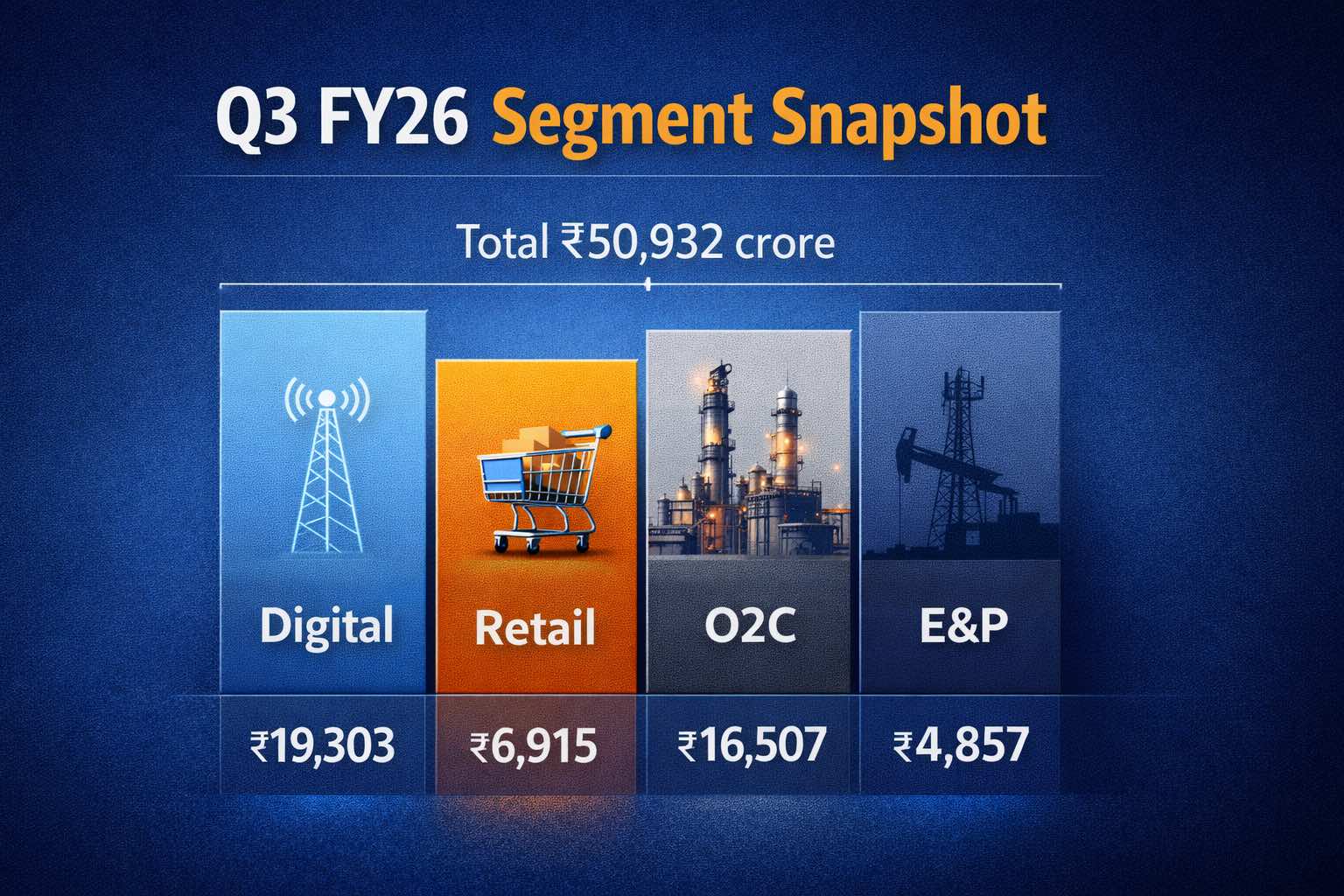
Digital is now the cleanest operating leverage engine: Jio revenue from operations rose to ₹37,262 crore (+12.7% YoY), and EBITDA climbed to ₹19,303 crore (+16.4% YoY), supported by ARPU of ₹213.7 and 170 bps margin expansion.
Retail is growing, but reinvestment is visible in margins: Retail revenue from operations reached ₹86,951 crore (+9.2% YoY) while consolidated Retail EBITDA margin (on revenue from operations) eased to 8.0% (down 60 bps YoY). Quick commerce scale is rising quickly, which is strategically valuable but typically margin-dilutive early on.
O2C carried the energy complex: O2C EBITDA rose 14.6% YoY to ₹16,507 crore and margin improved to 10.2%, driven by stronger transportation fuel cracks and better volumes, partly offset by weaker downstream chemical margins.
Upstream remained the swing factor in consolidated profit quality: E&P revenue fell 8.4% YoY to ₹5,833 crore, and EBITDA declined 12.7% YoY to ₹4,857 crore, reflecting lower volumes and realizations.
Non-energy EBITDA dominance is no longer a narrative; it is a number: Reliance’s presentation highlights that nearly 60% of EBITDA is now contributed by non-energy businesses, reinforcing a gradual reduction in cyclical exposure.
Metric (Consolidated) |
Q3 FY26 |
YoY change |
| Revenue | ₹293,829 crore | +10.0% |
| EBITDA | ₹50,932 crore | +6.1% |
| EBITDA margin | 17.3% | -70 bps |
| Profit after tax | ₹22,167 crore | +1.7% |
| PAT + associates/JVs | ₹22,290 crore | +1.6% |
| Capex (ex spectrum) | ₹33,826 crore | n/a |
| Net debt | ₹117,102 crore | broadly stable |
A common reading of the Reliance Industries Q3 results is “EBITDA up, profit flat.” The important part is why.
EBITDA increased from ₹48,003 crore to ₹50,932 crore, a gain of ₹2,929 crore.
Depreciation increased from ₹13,181 crore to ₹14,622 crore, a gain of ₹1,441 crore.
Finance costs increased from ₹6,179 crore to ₹6,613 crore, a gain of ₹434 crore.
Tax increased from ₹6,839 crore to ₹7,530 crore, a gain of ₹691 crore.
Add those three cost lines together, and the increase is ₹2,566 crore. That leaves roughly ₹363 crore, which is almost exactly the year-on-year lift in PAT including associates/JVs (₹22,290 crore vs ₹21,930 crore, up ₹360 crore). This is not a mystery quarter. It is a capital intensity quarter, where operating growth is being converted into depreciation and financing, not reported profit.
This is also the lens investors should apply to the next few quarters. If capex remains high and assets keep getting capitalised into depreciation, reported profit will lag operating profit, even if business momentum stays strong.
At an operating level, Q3 was powered by two engines, Digital Services and O2C, with Retail growing but showing margin pressure and E&P contracting.
Jio Platforms: Gross revenue ₹43,683 crore (+12.7% YoY), revenue from operations ₹37,262 crore (+12.7% YoY), EBITDA ₹19,303 crore (+16.4% YoY), EBITDA margin 51.8% (up 170 bps YoY).
Reliance Retail: Gross revenue ₹97,605 crore (+8.1% YoY), revenue from operations ₹86,951 crore (+9.2% YoY), EBITDA ₹6,915 crore (+1.3% YoY), EBITDA margin 8.0% (down 60 bps YoY).
O2C: Revenue ₹162,095 crore (+8.4% YoY), EBITDA ₹16,507 crore (+14.6% YoY), EBITDA margin 10.2% (up 60 bps YoY).
E&P: Revenue ₹5,833 crore (-8.4% YoY), EBITDA ₹4,857 crore (-12.7% YoY), EBITDA margin 83.3% (down 410 bps YoY).
The composition matters because it influences how durable the quarter is. O2C is cyclical and crack-driven. Digital Services is repeatable, high-margin, and scale-led. Retail is strategically critical but currently in an investment phase that can dilute margins while building defensible distribution density.
Jio’s Q3 performance is the clearest example of “scale plus monetisation” translating into margin expansion.
Subscriber base reached 515.3 million, with 8.9 million net additions in the quarter.
ARPU improved to ₹213.7 (from ₹211.4 in Q2 FY26 and ₹203.3 in Q3 FY25).
Data traffic rose to 62.3 billion GB (+34% YoY), while per capita consumption reached 40.7 GB per month.
5G users reached 253 million, and 5G accounted for about 53% of wireless traffic, indicating a genuine mix shift rather than a marketing metric.
Fixed broadband-connected premises increased to 25.3 million, and JioAirFiber crossed 11.5 million subscribers.
The strategic takeaway is that Jio is now monetising two networks simultaneously: mobile and home broadband. That twin-network model usually improves customer stickiness and lowers churn sensitivity. With churn stable at 1.8%, incremental ARPU tends to flow through to EBITDA at a high rate, which is exactly what the margin expansion signals.
Retail delivered solid growth during a festive-heavy quarter, but the margin trajectory shows the cost of building speed and reach.
Operationally, the scale continues to rise:
Transactions reached 524 million in Q3 FY26, up 47.6% YoY.
Store count increased to 19,979 (431 stores added in the quarter).
Registered customer base expanded to 378 million (+11.8% YoY).
The unique angle in Q3 sits inside hyperlocal commerce. JioMart crossed an exit run-rate of 1.6 million daily orders, with 53% QoQ and 360%+ YoY growth in average daily orders, plus 5.9 million new customers added during the quarter.
That is strategic progress, but it also explains why EBITDA growth is subdued. Quick commerce expansion typically requires dark stores, higher fulfillment intensity, and promotional spend to lock in frequency. Those costs can compress margins before density kicks in. The market should read Q3 Retail margins as “investment-led,” not as demand weakness.
O2C was the swing factor on the energy side, and it performed well in Q3 FY26.
Segment revenue increased to ₹162,095 crore (+8.4% YoY).
EBITDA rose to ₹16,507 crore (+14.6% YoY), and margin expanded by 60 bps to 10.2%.
The driver was a sharp improvement in transportation fuel cracks and better volumes, while downstream chemical margins stayed weak, and feedstock freight costs were higher.
The macro context supports the fuel side. Dated Brent averaged $63.7 per barrel in Q3 FY26, down $11.1 per barrel YoY, while demand indicators for refined products stayed constructive. That combination often widens cracks when product markets tighten.
Jio-bp is also becoming an operational lever rather than a footnote: the network reached 2,125 outlets (+14% YoY), and volumes grew 24.7% for diesel and 20.8% for petrol on a YoY basis.
The risk, as always, is that crack strength normalises faster than chemical margins recover. For Q4 and FY27 positioning, the key is whether chemicals stop being a drag at the same time fuel margins soften, or whether the cycle hands back part of Q3’s gain.
E&P remains high-margin but smaller in scale, and Q3 showed the downside of natural decline.
Revenue fell to ₹5,833 crore (-8.4% YoY).
EBITDA declined to ₹4,857 crore (-12.7% YoY).
KGD6 gas realisation averaged $9.65 per MMBTU versus $9.74 a year ago, while CBM realisation was $9.29 per MMBTU versus $10.58.
Average KGD6 production was 25.6 MMSCMD of gas and 17,290 bbl/day of oil/condensate, and KGD6 production was 61.8 BCFe for the quarter.
The operational update shows efforts to support CBM volumes through a multi-lateral well campaign, but those projects take time to translate into meaningful offsets.
Reliance’s balance sheet remains controlled relative to earnings power:
Outstanding debt was ₹346,896 crore, and cash and equivalents were ₹229,794 crore.
Net debt was ₹117,102 crore, and net debt to annualised EBITDA was 0.57x.
The more important message is capital allocation. Capex was ₹33,826 crore in Q3 FY26 (excluding spectrum), with investment spanning O2C, New Energy, and ongoing strengthening of the Jio and Retail networks.
This is why the profit bridge matters. Reliance is in a phase where operating strength is visible in EBITDA, while reported profit is being shaped by depreciation and finance costs as assets get operationalised, especially in telecom.
Consolidated revenue was ₹293,829 crore, EBITDA was ₹50,932 crore, and profit after tax was ₹22,167 crore. Profit after tax plus share of associates and JVs was ₹22,290 crore. EBITDA margin was 17.3%, down 70 bps year on year.
EBITDA rose by ₹2,929 crore YoY, but depreciation increased by ₹1,441 crore, finance costs by ₹434 crore, and tax by ₹691 crore. Those increases absorbed most of the operating profit uplift, leaving only a small net increase in profit.
Jio revenue from operations rose to ₹37,262 crore, and EBITDA increased to ₹19,303 crore, with EBITDA margin expanding to 51.8%. ARPU improved to ₹213.7, and the subscriber base reached 515.3 million, supported by 253 million 5G users.
Retail revenue from operations reached ₹86,951 crore, and EBITDA was ₹6,915 crore. Transactions rose to 524 million, and store count increased to 19,979. JioMart’s exit run-rate of 1.6 million daily orders signals rapid hyperlocal scaling, even as margins tightened.
O2C EBITDA rose 14.6% YoY to ₹16,507 crore with margin expanding to 10.2%. The main driver was stronger transportation fuel cracks and higher volumes, partly offset by weaker downstream chemical margins and higher feedstock freight rates.
Net debt was ₹117,102 crore, and net debt to annualised EBITDA was 0.57x, with cash and equivalents of ₹229,794 crore. Quarterly capex was ₹33,826 crore (excluding spectrum), reflecting continued investment while keeping leverage controlled.
The Reliance Industries Q3 results are best read as an operating-strength quarter rather than a headline-profit quarter. Revenue growth stayed healthy, EBITDA expanded, and the business mix continued shifting toward Digital Services and Retail. Yet rising depreciation and finance costs kept reported profit growth muted, a predictable outcome in a high-investment phase.
The next key inflection is not whether Reliance can grow, but how efficiently it can convert growth into free cash flow as telecom and new energy assets mature. If operating momentum stays intact while the depreciation and financing burden stabilise, the gap between EBITDA growth and profit growth should narrow, improving earnings visibility across cycles.