Published on: 2025-12-15
Updated on: 2025-12-15
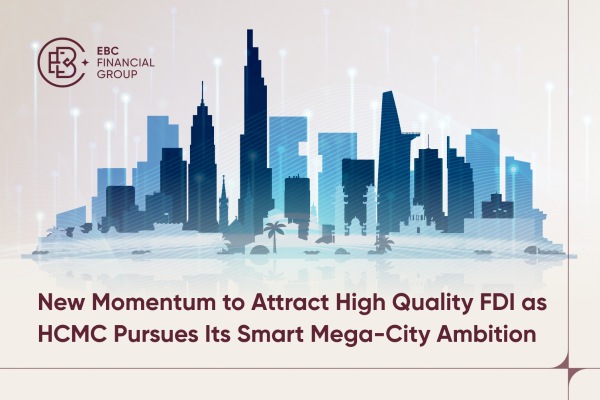
HO CHI MINH CITY, 15 DECEMBER 2025 — Ho Chi Minh City ("HCMC") has set its sights on becoming a smart mega city and a leading regional financial centre. This ambition requires enormous foreign capital as domestic financial capacity is stretched. International investment funds, therefore, emerge as a critical driver for technology, management expertise, and global market integration.
According to Samuel Hertz, Head of APAC at EBC Financial Group ("EBC"), "The era when low costs served as Ho Chi Minh City's main competitive advantage is ending. Global investors today apply much stricter filters focused on sustainability and operational efficiency. For HCMC to attract high quality FDI, it must accelerate the shift towards sustainable, high-value, and smart industrial zones," he said.
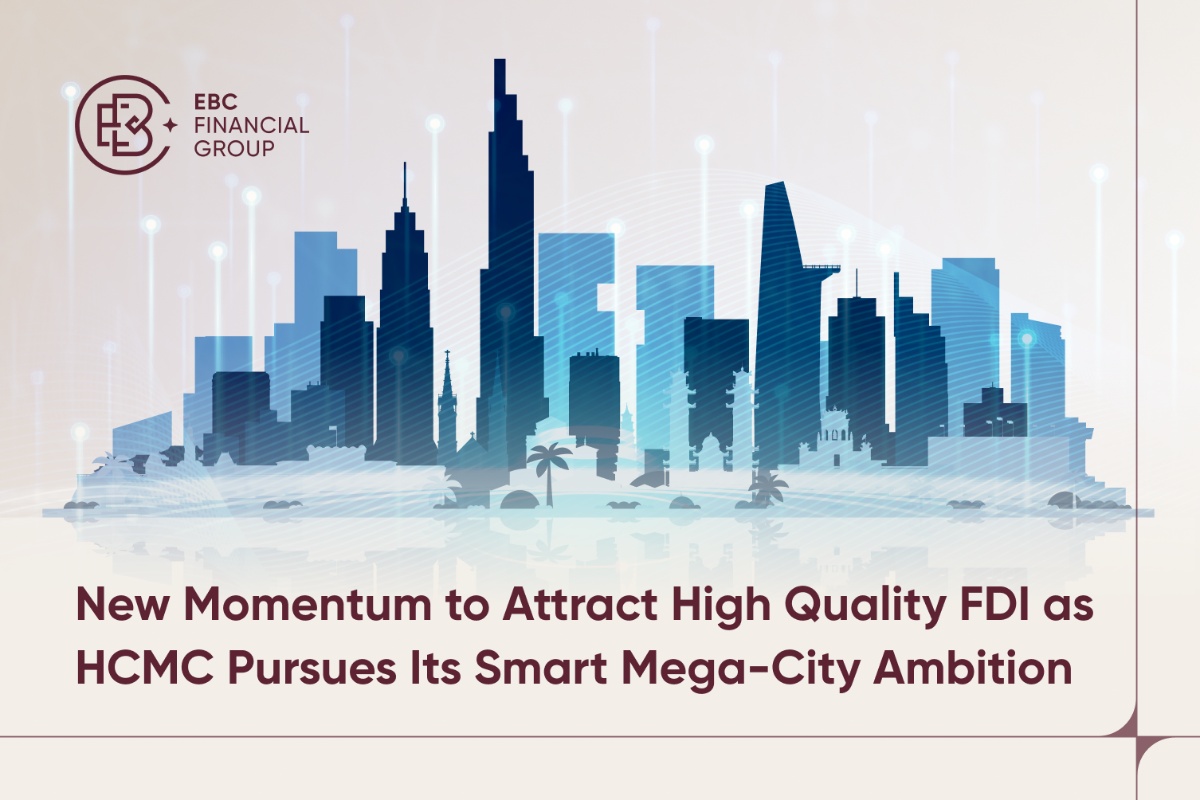
Following the merger with Binh Duong and Ba Ria - Vung Tau, HCMC has become Vietnam's first true mega city, reaching an economic scale of VND3.03 quadrillion in GDP, equivalent to 23.5% of national GDP and comparable to a mid-sized ASEAN economy. The city has quickly reaffirmed its status as Vietnam's top FDI destination, attracting USD7.23 billion in the first ten months of 2025, a 28.67% increase year-on-year.
The consolidation unlocks the potential to develop Vietnam's largest integrated urban-industrial-seaport region. Binh Duong contributes advanced manufacturing and high-tech parks, Ba Ria - Vung Tau offers renewable energy and deep-sea ports, while HCMC brings digital infrastructure, data capabilities, and financial services. Combined, these elements lay the foundation for Vietnam's first green industrial-urban-port corridor.
The expanded HCMC envisions a population of 18-20 million and aims to contribute 30-40% of national GDP by 2045. This growth potential, however, comes with challenges—from spatial planning and policy coordination to the imperative of sustainable development.
Hertz noted, "The key issue is no longer how much the city expands, but how it unlocks new growth drivers. HCMC's development headroom is enormous, and the city must adopt a comprehensive industrial strategy based on multi-centred industrial clusters. This is essential to strengthen regional competitiveness and attract large-scale FDI, especially in finance, high-tech manufacturing, logistics, and smart urban development."
FDI into HCMC is shifting from short-term, opportunistic capital to long-term strategic investment, particularly in green energy, technology, real estate, and healthcare. Investors are applying increasingly rigorous criteria that emphasise sustainability and operational excellence.
Hertz explained, "Global investors now scrutinise the robustness of logistics infrastructure, which determines supply-chain expansion and market access. For high-tech projects, ecological stability is non-negotiable. Industrial parks must ensure uninterrupted 24/7 clean electricity, water, and utility supply. Investors also expect infrastructure to be fully integrated and built to the highest operating standards from day one," he said.
Therefore, key priorities for HCMC include strengthening policy stability to maintain investor confidence, implementing a comprehensive industrial development strategy centred on interconnected clusters, and clearly defining functional zones ranging from high-tech R&D hubs to processing-manufacturing parks, logistics centres, supporting industries, and port-linked heavy industrial zones.
To capture next generation FDI in semiconductors, AI, robotics, clean technology, and R&D, HCMC's high-tech zones must upgrade their technology, utilities, and operating models. Moreover, a targeted investment-attraction framework is essential, especially one that prioritises green production, advanced technology, and smart industrial ecosystems.
The city must also act swiftly to leverage its low financial operating costs and the advantages provided by free trade agreements (FTA) to compete with regional financial centres such as Singapore and Hong Kong. At the same time, HCMC must mobilise state, private, and foreign capital for industrial development and accelerate major transport infrastructure - including metro lines, ring roads, expressways, and a smart deep-sea logistics corridor in Can Gio.
"HCMC must prioritise selective FDI, especially in high-tech sectors, to ensure sustainable development and support the operation of a competitive financial centre built on transparent regulation and favourable tax policy," Hertz added.
Under its new development plan, HCMC will establish four free trade zones (FTZs), including: Cai Mep Ha, Can Gio, Bau Bang, and An Binh. For a mega city aiming to become a regional financial hub, FTZs represent more than preferential economic zones. They are strategic anchors that integrate finance, logistics, and high technology.
Global financial centres such as New York, Singapore, and Hong Kong all rely on similar privileged zones where tax, foreign-exchange controls, and corporate regulations operate under international standards. FTZs act as gateways connecting domestic industries with global markets, generating spillover benefits for the wider economy.
A core advantage of HCMC's future IFC lies in its alignment with FTZ development, particularly in digital finance infrastructure, fintech innovation, and the integration of Cai Mep - Thi Vai deep-sea ports with Long Thanh International Airport. When FTZ commercial flows are processed through advanced digital financial platforms, supply chains become faster, more transparent, and more efficient.
Cai Mep Ha FTZ, located adjacent to one of the world's top deep-sea port clusters, with capacity for vessels up to 250,000 TEUs, offers strategic positioning for high-value global trade.
Hertz concluded, "HCMC has a unique opportunity. The convergence of deep-sea ports, an international financial centre, and an innovation ecosystem will create unmatched competitiveness compared to conventional FTZs. For multinational corporations, the decision to invest depends not only on world-class logistics but on access to an internationalized financial environment that provides asset management, fund services, derivatives trading, and corporate bond markets. In an era of supply-chain restructuring, investors are seeking integrated destinations that combine physical infrastructure with financial services in a single, seamless package."
Disclaimer: This material is for information only and does not constitute a recommendation or advice from EBC Financial Group and all its entities ("EBC"). Trading Forex and Contracts for Difference (CFDs) on margin carries a high level of risk and may not be suitable for all investors. Losses can exceed your deposits. Before trading, you should carefully consider your trading objectives, level of experience, and risk appetite, and consult an independent financial advisor if necessary. Statistics or past investment performance are not a guarantee of future performance. EBC is not liable for any damages arising from reliance on this information.