Published on: 2025-12-05
Updated on: 2025-12-05
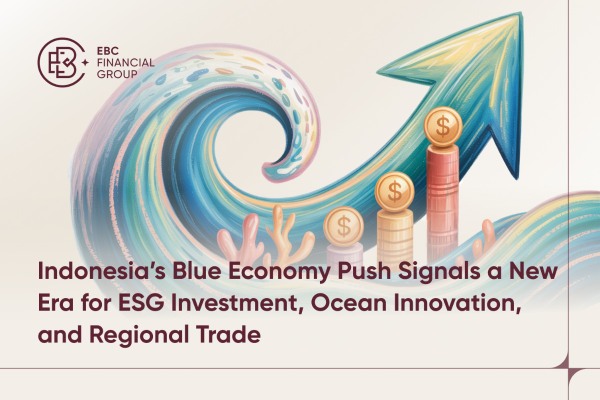
(Jakarta, 4 December 2025) — Indonesia's renewed commitment to advancing its blue economy marks a structural moment for Southeast Asia's economic trajectory, with implications stretching from ESG-driven investment flows to supply-chain resilience and new frontiers in ocean-based innovation, according to analysis from EBC Financial Group (EBC).
"Indonesia is entering a phase where economic growth and environmental stewardship are no longer competing priorities," says Samuel Hertz, Head of APAC at EBC Financial Group. "The blue economy brings those two worlds together in a way that could reshape how Indonesia interacts with global investors, climate markets, and regional trade systems."
With the world's second-longest coastline, the largest archipelago on the planet, and one of the richest concentrations of marine biodiversity, Indonesia is uniquely positioned to turn its oceans into a strategic economic engine.
Indonesia holds some of the world's largest mangrove forests and extensive seagrass ecosystems. Together, they cover roughly 3.4 million hectares, representing about 20% of the world's total mangroves, and are capable of absorbing CO₂ far more efficiently than terrestrial forests. These ecosystems represent a climate asset with the potential to anchor a globally relevant blue-carbon market — one that could play a decisive role in helping investors and corporates meet tightening decarbonisation targets.
Realising this potential, however, demands credible governance frameworks, consistent monitoring systems, and strong community-level safeguards. The credibility of these structures will determine whether Indonesia can translate these natural carbon sinks into scalable climate assets or whether blue carbon remains an underdeveloped opportunity.
Innovation is quickly emerging as a key driver of Indonesia's blue economy. In 2024, Indonesia's seaweed production reached 10.80 million tonnes, up 10.82% from the previous year, and the country now supplies roughly 38% of global seaweed output. Yet only about 11.65% of the potential cultivation area is currently utilised — signalling large room for growth and for the development of value-added downstream products such as bioplastics, fertilisers, and nutraceuticals.
Marine biotechnology also presents opportunities in pharmaceuticals and environmentally friendly materials derived from Indonesia's rich ocean biodiversity. Technology-driven aquaculture is advancing to meet demands for traceability, food security, and environmental responsibility. Smart-port initiatives and digitalised maritime logistics further demonstrate Indonesia's ambition to integrate innovation into previously traditional sectors.
This combination of scale, innovation, and untapped potential positions Indonesia not just as a raw commodity exporter but as a global hub for ocean-based sustainable technologies.
Indonesia's geography grants it a strategic advantage at a time when global supply chains are undergoing significant transformation. As geopolitical tensions, shifting energy flows, and trade fragmentation reshape global logistics, Indonesia is emerging as a pivotal maritime hub in Southeast Asia.
Its blue-economy expansion could influence the development of new shipping corridors, particularly routes running through the Malacca Strait and alternative pathways across the eastern archipelago. Ocean-based renewable energy projects also have the potential to modify regional energy logistics, while ASEAN's growing interest in blue-carbon financing positions Indonesia as a regional leader in ocean governance.
Moreover, the economic benefits are already reaching coastal communities. Average income for coastal and seaweed-farming households in producing regions increased by ≈4.55% in 2024, reflecting both aquaculture growth and rising productivity. This demonstrates that the blue economy can simultaneously advance sustainability and social inclusion.
EBC's analysts view Indonesia's blue economy as a structural, multi-decade transformation shaped by three core pillars. First, policy credibility in blue-carbon markets will determine whether the country can attract global ESG financing and establish itself as a leader in nature-based climate solutions. Second, innovation in marine biotechnology, seaweed downstreaming, and sustainable aquaculture will help drive diversification away from raw commodity dependence. Third, improvements in maritime infrastructure and logistics systems will reinforce Indonesia's role within Southeast Asia's evolving trade architecture.
"The blue economy has the potential to redefine how Indonesia is positioned in global markets — not just as a commodity exporter, but as a sustainability and innovation leader," Hertz adds. "Investors, traders, and analysts should treat this as a structural transformation story, not a short-term theme."
Disclaimer: This material is for general information purposes only and is not intended as (and should not be considered to be) financial, investment or other advice on which reliance should be placed. No opinion given in the material constitutes a recommendation by EBC or the author that any particular investment, security, transaction or investment strategy is suitable for any specific person.